



Who was the biggest money magnet in the U.S. stock market in 2024?

The year 2024 holds special significance for the U.S. stock market.
During this year, the Federal Reserve initiated an interest rate cut cycle, with the federal funds rate gradually declining from its peak, injecting optimism into the U.S. stock market.
Especially driven by the AI wave, the stock prices of giants like $NVIDIA(NVDA.US) , $Apple(AAPL.US), Google (GOOG.US), Amazon (AMZN.US), and TSMC (TSM.US) continued to hit new highs.
The new highs of tech giants also drove the Nasdaq Composite (IXIC.US), Dow Jones Industrial Average (DJI.US), and S&P 500 Index to continuously refresh their record highs.
Amid the new highs of the three major indices, the market began to speculate whether AI investment returns could catch up with their high valuations. The high valuations even deterred some investors, such as the "Oracle of Omaha" Warren Buffett significantly reducing his beloved Apple holdings.
In addition, geopolitical risks further intensified in 2024, with significant fluctuations in commodity and cryptocurrency prices, casting a shadow over the global economic outlook and stock market performance.
Amidst the risks and opportunities, which companies have gained capital recognition in the U.S. stock market? Let’s take a look at the fundraising activities in the U.S. stock market in 2024.
Rebound in IPO Fundraising Scale
Amid the positive atmosphere of the U.S. stock market hitting new highs, IPO activities rebounded from the lows of 2022 and 2023.
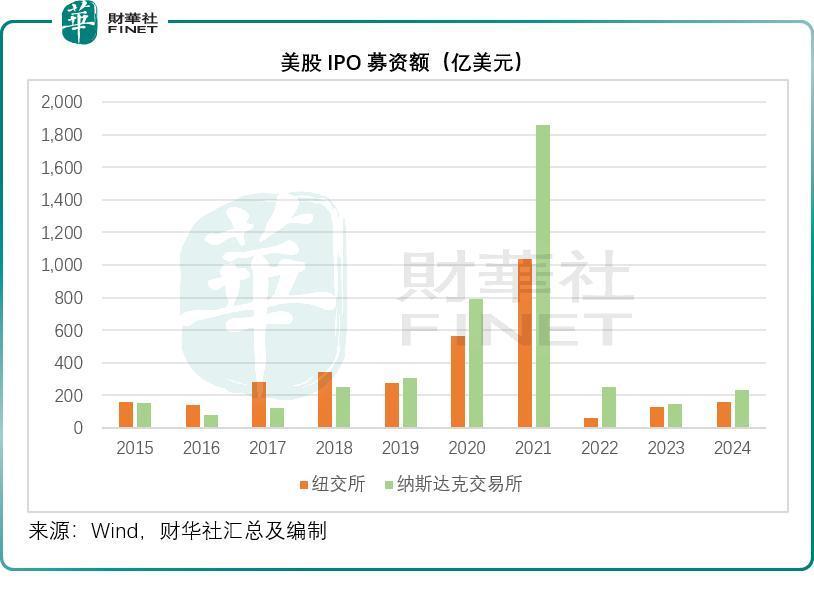
Data from Wind shows that the fundraising amount for new listings on the NYSE in 2024 may reach $16.1 billion, while the Nasdaq may raise $23.6 billion, totaling approximately $39.714 billion, up 26.13% from 2022 and 46.04% from 2023, as shown in the figure below.
Excluding SPACs, the IPO fundraising scales for the NYSE and Nasdaq may be $14.761 billion and $16.417 billion, respectively, both significantly higher than the levels in 2022 and 2023, as shown in the figure below.
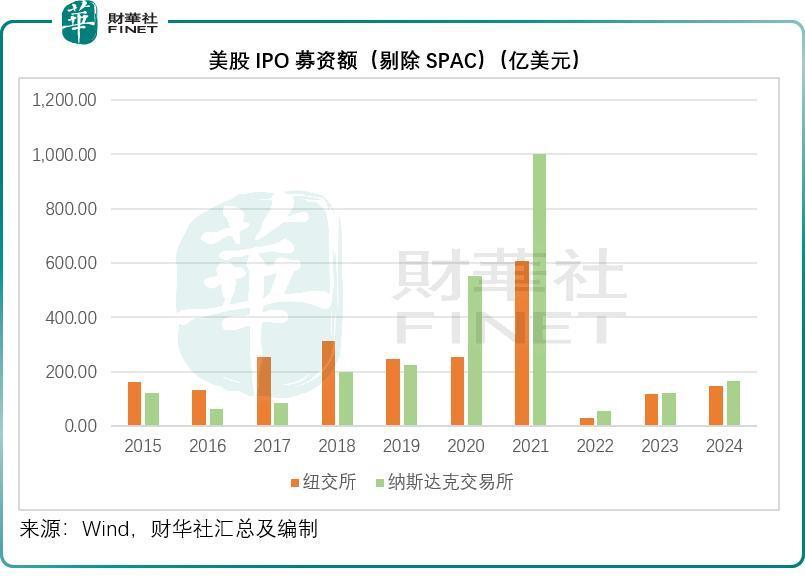
Moreover, the gap between the NYSE and Nasdaq has narrowed. This may reflect that more SPACs are choosing to list on the Nasdaq.
IPO "Cash Magnets"
In 2024, the largest IPO fundraising in the U.S. stock market was Lineage (LINE.US), a real estate investment trust for commercial properties like cold storage, with an initial fundraising amount of approximately $5.102 billion.

The second-largest was Standardaero (SARO.US) in the aerospace and defense sector, with a fundraising scale of approximately $1.656 billion. The third was AS (AS.US), the high-end sports brand company under Anta (02020.HK), including Arc'teryx, with a fundraising scale of $1.571 billion.
The best-performing new stock this year was Nano Nuclear (NNE.US), a developer of nuclear energy, with a cumulative increase of 529.75% year-to-date and a current market value of $902 million.
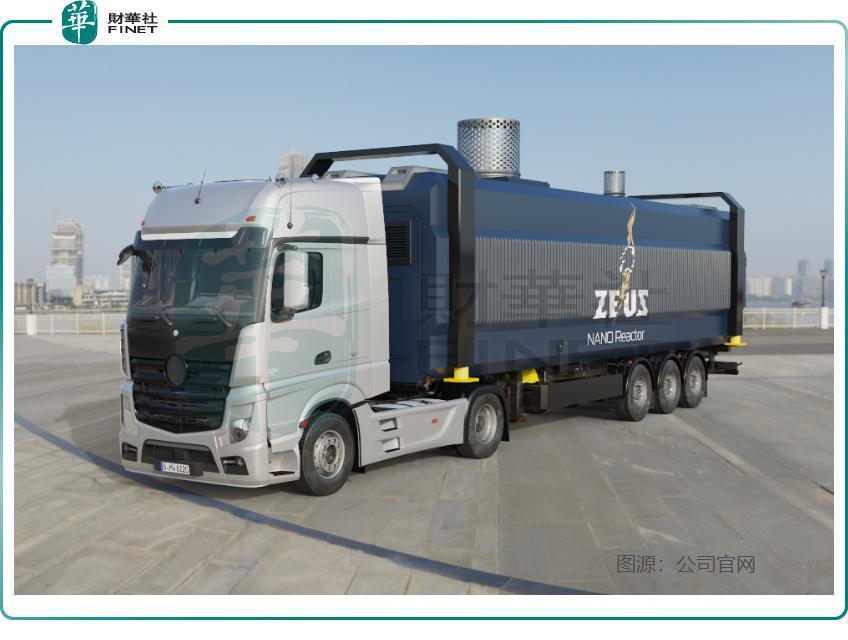
It is worth mentioning that the AI investment wave has spawned the rise of many niche industries. Since AI computing requires massive energy, the energy industry has quietly become a new favorite of capital. Compact and affordable micro-nuclear reactor businesses have gained traction from figures like Amazon founder Jeff Bezos. Riding this trend, Nano Nuclear has also surged, surpassing the popular internet company Reddit (RDDT.US), which has a cumulative increase of 402.09% year-to-date.
Chinese Concept Stock IPOs
Data from Wind shows that the number of Chinese concept stocks listed in the U.S. this year may be 25, with a total net fundraising amount of approximately $2.307 billion, a significant improvement from the $711 million for the entire last year. The largest fundraising was AS (AS.US), mentioned earlier, with a fundraising amount of $1.277 billion.
The second-largest was ZEEKR (ZK.US), the new energy vehicle brand under Geely, with a fundraising of $401 million. The third and fourth were autonomous driving solution providers Pony.ai (PONY.US) and WeRide (WRD.US), with net fundraising amounts of $241 million and $106 million, respectively.
The best-performing Chinese concept stock IPO this year was$PTL(PTLE.US), a marine fuel logistics service provider, whose stock price has risen 123.75% since its listing.
Following closely were AS and$Star Fashion Culture(STFS.US), an advertising service provider specializing in precision marketing, with cumulative increases of 116.77% and 76.25%, respectively.
The worst-performing Chinese concept stock IPO this year was$YXT.COM(YXT.US), a SaaS operator, with a decline of 79%. However, the biggest cash magnet in the U.S. stock market this year was not in the IPO market but in the follow-on offering market.
Post-IPO Fundraising Scale
Before 2018, post-IPO fundraising activities on the NYSE and Nasdaq were mostly less active than IPOs. However, by 2020, when global developed economies had low interest rates driving a stock market surge, post-IPO fundraising activities became more active, even surpassing IPO fundraising scales.
In 2024, post-IPO fundraising amounts on the NYSE and Nasdaq reached $68.1 billion and $64.7 billion, respectively, far exceeding the IPO fundraising amounts of $16.1 billion and $23.6 billion during the same period, as shown in the figure below.
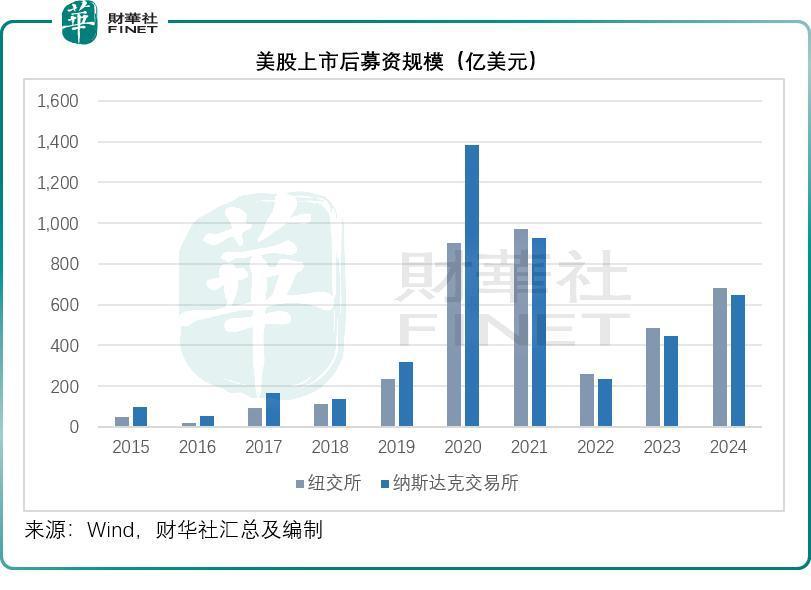
Caijing noticed that $Boeing(BA.US) alone raised $10.688 billion through a public offering, equivalent to 72% of the NYSE's IPO fundraising amount (excluding SPACs) of $14.761 billion in 2024, undoubtedly making it the "cash magnet" of the U.S. stock market this year.
Boeing has faced numerous challenges in recent years. First, its most important product line, the 737 series, faced delivery delays and frequent "brittle door" incidents, followed by strikes. In the first three quarters of this year, its total revenue fell 8.07% year-over-year to $51.275 billion, turning from a gross profit of $5.027 billion last year to a gross loss of $402 million. The non-GAAP core operating loss further expanded to $7.769 billion, a 304.85% increase from the loss of $1.919 billion the previous year. The free cash outflow reached $10.212 billion.
At the end of September 2024, Boeing held $10.5 billion in cash and marketable securities, while its total debt was as high as $57.7 billion. It seems fundraising was indeed a last resort. In October, the company issued common and treasury shares to raise funds for debt repayment, working capital replenishment, capital expenditures, and financing and investment for its subsidiaries.
Conclusion
This year, both IPO and post-IPO fundraising activities in the U.S. stock market have rebounded significantly compared to the past two years, likely due to the strong dollar and the high risk-return profile of dollar-denominated assets. The Nasdaq Composite has risen 30.39% year-to-date, with a P/E ratio as high as 46.7x.
Looking ahead to 2025, Trump's highly anticipated tariff and trade policies, geopolitical risks, and the Federal Reserve's pause in rate cuts will all have a significant impact on the global economy, particularly affecting the interests of U.S. companies in overseas markets. This may not sustain such high valuations. If the U.S. stock market faces a correction risk, fundraising activities will also be affected.
Author: Mao Ting
The copyright of this article belongs to the original author/organization.
The views expressed herein are solely those of the author and do not reflect the stance of the platform. The content is intended for investment reference purposes only and shall not be considered as investment advice. Please contact us if you have any questions or suggestions regarding the content services provided by the platform.
