



Three cobblers with their wits combined can surpass Toyota?

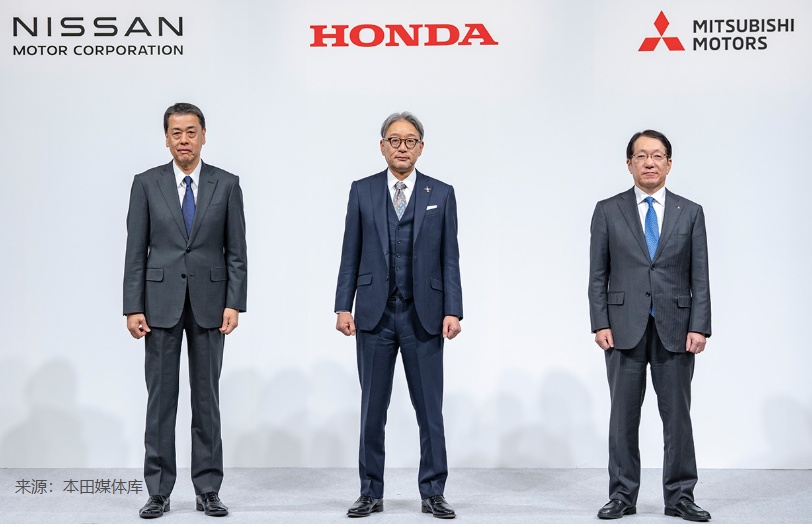
After just a few days of rumors, three automotive giants—Honda (HMC.US), Nissan (7201.T), and Mitsubishi Motors (7211.T)—have officially signed a memorandum of understanding. Honda and Nissan have formally initiated merger talks, while Mitsubishi Motors is exploring participation in the merger.
Why Merge?
Honda's CEO Toshihiro Mibe stated that the rationale behind the integration with Nissan is the rise of Chinese companies with strong price competitiveness and emerging players like Tesla (TSLA.US) in the U.S.
According to the memorandum, Honda and Nissan will establish a joint holding company as their parent entity through a share transfer agreement. The new holding company is planned to be listed on the Tokyo Stock Exchange by August 2026, while the original two companies will delist. The plan is still subject to approval from shareholders and relevant authorities.
Mitsubishi Motors will decide by the end of January 2025 whether to participate in the merger between Nissan and Honda.
Merger Goal: The World's Third-Largest Automaker
Honda's announcement indicates that if the merger proceeds, the three companies will combine their management resources—including expertise, human capital, and technology—to create deeper synergies, enhance adaptability to market changes, and optimize long-term corporate value.
Additionally, the trio aims to foster Japan's industrial foundation by building a "globally leading mobility company." This will involve integrating their four-wheel vehicle businesses, Honda's motorcycle and electric product divisions, and other operations (including aviation) to boost brand appeal.
The combined entity targets annual revenue exceeding ¥30 trillion and operating profit surpassing ¥3 trillion, implying a 10% operating margin—positioning it as the world's third-largest automaker.
Is the Goal Achievable?
Our analysis in "Challenging Toyota and Tesla? Assessing the Trio's Capabilities" examined the three Japanese automakers' current operations, finances, and valuations. While merging could elevate them to third place globally—behind $Toyota Motor(TM.US) and Volkswagen—they still trail far behind the top two.
Based on their latest fiscal forecasts (September 2024), the merged entity's annual vehicle sales could reach 7.24 million units by March 2025, with revenue hitting ¥36.58 trillion (matching their target). However, operating profit might only reach ¥1.76 trillion—a 4.81% margin.
Notably, Toyota—the global sales leader—revised its FY2025 sales forecast downward from 9.5 million to 9.4 million units (below FY2024's 9.443 million) in its H1 FY2024 report.
Even with this adjustment, Toyota's sales target remains 30% higher than the trio's combined goal, revenue is 26% larger, and its projected 9.35% operating margin nearly doubles the trio's 4.81%.
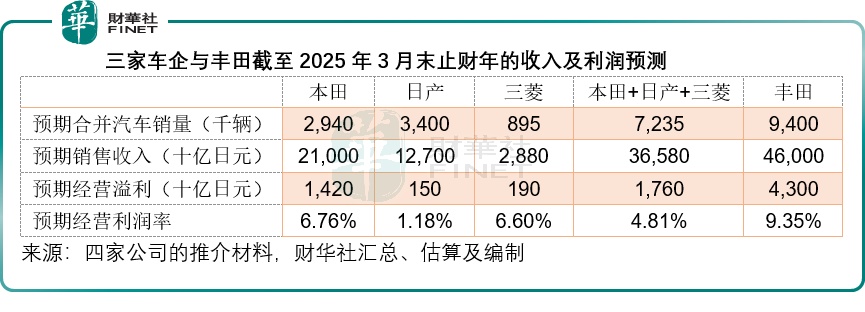
In short, the three automakers currently operate with razor-thin margins. Closing the gap with Toyota—let alone achieving their 10% target—would require unprecedented synergies through scale and cost-cutting.
How to Get There?
Honda outlined seven measures to achieve scale:
1) Standardize vehicle platforms to reduce per-unit costs;
2) Merge R&D teams to enhance capabilities and cut costs;
3) Optimize production systems to lower fixed costs;
4) Integrate procurement to strengthen supply chains;
5) Streamline operations to save costs;
6) Combine sales financing for scale benefits;
7) Build talent pools for smart/EV technologies.
Conclusion
While rumors suggest this merger counters Foxconn's ambitions for Nissan, it clearly represents Japan's auto industry fighting for relevance amid market shifts.
Global automakers now prioritize standardization and smart tech. $Tesla(TSLA.US) boosts margins via innovations like gigacasting and direct sales—while Chinese EV makers like $BYD COMPANY(01211.HK) leverage local supply chains for cost advantages.
Can three Japanese automakers compete through merger alone? Time will tell.
Author: Mao Ting
The copyright of this article belongs to the original author/organization.
The views expressed herein are solely those of the author and do not reflect the stance of the platform. The content is intended for investment reference purposes only and shall not be considered as investment advice. Please contact us if you have any questions or suggestions regarding the content services provided by the platform.
