

In-depth analysis of Broadcom's 2025Q1 earnings report: AI chip business drives strong performance, stock price rebounds against the trend after hours, is the industry landscape changing?

1. Core Financial Data: AI Chip Revenue Surges 77%, Dual Business Drivers Exceed Expectations
Broadcom (AVGO) released its Q1 2025 fiscal year earnings report after the U.S. market closed on March 6, with multiple indicators hitting record highs:
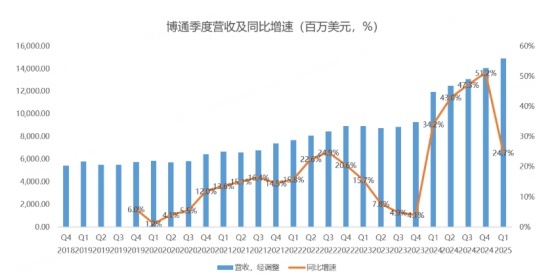
Revenue: $14.92 billion, up 25% YoY, surpassing market expectations of $14.61 billion;
Net Profit: GAAP net profit rose 315% YoY to $5.5 billion, while non-GAAP net profit reached $7.82 billion;
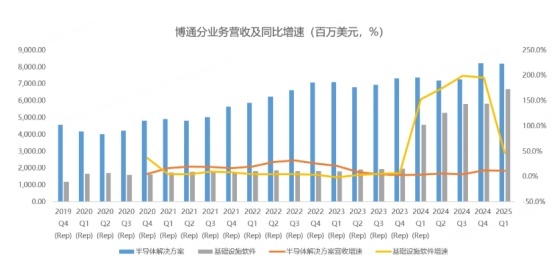
AI Chip Business: Revenue hit $4.1 billion, surging 77% YoY, accounting for 50% of total semiconductor revenue;
Infrastructure Software Business: Revenue reached $6.7 billion, up 47% YoY, primarily benefiting from synergies post-VMware integration;
Cash Flow: Free cash flow stood at $6.01 billion, representing 40% of revenue, providing ample ammunition for dividends and R&D.
The company provided optimistic guidance for Q2: projected revenue of $14.9 billion (up 19% YoY), with AI chip revenue expected to rise to $4.4 billion, a sequential growth rate of 7.3%.
2. Stock Performance: After-Hours Surge of 13% Defies Market, Nvidia's Plunge Highlights Divergence
Despite a broad decline in U.S. tech stocks on the earnings release day (Nasdaq down 2.61%), Broadcom's stock soared as much as 17% after hours, ultimately closing up 12.8%, with its market cap reclaiming the $900 billion mark. This rebound is attributed to:
1. Easing concerns about AI demand: Broadcom's AI chip revenue grew over 70% for two consecutive quarters, with two new hyperscale customers (speculated to be OpenAI and Apple), validating the necessity of custom ASIC chips;
2. Resilience in software business: Post-VMware integration, it contributed stable cash flow, with an EBITDA margin of 68%, optimizing the profit structure.
Contrast with Nvidia: On the same day, Nvidia (NVDA) plunged 5.74%, losing over $1 trillion in market cap, with its year-to-date decline widening to 23%. The divergence reflects a shift in market logic:
Technology roadmap debate: Nvidia's GPU-dominated general computing faces bottlenecks, while Broadcom's ASIC chips hold advantages in inference efficiency and energy consumption, aligning with the trend of low-cost AI models like DeepSeek;
Customer strategy differences: Nvidia relies on a few cloud vendors, while Broadcom is tied to top clients like Google, Meta, and ByteDance, accelerating penetration into emerging markets.
3. Industry Outlook: ASIC Chips May Become the New Battleground, Broadcom's Three Growth Drivers
1. Custom chip wave: JP Morgan predicts North American cloud providers' AI capital expenditure will reach $320 billion in 2025, with Broadcom poised to capture 30% share due to its ASIC design capabilities. The company expects three major clients to deploy million-level XPU clusters by 2027, representing a potential market size of $60-$90 billion;
2. Deepening technological barriers: Innovations like 3.5D packaging and silicon photonics enhance chip performance, while collaboration with TSMC's 2nm process strengthens manufacturing advantages;
3. Software ecosystem closure: VMware Tanzu platform synergizes with chip business, building a full-stack "hardware + virtualization + networking" solution, replicating Apple's ecosystem model.
Risk warnings:
Geopolitics and tariffs: Trump's proposed 25% tariff on imported chips could compress Broadcom's margins (China accounts for 18% of revenue);
Customer concentration risk: Apple's in-house Wi-Fi chip development may cost Broadcom $3 billion in orders by 2026;
Valuation pressure: Current P/E of 143x requires sustained high AI revenue growth to justify the premium.
4. Institutional Views: Goldman Sachs and Morgan Stanley Raise Price Targets, Long-Term Bullish on Leadership
Goldman Sachs: Raised target price from $240 to $260, calling Broadcom a "core beneficiary of the AI arms race";
Morgan Stanley: Upgraded 2025 North American cloud capex growth forecast from 29% to 32%, with Broadcom's ASIC business set to benefit directly;
Oppenheimer: Maintained "Outperform" rating with a $225 target, emphasizing its industry position second only to Nvidia.
Conclusion: AI Race Enters Second Half, Can Broadcom Disrupt Nvidia's Dominance?
Broadcom's earnings prove that AI computing demand is shifting from training to inference, with custom chips potentially becoming the next battleground. Despite short-term pressure from tech stock corrections, its "ASIC + software" dual-driver business model has built a differentiated moat. If it maintains technological leadership, Broadcom could become the next permanent member of the trillion-dollar market cap club.$Broadcom(AVGO.US)
The copyright of this article belongs to the original author/organization.
The views expressed herein are solely those of the author and do not reflect the stance of the platform. The content is intended for investment reference purposes only and shall not be considered as investment advice. Please contact us if you have any questions or suggestions regarding the content services provided by the platform.
