


New rules from HKEX: Up to 10x margin for IPO subscriptions! Are retail investors doomed?

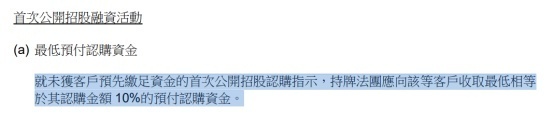
Yesterday, the Hong Kong Securities and Futures Commission issued the "Circular to Licensed Corporations – Regarding Initial Public Offer Subscriptions and Margin Financing Services".
In simple terms, it means strengthening the verification of customer identity information and requiring more caution in providing margin financing. Of course, the most significant change is that the maximum margin leverage will now be capped at 10x!
Original announcement:
To analyze the potential impact of this policy, we first need to understand why the Hong Kong Stock Exchange implemented it.
The allocation method for Hong Kong IPO subscriptions has always followed the "Red Shoe" mechanism, prioritizing one person, one account, one lot. Before the FINI system was introduced, participants often opened 10 accounts across 10 brokers to increase their chances of winning, with dozens of accounts being the norm. Some even became "Hundred-Account Lords".
This clearly contradicts the Red Shoe mechanism. Since the FINI system was introduced, the Hong Kong Stock Exchange has explicitly prohibited multiple-account subscriptions, deeming repeated IPO applications under the same name invalid.
As Wang Zhiwen's character Guo Xiaopeng said in the drama "Black Ice": "Rules, from the moment they are established, create enormous benefits for those who break them".

Although the era of one person with multiple accounts is over, if someone has access to others' accounts and combines it with increasingly high margin leverage, they can still achieve significant gains with minimal capital. Moreover, if you have multiple accounts while others have only one, who else would win the subscription if not you?
Therefore, we can almost certainly conclude that one of the main objectives of this new policy is to crack down on the practice of one person holding multiple accounts.
Currently, brokers often adopt a "heat-over-risk-control" approach. For a stock with less than 15x margin demand, they might offer only 5x or 10x leverage. But if the stock becomes extremely popular with margin demand reaching hundreds or thousands of times, they might offer 100x leverage.
This carries significant risks.
Previously, during the IPO of $MGP.HK, a fan messaged me in a panic after the subscription results were announced. He had intended to play with just 3,000 yuan but ended up winning 12,000 yuan worth of shares. After calming him down, I wrote an article titled "100% Winning Rate for One Lot: Three Reasons Why MGP Won't Break Its IPO Price". Interested readers can search for it on my homepage. I also wrote something similar about Guming.
Fortunately, the outcome was positive, as MGP's stock price surged.

Does this mean that as long as the winning rate is low, there's no problem? For highly popular stocks, since few lots are won, is risk control unnecessary?
Not at all. Take $BLOKS.HK and $Mixue Group.HK as examples. These two stocks had an average margin leverage of 100x, with one lot costing 20,000 yuan but requiring only 100 yuan in capital.
The winning rate for one lot was around 10%, which isn't high, but some people ended up winning 20,000 yuan worth of shares with just a few hundred yuan. If the grey market price dropped by 50%, it could lead to massive bad debts—10,000 yuan per account.
Don't assume hot stocks can't fall.
$Yuanxu Tech.HK, with 1,935.9x margin demand, dropped 28.93% in the grey market;
$Jiuyuan Gene.HK, with 435.99x margin demand, dropped 28.5%;
$Tianjin Construction.HK, with 358.47x margin demand, dropped 24%;
$Caoji Group.HK, with 5,667.89x margin demand, rose 27.73% in the grey market but began plummeting the next day and has now fallen 52.5% below the IPO price, a clear case of a bubble.

Therefore, I never claim that a stock will 100% rise. Always maintain respect for the market. Even when going all-in, it's based on thorough analysis of the company's strong fundamentals, high subscription demand, and a high probability of market approval.
Without reform, if brokers keep pushing margin leverage higher, a major crisis is inevitable. For example, an unscrupulous underwriter could use fake accounts to inflate margin demand and then withdraw before the subscription deadline. Where would you go to cry then?
From a broader perspective, I believe this reform will help stabilize and improve risk control in the Hong Kong IPO market.
Now, let's look at the specific impact on retail participants.
1. Multiple-account subscriptions may be suppressed
First, the Red Shoe mechanism won't change. For families participating together, multiple accounts still provide an advantage. However, for those holding multiple accounts for "profit-driven" purposes, the reduced margin leverage will lower the marginal returns of each account. If it's no longer profitable, the practice will naturally decline.
2. Concentration in lower-tier Group A will increase significantly
Take Mixue Bingcheng as an example. Suppose there are 1,000 participants with capital between 2,000 and 20,000 yuan. With 100x margin leverage, they could subscribe across 17 tiers, from 1 lot to 45 lots. But with only 10x leverage, they can only choose between 1 and 4 lots, leading to much higher concentration and much lower winning rates.
This will happen across all tiers, but I suspect that mid-Group A to small-Group B tiers will see fewer small-capital participants, replaced by those downgrading from higher tiers. The change won't be drastic, but lower-tier Group A participation will surge. It's like a crowd at a cliff's edge with a beast ahead—those near the edge will get squeezed as they have nowhere to retreat.
For high-tier Group B participants, numbers will drop significantly. As the saying goes, "It's lonely at the top"—comfortable!
3. Group A and B allocation methods may be redefined
Currently, Group A is for subscriptions below 5 million yuan, and Group B for those above, with each group allocated 50% of shares.
Why is the margin leverage for large stocks capped at 100x, not 300x or 500x? I believe there's a balance here (though not perfectly executed).
If leverage is too high, everyone crowds into Group B, leaving Group A empty—unreasonable. If too low, Group A tail draws lots while Group B head gets full allocation—also unreasonable.
What's the right balance? When Group A tail and Group B head have similar winning rates. Logically, these two tiers have similar capital amounts, so their winning rates should be close. But recently, for two hot stocks, Group A tail's winning rate was much higher than Group B head's. The Hong Kong Stock Exchange realized margin leverage was too high, overcrowding Group B, hence the cap.
But is a hard 10x cap an overcorrection? Hard to say. The market will need to test it with upcoming IPOs. If Group B head's winning rate far exceeds Group A tail's again, adjustments may follow.
4. Little impact on cold, small stocks
That said, overall, except for hot stocks squeezing out retail participants, small stocks with 10x-20x leverage won't be much affected. Brokers rarely offer high leverage for these, and even if they do, few investors would blindly chase 100x.
So, as always, big stocks depend on luck, small stocks on skill.
After the reform, it simply means big stocks require more luck, small stocks more skill.
Summary:
Too lazy to summarize—everything's already said above.
No time to write about Jiangsu Hongxin today. Will do it next Monday—stay tuned.
Shubao International is currently at 28x leverage. Hitting 200x seems unlikely. Plan remains unchanged—no subscription unless it reaches 200x. I'll update in the group if it does.
The copyright of this article belongs to the original author/organization.
The views expressed herein are solely those of the author and do not reflect the stance of the platform. The content is intended for investment reference purposes only and shall not be considered as investment advice. Please contact us if you have any questions or suggestions regarding the content services provided by the platform.
