



Can the overcrowded JD Food Delivery compete with Meituan on equal footing?


After recently launching a 10-billion-yuan subsidy, JD.com's food delivery servers were overwhelmed by "coupon hunters"!
Many netizens recently reported that JD.com's food delivery page could not display product information, showing "Please try again."$JD-SW(09618.HK) responded that due to the overwhelming popularity of the 10-billion-yuan subsidy campaign, JD.com's food delivery system experienced a brief glitch lasting less than 20 minutes, which has now been resolved.
In the food delivery industry, one player dominates,$MEITUAN(03690.HK) holding about 70% of the market share, while Ele.me has struggled to counterattack and remains mired in losses. So, what does it mean when Richard Liu generously offers consumers a 10-billion-yuan subsidy and sets a strict rule for JD.com's food delivery: "Profit margins will never exceed 5%"? Will Meituan and Ele.me feel the heat?
Why constrain profitability?
JD.com officially entered the food delivery market in February this year, partnering with high-quality dine-in restaurants.
In terms of delivery methods, JD.com's food delivery offers two options: "Merchant Self-Delivery" and "Dada Instant Delivery."
The food delivery industry is capital-intensive, especially in the early stages with massive expenditures. Why is Richard Liu daring to cap profits at 5%?
According to Richard Liu's business blueprint, JD.com's food delivery is not solely for profit but serves as a traffic funnel to lock users into JD.com's ecosystem (covering retail, finance, membership, etc.), i.e., "Not making money from food delivery, but from the ecosystem."
JD.com's food delivery business is not just about meal delivery but a critical part of its instant retail strategy. By increasing user stickiness through high-frequency food delivery orders, it leverages instant delivery capabilities to boost core businesses like 3C and home appliances, creating an ecosystem synergy of "using high frequency to support low frequency."
From an industry perspective, China's instant retail market has matured, reaching hundreds of billions in scale. JD.com aims to enhance the efficiency of its logistics resources, using food delivery to complete the "key puzzle piece" in its ecosystem. Essentially, JD.com's food delivery is a strategic gamble trading short-term profits for ecosystem upgrades.
The "Three Kingdoms" of food delivery—who will have the last laugh?
A 2023 report by iResearch shows that Meituan's food delivery holds 67.4% of the domestic market share, while Ele.me has 29.6%, nearly monopolizing the entire market.
Compared to Meituan, Ele.me is clearly at a disadvantage. Despite significant order growth, it remains trapped in losses.
According to Alibaba's (09988.HK) announcement, for the three months ending December 31, 2024, the local living group, driven by Ele.me and Amap order growth, saw revenue rise 12% year-on-year to 16.988 billion yuan (in RMB), with adjusted EBITA losses narrowing from 2.068 billion yuan a year earlier to 596 million yuan.
In this monopolized food delivery race, JD.com's entry adds a new variable, potentially leading to a "Three Kingdoms" competitive landscape in the future.
Although the food delivery industry requires restraining profit-making abilities and desires, JD.com's ambitions in this field will challenge Meituan and Ele.me.
JD.com is not short on cash, with over 110 billion yuan in cash and equivalents by the end of 2024 and a $5 billion share repurchase plan announced last August.
Industry insiders say JD.com's zero-commission policy for merchants, coupled with social security for riders and a 10-billion-yuan subsidy, may not yield immediate profits but quickly wins merchant and consumer goodwill.
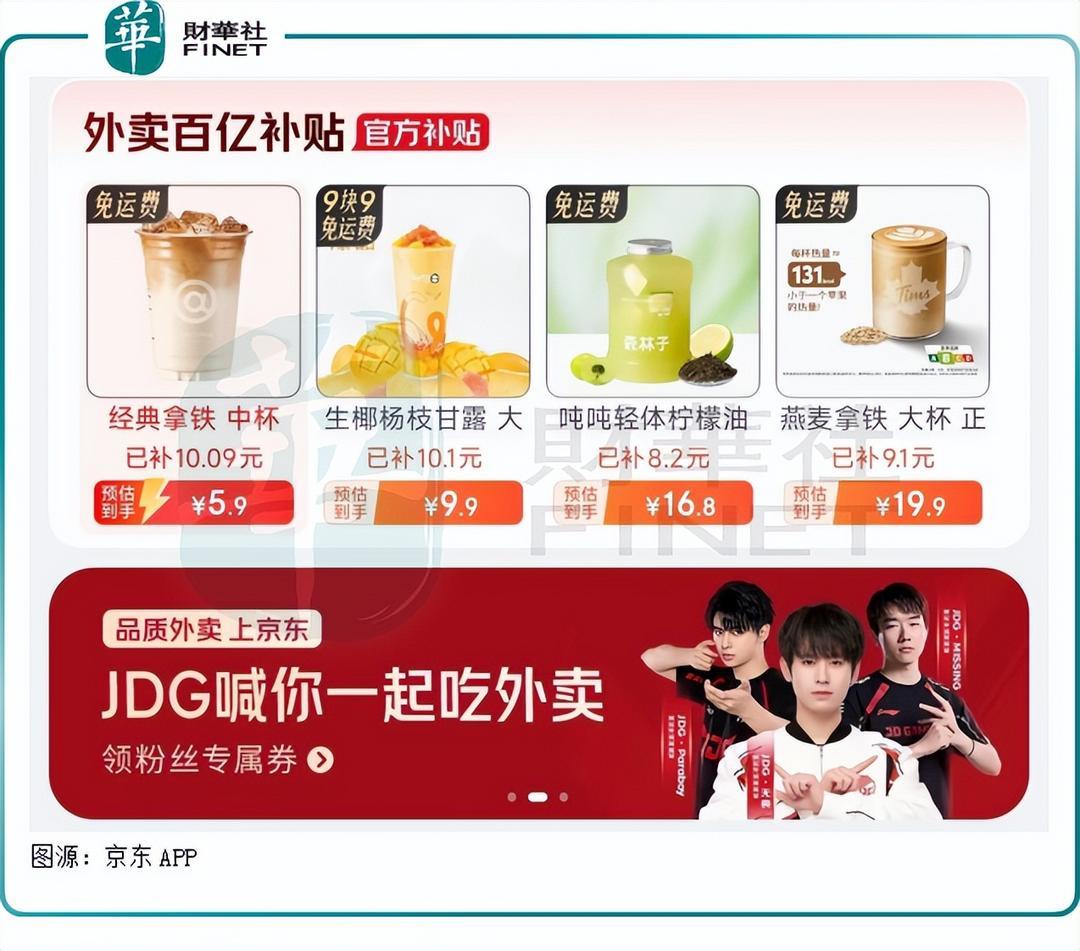
Data shows that within just two weeks of launch, about 30% of restaurants in Beijing's Wangjing area are already partnering with JD.com's food delivery, highlighting its strong appeal to merchants. JD.com's official blog announced on April 15 that daily orders for JD.com's premium food delivery would exceed 5 million, with rapid growth drawing attention.
A rider told the media, "After JD.com launched the 10-billion-yuan subsidy, Ele.me's orders dropped. Meituan's large order volume remained largely unaffected."
At this pace, JD.com could overtake Ele.me and challenge Meituan head-on.
Beyond its friendly stance toward merchants, riders, and consumers, JD.com's core strengths provide solid backing for its challenge to Meituan. Its supply chain and logistics advantages make it more competitive in high-end brand collaborations and high-average-order-value products.
As an internet retail giant, JD.com also boasts a massive user base and traffic. QuestMobile data shows JD.com had 550 million monthly active users in November 2024. Additionally, by the end of 2022, JD.com reported 34 million JD PLUS members. These users can be directly converted to food delivery through subsidies.
In the short to medium term, JD.com's food delivery, fueled by the 10-billion-yuan subsidy, is rapidly carving out a niche in the industry, potentially triggering a price war. In the long run, ecosystem battles will determine the winners among the three players, with JD.com's "retail + logistics + finance" ecosystem clashing with Meituan's "in-store + home delivery + payment" ecosystem.
However, the food delivery market competition is far from over. Meituan and Ele.me won't sit idle, and JD.com must prepare for prolonged cash burn.
How this "Three Kingdoms" battle evolves remains uncertain. Whether JD.com can maintain long-term competitiveness with its ecosystem advantages and how Meituan and Ele.me will respond are questions worth watching.
Author: Yao Yuan
The copyright of this article belongs to the original author/organization.
The views expressed herein are solely those of the author and do not reflect the stance of the platform. The content is intended for investment reference purposes only and shall not be considered as investment advice. Please contact us if you have any questions or suggestions regarding the content services provided by the platform.
