


Taking Duality Biologics as an example, decrypting the new share subscription lottery mechanism in Hong Kong stocks after the new regulations.

Since the Hong Kong Stock Exchange introduced new regulations on March 20 limiting the maximum financing multiple (10x), $DUALITYBIO-B(09606.HK) is likely the first hot stock to list under these rules. (Jiangsu Hongxin is too small, and Zenergy Power lacks hype, so they don’t count.)
So congratulations again to all the brothers and sisters who participated—80% subscription rate, peak gains of 130%, easy profits even if you closed your eyes and sold.
Beyond making money, I think everyone is equally curious about the subscription rate. Did the new rules play out as expected—big players feasting while retail investors got wiped out? Compared to before, has the crowd all squeezed into Group A?
Warning: Today’s content is dry—bring your own drinks.
1. Control Group:$GUMING(01364.HK)
I vaguely remember my middle school science teacher’s earnest lesson: the control variable method is a scientific research approach to determine causal relationships between variables, widely used in experiments. To apply it, you first need a control group.
Overall, Guming, which listed in February this year, is a suitable comparison. Here’s how the two stack up:
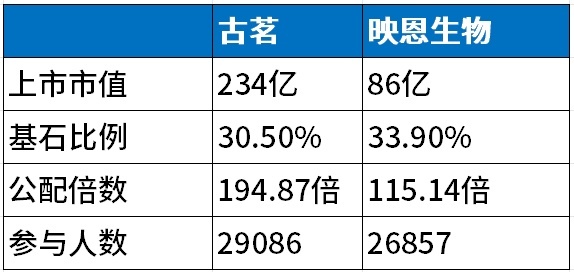
Another key point: both stocks faced significant controversy during their IPO. Guming was impacted by the broad slump in bubble tea stocks and the sector’s downturn, while Duality Biologics faced market turbulence and U.S.-related risks. Both saw heavy margin financing (孖展) sneaking in on the last day, making their situations quite similar.
However, Guming’s allocation method was bizarre—Group A mostly got 5 lots each, Group B mostly 60 lots (copying the U.S. market’s "five shares of prosperity," huh?). This makes it less useful for reference, but no matter—we’ll focus on group participation and crowding to analyze subscription rates.
The basic logic: if a certain tier is abnormally crowded, its subscription rate will be noticeably lower, and vice versa.
2. More People Used Margin Financing—Brokers Profited
First, a key assumption: participants applying for 1-2 lots are likely using their own cash, while those applying for more than 2 lots are using margin financing. For margin multiples, Guming used a flat 50x, while Duality Biologics was capped at 10x.
Here’s an interesting observation: post-regulation, the number of people using cash for 1-2 lots dropped significantly. For Duality Biologics, cash applicants fell by 11.5 percentage points compared to Guming.
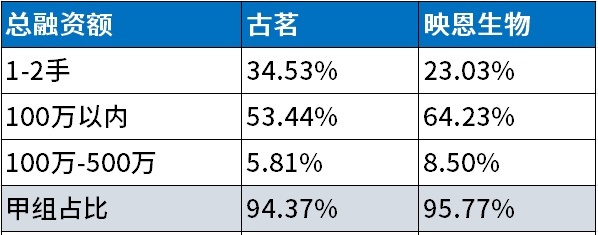
This makes sense—after the margin cap, many assumed Group A would be overcrowded (I thought so too), so those who previously used cash now maxed out leverage, afraid of missing out.
Duality Biologics had 25,720 participants; 11.5% of that is 2,978 people. Assuming cash applications are free and margin financing incurs a $100 fee, brokers made an extra $298,000.
Don’t scoff at $300K—this is just one stock. There are so many IPOs every year!
3. Group A Isn’t as Crowded as Expected
In reality, Group A isn’t nearly as packed as imagined.
Guming’s Group A participation was 94.37%, while Duality Biologics’ was 95.77%—no statistically significant difference, just 1.4 percentage points higher.
For tiers under $1M in financing, Duality Biologics was 10.8 percentage points higher; for $1M-$5M, it was 2.7 points higher.
The conclusion: the new rules pushed many 1-2 lot cash participants into mid-tier Group A, increasing mid-tier crowding and reducing its value. If you have two accounts with $400K+, a cash + Group A tail combo might be better than two mid-tier Group A positions.
4. The Top Tier Is Lonely at the Peak
Aside from higher-than-expected overall participation, Group B changes were mostly in line with predictions. Group B heads and mid-tier Group B dipped slightly, while mid-tier Group B stayed flat—likely because those retreating from Group B tails to mid-tier offset those moving from mid-tier to Group A tails or Group B heads.
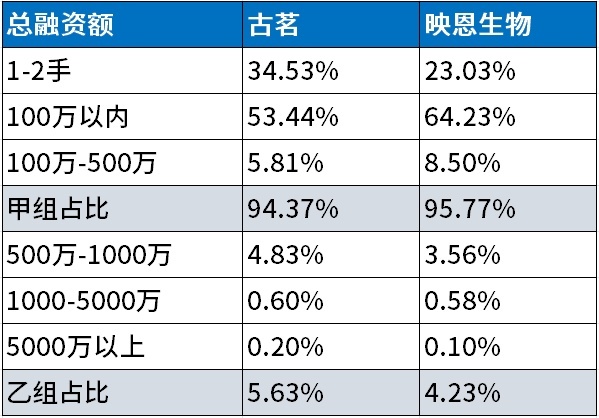
But Group B heads are interesting—their share halved. In absolute terms, Guming had 44 top-tier subscriptions, while Duality Biologics had only 18.
Does that mean you should blindly rush for the top tier?
Jiangsu Hongxin had a 3.91% single-lot subscription rate: Group A tails got 12 lots, Group B heads got 587 lots (49x Group A tails), and Group B tier 3 got 754 lots (no one went for the top tier)—wildly uneven.
But for hyped stocks like Duality Biologics, if you split a top-tier allocation ($7.77M at 10x leverage) into two accounts applying for 3,500 lots each, you’d get 47 extra lots.
In short, to maximize subscriptions: go for Group B if you can, and if you have extra funds, follow the red-shoe mechanism—split evenly across multiple accounts (note the difference from Group A). But for less hyped small caps, beware of allocation risks in Group B.
5. Retail Investors Are Willing to Pay More
Another fascinating point: after reverse-calculating participants’ actual payments based on financing amounts, I found that for Guming, 94.2% of participants invested under $20K, while for Duality Biologics, it was just 62%.
For investments between $20K-$100K, Guming had 6.2%, while Duality Biologics had 25.3%.
Clearly, the new rules’ "FOMO effect" worked wonders—squeezing more money out of retail investors’ pockets.
6. Summary
Copy-pasting the conclusions:
1. Group A isn’t as crowded as expected;
2. Mid-tier Group A is more crowded and less cost-effective—consider cash + Group A tail instead;
3. Aim for Group B if possible, and split funds evenly across accounts (red-shoe mechanism);
4. For less hyped small caps, be cautious with Group B allocations;
5. Time to dig into those savings.
The copyright of this article belongs to the original author/organization.
The views expressed herein are solely those of the author and do not reflect the stance of the platform. The content is intended for investment reference purposes only and shall not be considered as investment advice. Please contact us if you have any questions or suggestions regarding the content services provided by the platform.
