


Baidu and Youku are about to fight a 'horizontal and vertical battle'.

Original © New Entropy Entertainment Team
Author 丨 Fushen Editor 丨 Siyuan Chief Editor 丨 Jiuli
When the attention garnered on small screens surpasses that on the big screen, the collective "All in" drama of internet giants is once again unfolding.
Data released by the China Film Administration this New Year's Day shows that the total box office of China's film market in 2024 was 42.502 billion yuan. The "China Online Audiovisual Development Research Report (2025)" mentions that the market size of Chinese micro-short dramas has exceeded 50.44 billion yuan. In contrast, the advantage gap between films and short dramas in 2023 was still over 15 billion yuan.
The speed of this reversal has caught most people off guard. When short dramas first sprouted within short video platforms like Douyin and Kuaishou, long video platforms such as "Youku, iQiyi, and Tencent Video" were somewhat dismissive. The reason was simple: they believed that low-quality, formulaic short dramas and high-quality long dramas had distinct audience segments and did not constitute direct competition. Although they launched short drama content internally, it was merely a defensive move.
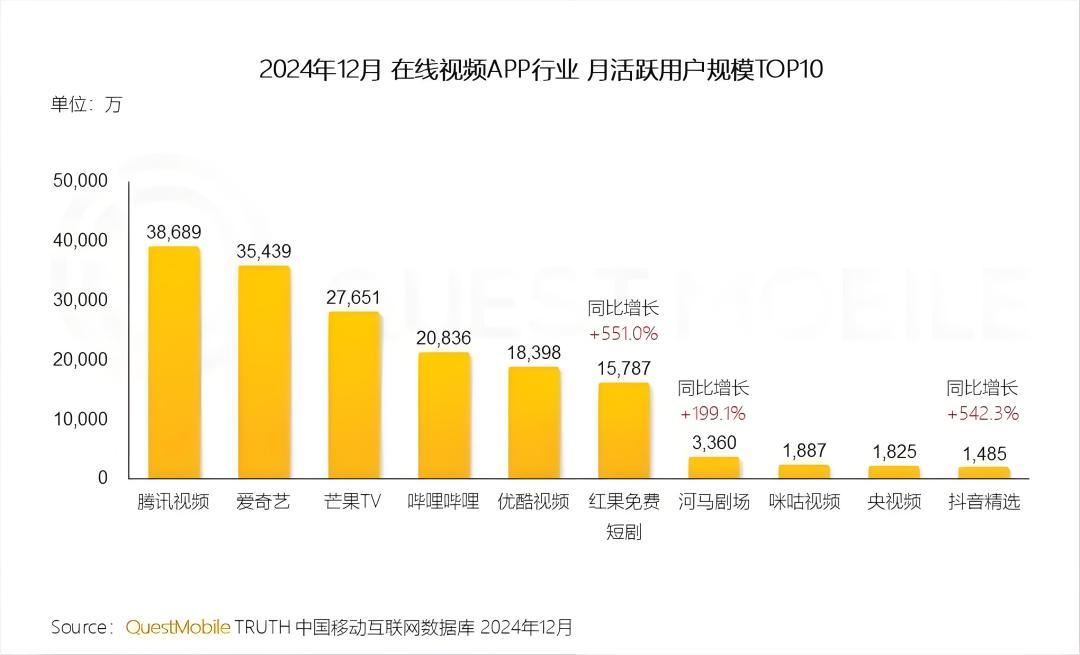
It wasn’t until the emergence of the free short drama app Hongguo that the video industry was jolted awake. According to official data, Hongguo’s monthly revenue exceeded 100 million yuan in June 2024, soon surpassing 200 million yuan in September, and jumping to over 300 million yuan by November. Additionally, data from third-party agency QuestMobile shows that Hongguo’s monthly active users surged to 158 million in December 2024, narrowing the gap with long video platform Youku to less than 30 million.
Compared to iQiyi and Tencent Video, which began strategic catch-up efforts last year, Youku’s focus on short dramas has only recently been confirmed. According to "China Entrepreneur Magazine," on March 19, Eddie Wu, CEO of Alibaba Digital Media and Entertainment and President of Youku, announced the establishment of a micro-short drama center during an internal meeting. During the short drama business review after the Qingming Festival holiday, senior executives from Alibaba Group were also present.
Another tech giant that has been "late to the party" is Baidu. With its dual positioning as a search tool and news platform, Baidu APP sits on a goldmine of traffic but struggles to find monetization avenues. After nearly a year of trial and error, Baidu finally applied to register the "Baidu Short Drama" trademark at the end of last year and partnered with multiple content collaborators to launch the "Hundred Dramas Plan," revealing its ambitions.
With more tech giants joining the fray, the second half of the short drama race has suddenly become more unpredictable.
Rushing to Catch the Last Train

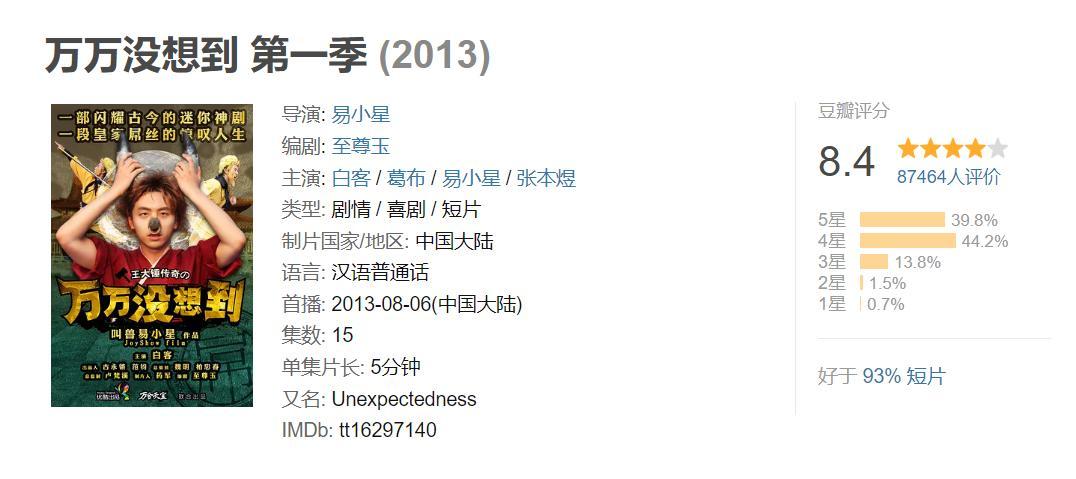
Online video platforms had already seen the embryonic form of short dramas during the early UGC (User Generated Content) era. In 2013, the comedy series "Surprise" produced by Wanhe Tianyi on Youku was a groundbreaking pioneer.
Short dramas differ from ordinary community user-generated VLOGs or edited fan creations, and they certainly don’t meet the industrial standards of professional film and TV production teams. Therefore, they rely on dense humor, tight plots, and exaggerated emotions as selling points, naturally lending themselves to viral potential.
However, the subscription-based profit model that long video platforms eventually settled on favors star-studded, well-scripted, and high-production-value dramas. The ad-driven model that short dramas depend on was sidelined due to the scarcity of teams and production efficiency at the time.
It wasn’t until around 2019 that short dramas experienced a "renaissance" on platforms like Douyin and Kuaishou, finding a perfect monetization path. Formulaic scripts derived from mature online literature, efficient in-platform advertising channels, and pay-per-episode business models quickly gained traction in lower-tier markets. As content quality improved, they gradually captured audiences in first- and second-tier cities.
But just two years into the golden age of paid short dramas, the free model arrived and swiftly captured half the market. This path mirrors the evolution of the online literature sector, with ByteDance’s Hongguo emerging as a standout—essentially a short drama version of Tomato Novel.
Hongguo’s surprise attack shattered the long video platforms’ preconceptions about short dramas. Last year, iQiyi not only integrated short dramas into its existing paid membership system but also significantly increased revenue shares for producers, attempting to lock in resources that had already been claimed by Hongguo.
Tencent Video faced even greater pressure, dealing not only with competition from peers but also with the internal "horse racing" tradition within its parent company. Its ideal partner, IP provider Yuewen, launched its own short drama platform, Yuewen Short Drama, while WeChat introduced a mini-program called "Mars Short Drama Club," focusing on free short dramas.

According to the "2024 Micro-Short Drama Industry White Paper" released by DataEye Research Institute, China’s micro-short drama market is expected to exceed 68 billion yuan in 2025 and surpass 100 billion yuan by 2027. Despite the impressive growth rate, intensifying competition has accelerated the industry’s transition to its second phase.
Whether it’s Youku or Baidu, their slightly delayed entry can still be seen as a case of "better late than never." Especially now, as the short drama industry stands at a crossroads—grappling with choices between traffic and quality, domestic and overseas markets—these unresolved questions await answers from both pioneers and latecomers.
The Second Half Is Not the Final Chapter

The rapid collapse of paid short dramas doesn’t mean the free model can rest easy. The long video platforms’ signature move—subscription-based memberships—has quietly emerged in the short drama sector.
Last November, Douyin took the lead by introducing the "Short Drama Card." Users now have a third option beyond the free model (watching ads) and the pay-per-episode model: purchasing a Short Drama Card to unlock episodes. Specifically, a short drama will offer two unlocking modes starting from a certain episode—either watch an ad for free or buy the card.
Similarly, Kuaishou rolled out a new monetization model for content creators called "Paid Short Drama Membership." Subscribers gain access to thousands of short dramas during their membership period, with discounted rates of 2.8 yuan for 3 days, 4.8 yuan for 7 days, and 15 yuan for 30 days.
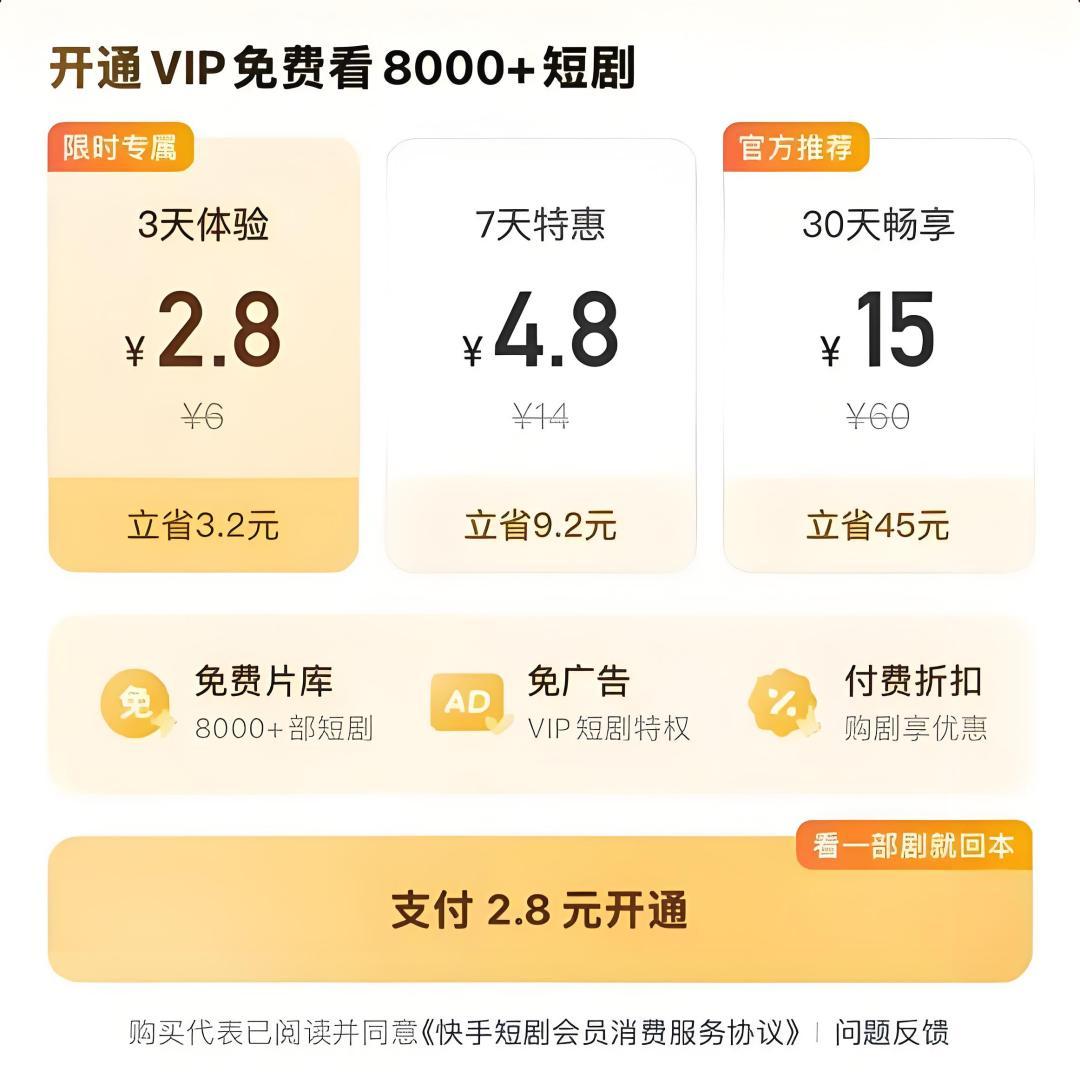
▲ Image/Kuaishou screenshot
As long as the borrowing and blending of business models continue to evolve, the landscape of any industry can be upended once again.
In fact, even before Hongguo’s free model became mainstream, e-commerce platforms had already recognized the traffic value of short dramas. While paying audiences were still watching episodes one by one on short video platforms, Pinduoduo, Taobao, JD.com, and even Meituan simultaneously launched short drama content with varying priorities. Free viewing in exchange for traffic could theoretically be monetized through e-commerce, but at best, it was merely a bonus.
Baidu’s entry, however, targeted its platform’s traffic distribution value from the outset, which could be paired with paid short dramas.
In early 2024, short dramas appeared as the third KR in the Q1 OKR of Baidu’s Senior Vice President and MEG Head He Junjie. The goal was to capitalize on the Spring Festival opportunity, streamline short drama distribution and user growth, establish Baidu’s reputation as a drama platform, and restructure new user acquisition logic, aiming for xxx billion DAU and outpacing industry growth in watch time (aggressive target). However, in practice, the user experience was no different from watching short dramas on e-commerce apps—entry points were buried deep, and even if users stumbled upon them, habit formation was unlikely.
According to Guangzi Planet, Baidu’s short drama strategy underwent multiple shifts after benchmarking against Douyin and Kuaishou, with directions adjusted almost quarterly. The business model oscillated between paid, free, and back to paid.
Fortunately, the sector’s 红利 (红利 =红利) partly offset operational missteps. At the recent 12th China Internet Audiovisual Conference, Baidu Short Drama disclosed its annual performance: Baidu APP’s video consumption time grew by 15.6%, with over 26,000 short dramas available for distribution and more than 1,400 short drama creators.
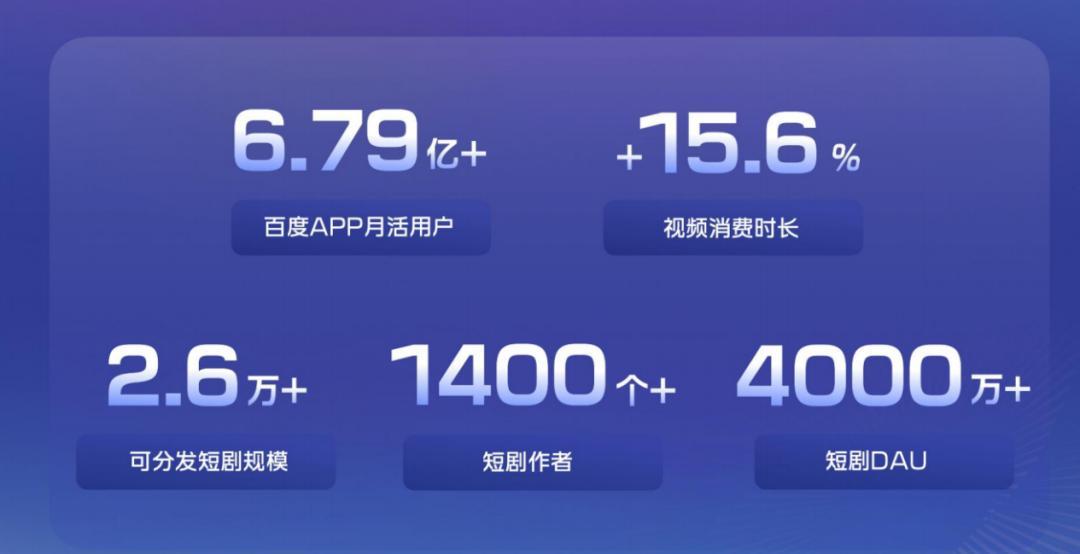
The commendable results have strengthened Baidu’s resolve to catch up. However, the underlying logic of the content industry remains a battle for upstream resources—users will always migrate to platforms with the best content.
Initiatives like Baidu’s and Youku’s collaborations with ecosystem partners to launch creator programs are also ways to counter the near-monopoly of resources by pioneers like Hongguo.
The Battle Between Vertical and Horizontal Has Just Begun

The "dragon 傲天" (dragon 傲天 = dragon 傲天) and "Mary Sue" tropes in short dramas are the traffic 密码 (密码 =密码) for lower-tier markets. For urban middle-class users with stronger willingness and ability to pay, higher-quality content is needed.
Zhao Hui, Director of the Audiovisual Art Research Center at the Communication University of China, believes: "The future of micro-short dramas requires both speed to seize opportunities and patience to 沉淀 (沉淀 =沉淀) value." When the industry returns to the main track of "content is king," long video platforms like Youku may have a chance to overtake latecomers.
This is why short dramas on short video platforms are mostly native vertical content, while long video platforms focus on horizontal formats when catching up. Reflected in monetization paths, the two approaches are fundamentally different.
Vertical short dramas can first partner with platforms for paid viewing, then transition to free models with ad revenue sharing after the initial release period. Horizontal short dramas follow the long-standing model of online movies and series—pre-funding, post-production 验收 (验收 =验收), and revenue sharing based on member watch time.
However, the seemingly 差异化 (差异化 =差异化) competition between vertical and horizontal short dramas is essentially a battle for users’ limited attention. The push for higher-quality short dramas has been underway for some time, but improvements have largely been limited to 硬件 (硬件 =硬件) upgrades like costumes and sets or shifts to high-cost genres like sci-fi, cultural tourism, and social issues.
The fast-paced, volume-driven business model 框架 (框架 =框架) means that the most critical aspects of quality—script refinement and cinematography—are often sacrificed. Until the easily earned profits dry up, short drama teams and platforms must make compromises, or the upward climb in content quality will remain an empty promise.
Additionally, with the domestic market becoming a 红海 (红海 =红海), overseas expansion presents another option. The "2024 Chinese Short Drama Overseas Industry Report" shows that, according to incomplete statistics, from August 2022 to June 2024, over 100 overseas short drama apps were launched, with cumulative downloads reaching 148 million and total in-app purchases hitting $252 million.
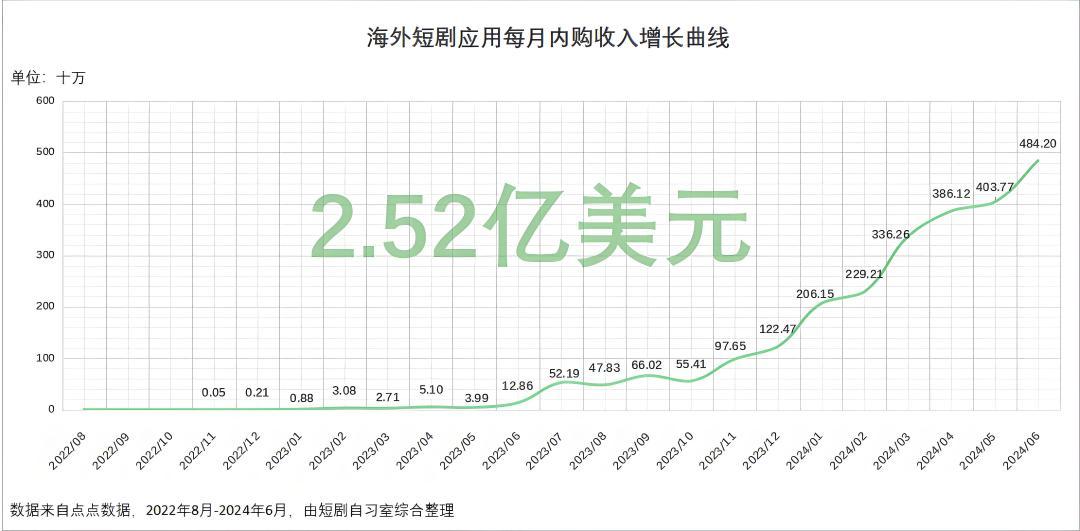
▲ Image/Short Drama Study Room
Of course, while production teams can 灵活 (灵活 =灵活) choose markets, platforms like Youku and Baidu must still engage in direct competition on their home turf. Long video platforms’ years of experience in producing high-quality dramas can be leveraged to 降维 (降维 =降维) 转型 (转型 =转型) short dramas. Tech giants’ deeper technological 底蕴 (底蕴 =底蕴), such as Baidu’s AI capabilities, can further reduce costs and improve efficiency in content production, fueling the creator ecosystem.
At the same time, both sides must not overlook the Matthew Effect observed in multiple content sectors like online literature and music. Platforms that attract users first and establish monetization paths naturally have the leverage to secure top-tier production resources. Latecomers must not only catch up quickly but also leverage their unique strengths to gain a foothold before expanding gradually.
The first world war of short dramas ended with the 鼎立 (鼎立 =鼎立) of free and paid models. The second world war of short dramas has only just begun.
References:
China Entrepreneur Magazine, "Youku’s Emergency 'Shortening'"
Guangzi Planet, "Has Baidu Caught the 'Last Train' of Short Dramas?"
Kasi Data, "In 2025, Short Dramas Will 'Charge' Differently"
First Financial, "Short Drama Overseas Expansion Explodes, with Hits Turning 200k Costs into 35M Revenue"
The copyright of this article belongs to the original author/organization.
The views expressed herein are solely those of the author and do not reflect the stance of the platform. The content is intended for investment reference purposes only and shall not be considered as investment advice. Please contact us if you have any questions or suggestions regarding the content services provided by the platform.
