


Tesla 2025 Q1 earnings preview

Market expectations for Tesla's Q1 revenue reach $21.54 billion, a slight year-over-year increase of about 1.12%, with earnings per share (EPS) at $0.37, up 8.24% YoY. Since the beginning of this year, Tesla's stock price has fallen by more than 40%, nearly halving from its all-time high. There are many reasons behind this, including but not limited to Elon Musk's political interventions and a sharp decline in Tesla's sales, which we won't elaborate on here. Below, we’ll mainly analyze the automotive and AI businesses.
Automotive Business
1. Continued Decline in Deliveries
Global deliveries in Q1 2025: 336,700 units, down 13% YoY, the lowest level since Q2 2022. Main models Model 3/Y delivered 323,800 units, down 12% YoY; new models like Cybertruck delivered only 12,800 units, showing weak performance.
2. Regional Market Divergence
European market: Affected by controversies over Musk's political stance, Tesla's market share in 15 European countries dropped from 17.9% to 9.3%, with Germany's share plummeting to 4%.
Chinese market: Q1 sales hit a three-year high of 137,200 units, but Model Y sales in February halved YoY.
3. Production and Cost Pressures
Production adjustments: Model Y production line upgrades led to a 16% drop in Q1 output, compounded by insufficient orders.
Unit cost: Q4 2024 unit cost fell to $35,000 (~¥250,000 RMB), but gross margins declined YoY, with price wars intensifying profit pressures.
AI-Related Business
1. FSD (Full Self-Driving)
Technical breakthrough: Pure vision-based L4/L5 FSD to launch in Texas in June 2025, with over 80,000 km of testing, supporting V2V communication and autonomous factory operations.
Commercial progress: Plans to cover North America by 2027, but China faces data localization challenges requiring domestic model training.
2. Optimus Humanoid Robot
Mass production plan: First batch in 2025, targeting annual output of 10,000–12,000 units, expected to reach 500,000–1 million by 2027; tech upgrades include 22-DOF hands, tactile sensors, and gait optimization.
3. Robotaxi (Autonomous Taxi)
Regulatory breakthrough: Secured California TCP license in March 2025, plans unsupervised service in Texas by June.
4. Energy Storage & AI Infrastructure
Megapack storage: 2024 deployments grew 153.66% YoY, targeting 47.1GWh in 2025.
AI computing investment: Cumulative capex of $5 billion, with Optimus training needs estimated at 10x automotive business levels.
U.S. auto tariffs impact Tesla with "short-term pain and long-term forced transformation."
Short-term: Surging supply chain costs, market share loss, stock pressure;
Long-term: Forced supply chain localization, accelerated tech iterations (e.g., 4680 battery), and emerging market expansion (e.g., Saudi Arabia).
I used AI to compile major institutions' Tesla assessments for your reference.
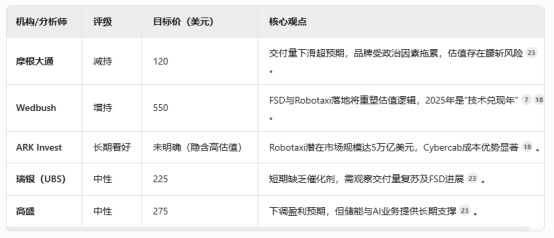
To summarize:
Short-term, Q1 earnings may further pressure Tesla's stock—watch for delivery recovery and gross margin bottom signals. Strong support around $214; if earnings miss, consider buying the dip. Long-term, focus on AI: FSD/Robotaxi/Optimus.$Tesla(TSLA.US)
The copyright of this article belongs to the original author/organization.
The views expressed herein are solely those of the author and do not reflect the stance of the platform. The content is intended for investment reference purposes only and shall not be considered as investment advice. Please contact us if you have any questions or suggestions regarding the content services provided by the platform.
