


7.2 trillion VS 4.5% yield rate: Powell and Trump's life-and-death game, who will collapse first?

The showdown between Federal Reserve Chairman Powell and the Trump administration is evolving into a power struggle that is tearing apart global capital markets. The crux of their conflict has clearly crystallized at the crossroads of a $7.2 trillion balance sheet—should they continue to maintain high interest rates to safeguard the credit of U.S. Treasuries, or pivot to rate cuts to rescue the faltering U.S. stock market? The stubborn core PCE inflation rate of 2.8% has led the Fed to aim its guns at the bond market: the 10-year Treasury yield is once again approaching the 4.5% warning line, while the 30-year mortgage rate has breached the psychological threshold of 7%, with the market already pricing in a potential liquidity crisis. Behind this policy resolve lies a brutal trade-off—the Treasury's net issuance of U.S. bonds in Q1 surged year-on-year, creating a funding black hole, while over two-thirds of S&P 500 companies flagged tariffs as their biggest earnings risk. These twin forces are like high-powered pumps draining market liquidity at an alarming rate.
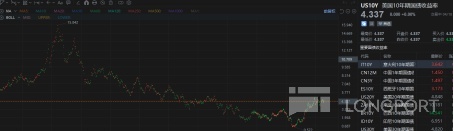
Trump's tariff weapon is backfiring. Legal challenges from states like California accusing the federal government of imposing illegal tariffs have forced the White House to delay some tax hikes. However, the brewing 'Mar-a-Lago Agreement' reveals an even more dangerous contradiction—a proposal to tax foreign investors holding U.S. Treasuries, coupled with threats to delist Chinese stocks, essentially wields a stick to drive away foreign capital just when the U.S. bond market desperately needs international buyers. The direct consequence of this policy split is the 10-year Treasury's real yield breaking 4%, a two-decade anomaly, creating a historic divergence from U.S. stock valuations. As Nvidia faces a potential $5.5 billion revenue loss due to H20 chip restrictions and AMD's China orders are halved, the two tech giants' stocks have retreated 15% from their peaks, replaying an escalated version of the 2018 trade war script—back then, only 20% of S&P 500 companies listed tariffs as a major risk; today, that number has tripled.
The semiconductor industry has become the bloodiest battleground in this struggle. After China imposed a 34% tariff on U.S. semiconductor equipment, the cost of importing core machinery like lithography systems surged over 50%, forcing companies like SMIC to accelerate domestic alternatives. Meanwhile, U.S. equipment giant Applied Materials saw its Q2 China revenue plummet 60%, and Lam Research laid off 15% of its workforce, exposing the technological costs of deglobalization. Although the Philadelphia Semiconductor Index's P/E ratio has retreated from a peak of 90x to 70x, the market clearly hasn't fully priced in the long-term risks of industrial fragmentation: during the 2018 trade war, the index halved in six months, while Japanese and Korean firms like Tokyo Electron and Samsung became unexpected winners by boosting exports to China by 40%. Today, despite Yangtze Memory's capacity utilization rising to 90%, the shadow of a three-nanometer technology gap looms large.
Facing this silent war, capital is reorganizing its defenses. The recommended allocation to the Nasdaq 100 has been slashed to below 40%, with high-PE tech stocks (over 50x) becoming prime targets for reduction. Funds are instead flooding into tariff-resistant assets to build new lines of defense: U.S. shale oil giant Chevron has regained investor favor as WTI crude stabilizes above $85/barrel amid import restrictions; Lockheed Martin, with $87 billion in government orders, is showcasing its safe-haven appeal amid geopolitical premiums; gold prices breaking $2,600/oz—a historic peak—hint at markets positioning for a wobbling dollar credit system. Some hedge funds are even double-betting on the VIX and USD/CNH exchange rates, hunting for arbitrage opportunities in the cracks of the $7.2 trillion balance sheet.
This power game may have no winner—if the Fed holds its rate ground, a repeat of 2022's 20% stock crash is possible; if the White House forcibly intervenes in monetary policy, the dollar's hegemony could crumble faster. The real undercurrents of change may emerge in Q3 2025: either the U.S. and China reach a provisional tariff truce to delay the crisis, or collapsing U.S. economic data triggers a policy U-turn. As the 10-year Treasury yield curve inverts, Wall Street traders hover their fingers over the sell button, awaiting the next black swan's wingspan.
$Eli Lilly(LLY.US) $Johnson & Johnson(JNJ.US) $NVIDIA(NVDA.US)
The copyright of this article belongs to the original author/organization.
The views expressed herein are solely those of the author and do not reflect the stance of the platform. The content is intended for investment reference purposes only and shall not be considered as investment advice. Please contact us if you have any questions or suggestions regarding the content services provided by the platform.
