


 Top 10 Influencers in 2025
 Likes Received
US Stock Live Trading-20250525: Crypto Shadow Stocks, The Younger Generation Shows Great Potential

Overview:
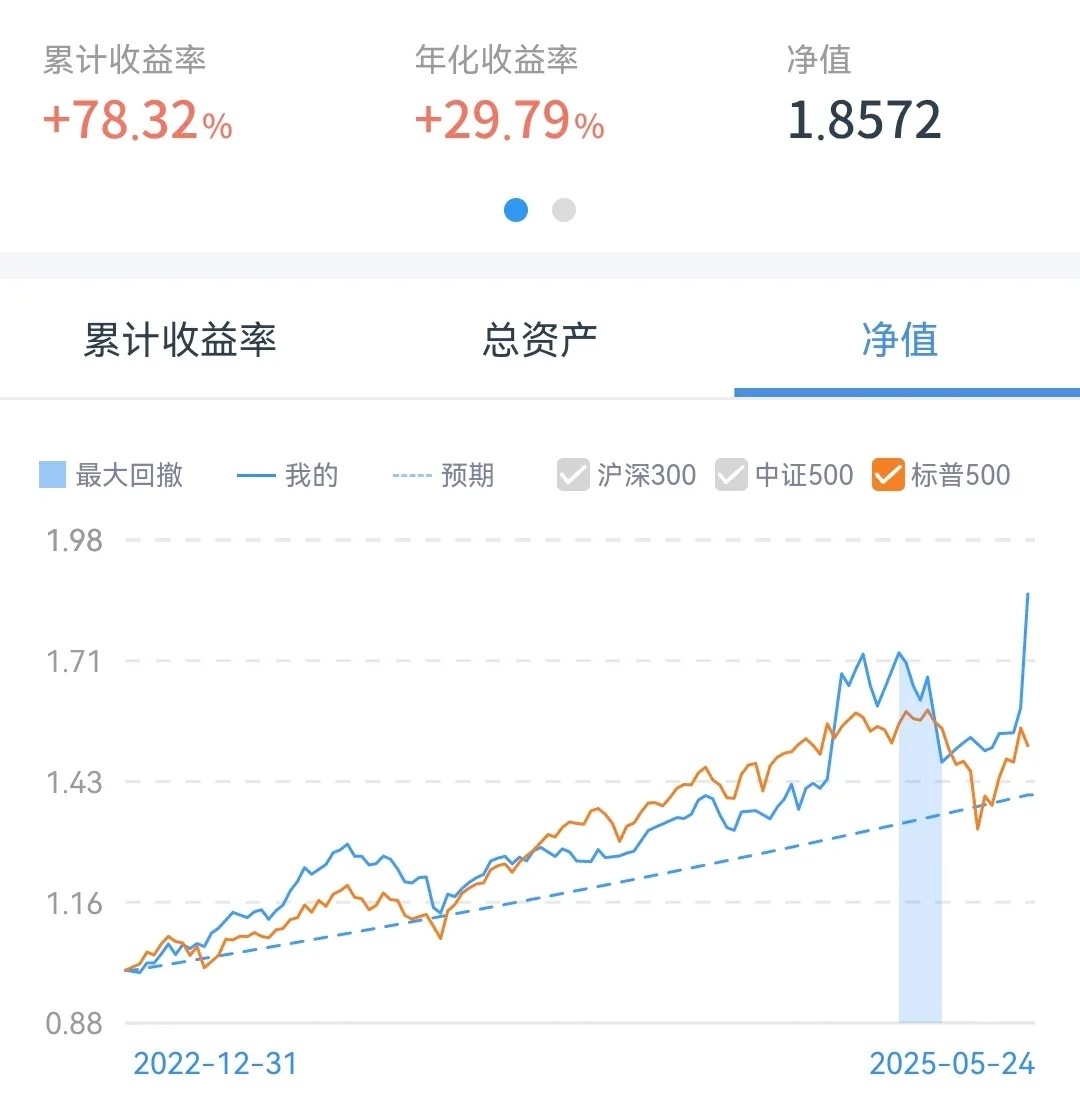
This week, the S&P 500 index fell by 2.61%, while my actual portfolio value rose by 16.26%.
In 2025, the S&P 500 index fell by 1.34%, and my actual portfolio value rose by 15.93% (starting the year with a net value of 1.60, this week's net value is 1.86).
Trades:
Sold 50% of the position in Cantor Equity and bought an equivalent amount of Kindly MD.
Liquidated Kindly MD and bought an equivalent amount of BIL.
Liquidated NVIDIA and bought an equivalent amount of BIL.
Holdings:
CEP 12.5%, TLT 16.9%, BIL 70.6%.
Numbers are rounded, and positions below 1% are generally not recorded.
Review:
This week, the U.S. stock market closed lower, but my account value reached a new all-time high, mainly thanks to crypto shadow stocks. There were many significant events this week, so let’s start with the trades.
Three trades in total, a week’s worth of activity equivalent to a month’s.
I closed 50% of CEP because it directly hit the first target price. The newly purchased Kindly MD, as I mentioned before, is like a younger version of CEP—both are crypto shadow stocks, but CEP surged ahead while Kindly MD is still waiting for its turn, so I shifted 50% there.
However, with the release of stablecoin drafts in both China and the U.S. this week, coupled with Bitcoin hitting a new all-time high, the two major catalysts combined with these well-consolidated potential concept stocks led to a short-term surge. Especially Kindly MD, which saw two days of 40%+ gains within three days of purchase, breaking previous highs. Since it’s still in the stage of preparing to buy Bitcoin, this rally is already overheated, so I immediately closed the position. I’ve seen this scenario before—last year with MSTR’s 30%+ single-day volatility, which marked a major top. History serves as a reference, so this time is no different.
For this wave of crypto-related asset allocation, I originally intended to mimic last year’s MSTR trade, but these younger companies surged unpredictably. The remaining 50% of CEP is pure profit, and I plan to hold it a bit longer. Based on my calculations, I’m targeting 67, and if it breaks through, I’ll aim for 100+.
As for liquidating NVIDIA, it’s a completely different logic.
When I chased the rally last week, I said I might exit at any sign of trouble. This year, my maximum allocation to U.S. tech heavyweight stocks is 30%, and with NVIDIA’s earnings report coming up—expected to swing ±7%—I didn’t want to gamble on this report.
Second, another major negative is the struggling new U.S. Treasury sales, driving yields up to 5%. At that rate, why bother with stocks? It’s a severe headwind for equities, especially heavyweights.
And then, an even bigger negative hit: Trump, who hadn’t tweeted about stocks in two weeks, posted: "The EU was formed mainly to take advantage of the U.S. in trade, but they’re tough. Their strong trade barriers, VAT, absurd corporate penalties, non-monetary trade barriers, currency manipulation, and unfair lawsuits against U.S. companies result in a U.S. trade deficit of over $250 million annually—completely unacceptable. Our discussions with them have gone nowhere. Therefore, I propose a 50% tariff on the EU effective June 1, 2025. No tariff if the product is made or produced in the U.S."
As soon as the headline dropped, I liquidated without even reading the details. It’s not about being bullish or bearish on NVIDIA; it’s just that all these signals screamed "hold cash over stocks" at this moment.
This weekend, I’ve been researching stablecoin legislation and related concepts. Future allocations will likely focus on this direction. Right now, my top pick is the Bitcoin ETF I failed to buy low and sell high earlier, followed by tracking the two crypto shadow stocks traded this week. Extreme volatility and cognitive divergence often create outsized returns.
The aging MSTR sits there, gazing fondly at its 22-year-old (CEP) and 2-year-old (KDLY) reflections.

---
Other stocks:
1. Tesla
On May 24, Musk announced a return to 7x24 work mode, even "sleeping in meeting rooms, server rooms, or factories." He also revealed that Tesla, SpaceX, and xAI are all approaching critical development milestones. U.S. media analyzed that Musk’s latest statement signals a major shift in his focus from politics back to business, potentially "stepping back from U.S. politics" to resume his role as a tech "Iron Man."
When he first entered politics, I said it was the wrong move. Since then, I’ve avoided this stock. Now that he’s been used and discarded, his fate might be... Well, I lack the expertise to value this, so I’ll just ignore him for now. Good luck to him.
2. Apple
Recently, Trump posted on social media that he had long told Apple CEO Tim Cook to "make iPhones sold in the U.S. in the U.S.," or else "Apple must pay at least 25% tariffs to the U.S."
Wall Street analysts predict that if the Trump administration insists on relocating iPhone production to the U.S., "Made in the U.S.A." iPhones could surge by at least 25%, possibly up to $3,500—190% higher than current prices.
This would directly impact Apple’s product demand, U.S. consumer spending, and exacerbate inflationary pressures, with profound implications for investors and tech stock valuations.
I don’t know if Trump is just throwing out ideas, but if this gets implemented, Apple is done.
3. Microsoft
The U.S. Federal Trade Commission (FTC) has formally dropped its antitrust lawsuit against Microsoft’s $68.7 billion acquisition of Activision Blizzard. The decision came three days after the FTC’s appeal was rejected by a federal court, marking the end of a nearly two-year legal battle.
Court documents show the FTC "believes dismissing the case best serves the public interest." This withdrawal ends all legal actions the FTC had taken since June 2022 to block the deal.
Microsoft Vice Chairman Brad Smith responded: "Today’s decision is a win for gamers nationwide and rational policymaking in Washington. We appreciate the FTC’s final decision."
Microsoft is the quietest winner among the M7 this year. After consolidating last year, it’s been rising against the market with almost no negative news—the smoothest holding.
4. Google
On May 20, Google’s 2025 I/O developer keynote showcased its latest advancements in AI, multimodal models, cross-device integration, and developer tools. From the upgraded Gemini 2.5 Pro model to XR applications for smart glasses and AI-driven search and browsing, Google demonstrated not just model performance but AI’s evolution from an "information tool" to a "general-purpose agent."
Google I/O 2025 highlighted Gemini 2.5’s prowess as a cross-platform AI engine.
From "Stitch" to "Casey," from voice assistants to robot generation, from Android to Web to Cloud, every update aligns with the core goal of "lowering barriers and accelerating creation." Key releases include Gemini 2.5 and Flash models, a revamped AI Studio, deep Android-Gemini Nano integration, multimodal tool Stitches, and real-time deployment capabilities. The stock surged on this news but closed lower due to Trump’s tweet.
5. NVIDIA
U.S. chip giant NVIDIA is reportedly launching a Blackwell-architecture AI chip for the Chinese market, priced significantly below the H20, with mass production expected as early as June. The new Blackwell-based processor is priced between $6,500 and $8,000, well below the H20.
This is a remedial move, but I think it’s too late. Domestic alternatives already cover these crippled versions. The more sanctions, the stronger China gets; the stronger China gets, the more decoupling happens. Jensen Huang is in a tough spot, squeezed between two superpowers. To survive this, he might want to ask Pony Ma how he weathered similar storms. NVIDIA’s future expectations need moderate downward adjustments.
6. TLT
The latest U.S. Treasury auction was weak, with yields significantly higher than expected, reflecting low investor interest. Combined with Moody’s downgrade of U.S. credit ratings, concerns about debt sustainability are growing. Treasury prices fell, and yields climbed. Markets also worry that U.S. tax cuts will widen the fiscal deficit and accelerate debt explosion.
The U.S. stablecoin bill’s general idea is to peg legal stablecoins 1:1 to Treasuries, creating new inflows to support the pressure. The crypto industry has money but no power; Trump has power but no money. It’s a perfect match, so crypto deserves more attention this year. TLT’s risk is lower than U.S. stocks but may not be as good as gold. Still weighing whether to switch.
---
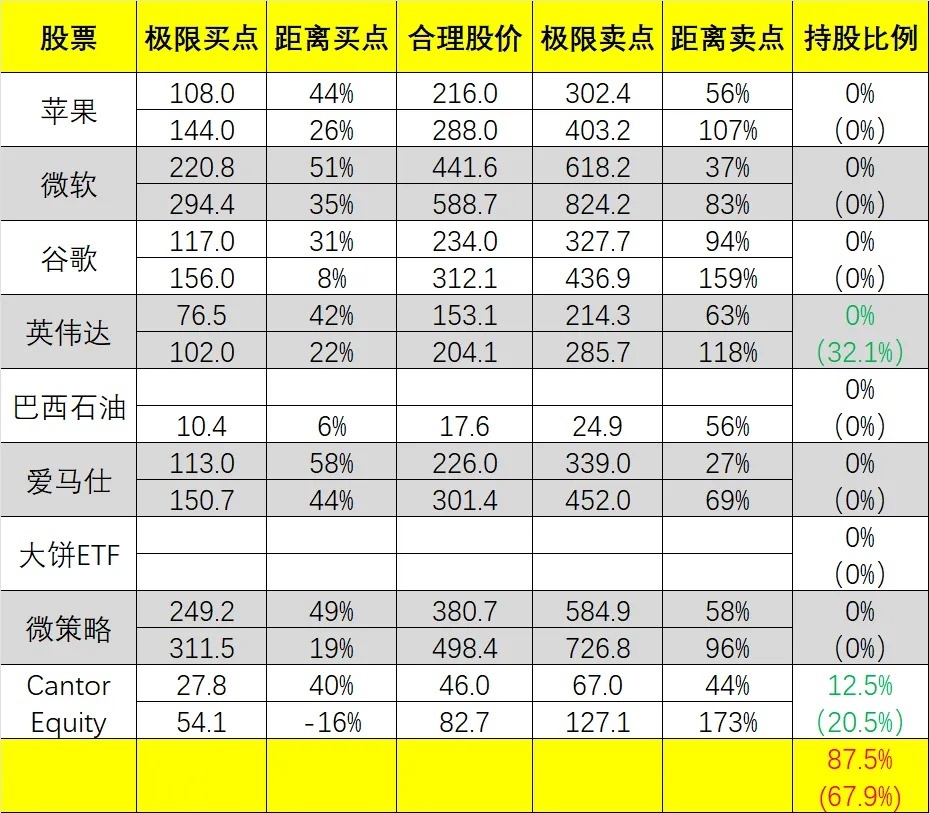
Finally, the valuation table (all figures in USD): Tesla removed, CEP added.
Notes (must read):
1. The buy points, fair prices, and sell points in the table above are calculated using my own methods—no universal standard, nor are they absolute or guaranteed. They’re just aids for my own judgment.
2. If a price point has two values, the lower is the floor and the higher is the ceiling. Which one I use depends on my subjective view and understanding of the company—no fixed rule.
3. Blue/red highlights are warnings for myself that a stock is near a buy/sell zone, requiring closer attention, but doesn’t mean I’ll definitely act.
4. Numbers in the table may adjust as I reassess company fundamentals. Don’t treat them as long-term references or correct answers.
5. The table is for my personal trading records, not advice. Don’t ask me what to buy—the answer is always "don’t."
6. If you hold any of these, feel free to comment and point out my mistakes. Let’s learn and profit together.$Kindly MD(KDLY.US) $Cantor Equity Partners(CEP.US) $Bitwise Bitcoin ETF(BITB.US)
The copyright of this article belongs to the original author/organization.
The views expressed herein are solely those of the author and do not reflect the stance of the platform. The content is intended for investment reference purposes only and shall not be considered as investment advice. Please contact us if you have any questions or suggestions regarding the content services provided by the platform.
