
The 'Miracle' of Duolingo: How Did It Become One of the Few Super-Growth Internet Companies in Recent Years?
 I'm LongbridgeAI, I can summarize articles.
A language learning APP with a staggering P/E ratio of 200 times and a market value of $18.7 billion, with only over 800 employees in 2024, and so far, there have been few short interest rumors. This is simply a miracle.
This company is Duolingo $Duolingo(DUOL.US).$Duolingo(DUOL.US)
What has given Duolingo such a staggering valuation? Is it a capital bubble or a rational market choice?
With these two prominent questions, this article will delve into the hidden concerns beneath Duolingo's prosperous facade and its future direction, attempting to restore a complete "Duolingo".
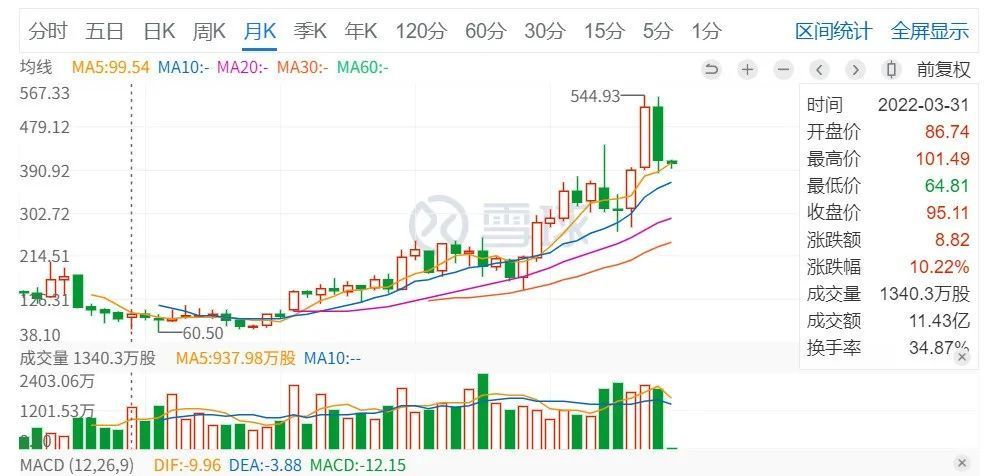
Figure: Duolingo monthly K-line. Source: Snowball
01 Duolingo Brief History
Duolingo was founded in 2009, and the app of the same name was launched in 2012. The founder, Luis von Ahn, was a professor in human-computer research at Carnegie Mellon University at the time.
Before founding Duolingo, Luis von Ahn was already a successful serial entrepreneur, which may have been an important factor in Duolingo's early rounds of financing.
Another founder of Duolingo, who later became the company's CTO, Severin Hacker, was Luis von Ahn's graduate student. This teacher-student combination laid the foundation for the stability of the early management team.
Luis von Ahn is a Guatemalan-American who has always advocated incorporating game mechanics into the learning process to make it easier for students to engage in learning, which later became Duolingo's biggest highlight.
At the beginning of Duolingo's founding, from the perspective of the financing process, it may have been more about the optimism for the founder von Ahn rather than truly recognizing the business model of online language education.
In the six rounds of financing before Duolingo's listing, there were almost no cases of previous round investors following up. If it weren't for the last two rounds of financing from Google, Duolingo's listing might have been quite bumpy, and the 193% increase in four years after listing gave early investors an ideal return.
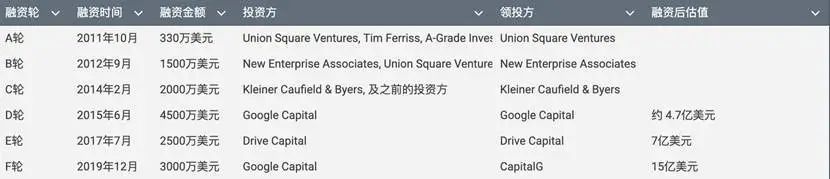
Figure: Duolingo financing process
With the help of listing, Duolingo ushered in a golden period of growth under the buff of the pandemic. The first quarter financial report of 2015 disclosed that the latest DAU reached 46.6 million, and MAU exceeded 130 million.
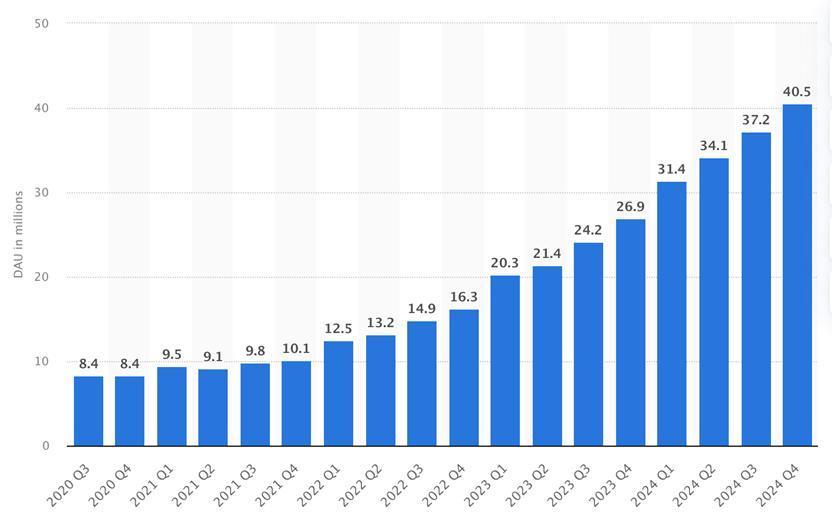
Figure: Duolingo DAU change curve, data source: statista.com
As a language learning app born in the mobile internet era, gamified interactive design, social mechanisms, and user incentives are the three magic weapons for Duolingo to maintain stable growth, and these three magic weapons have produced a wonderful organic reaction for a learning app.
Duolingo is most talked about for its gamified learning mechanism, which allows many users to enjoy the fun of "painless learning." The entire language learning process is more like a series of small game sessions, where users complete vocabulary, sentences, and oral learning in animated interactions. This is the biggest difference between Duolingo and many language learning products.
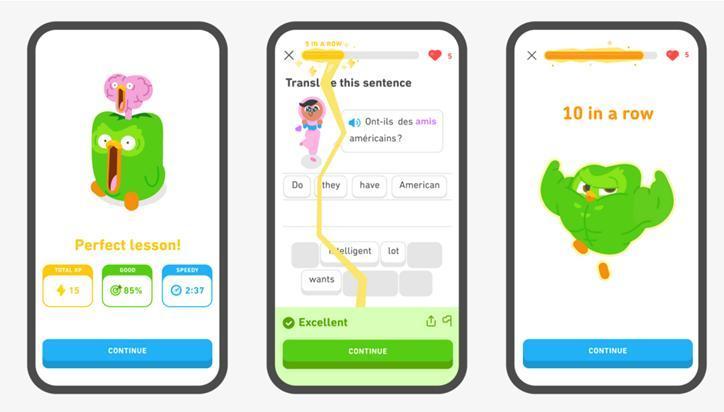
In addition to lowering the learning threshold through gamified design, Duolingo's social function is also an important means of maintaining user stickiness. Users can see their learning achievements ranked among friends in the app. This kind of subtle competition naturally stimulates users to stay active and use deeply, while the "circle of friends ranking" winner gains great emotional satisfaction.
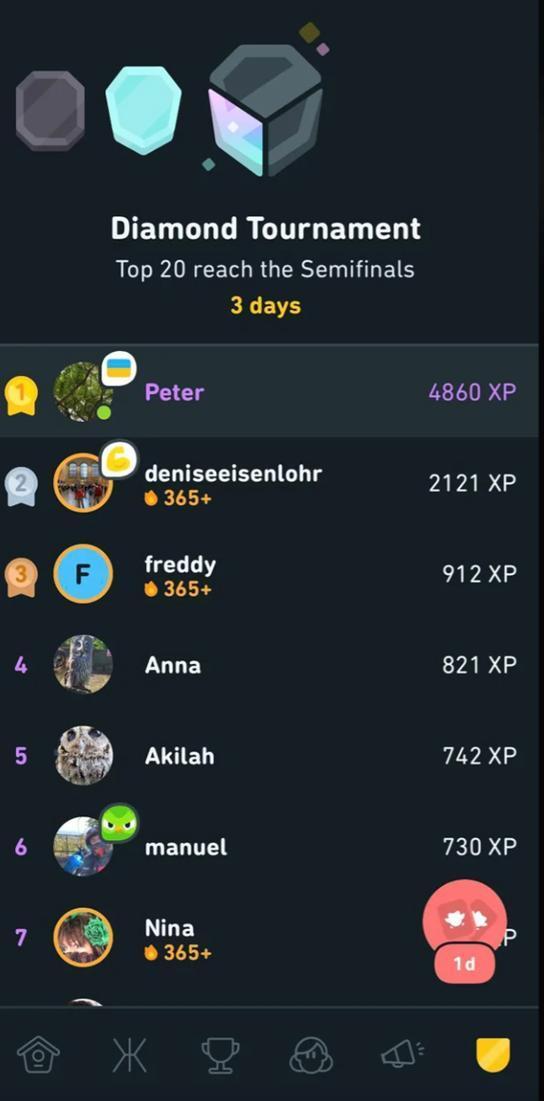
Streaks: Streaks are Duolingo's most powerful single incentive tool. In forum surveys, it was found that in comments, many users have streaks lasting 300 days, 877 days, 1000 days, and even 1200 days.
This is an amazing stickiness for an app. Losing the streak record is a real pain for users, and this strong psychological constraint is the core of its retention strategy.

Today's Duolingo is no longer just a single language learning app. The gradually enriched learning resources and expanded audience base are also important reasons why it is favored by the market.
In addition to expanding the user base by increasing learning resources, Duolingo provides an online language assessment tool, Duolingo English Test, to test learning results for learners, and has developed Duolingo ABC for children's language learning.
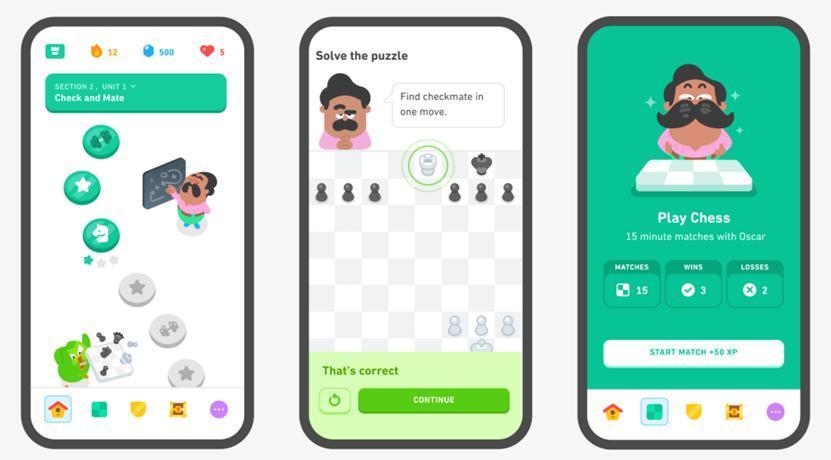
After consolidating the basic aspects of language learning, Duolingo launched math and music courses in 2022 and 2023, respectively. In 2025, it launched a chess course—according to the official statement, this is a product developed from a personal interest project that is popular with users. With the help of AI, users can gain a rich and interesting learning experience in chess gameplay, and the number of users is rapidly increasing.
02 A Glance at the Business Model
In terms of business model, Duolingo adopts the most popular "free + advertising + premium" model in the internet industry.
The product provides completely free course resources for users to learn. Only after each course session ends, users need to watch ads to enter the next level of learning. After learning, users can participate in interactive quizzes to gain incentives and energy, but when the number of wrong answers reaches a certain limit, users need to cool down for a period before answering questions again or open a paid subscription to get unlimited quiz opportunities.
The above two scenarios give rise to the "premium +" motivation, with ad-free and energy (Hearts) acquisition being the grasp of paid subscriptions.
Duolingo's main subscription products are Super Duolingo and Duolingo Max, the former can be seen as a plus version, and the latter is the Pro version.
Main features of Super Duolingo:
• Ad-free learning: Enjoy an ad-free experience
• Unlimited "Hearts": During the process of answering questions or correcting mistakes, when the free mistake correction limit is reached, Hearts are needed for exemption. Opening plus allows unlimited "Hearts" to continue answering questions (the core driving force of this feature is Duolingo's "circle of friends ranking")
• Customized practice: Customized correction units for mistakes made during practice, strengthening weak points
• Unlimited challenges to legendary: Can challenge "legendary" level questions unlimited times
The price of Super Duolingo is $12.99/month or $84/year. Family plans are $9.99/month and $119.88/year.
In March 2023, Duolingo launched a higher subscription tier, Duolingo Max, which adds three AI-driven intelligent learning features on top of Super Duolingo: Explain My Answer, Roleplay, and AI dialogue product "Call Lily."
Duolingo Max's subscription fee in the United States is $29.99 per month or $167.99 per year. In addition, a family package of $239.99 per year is provided, including all multi-user rights of Duolingo Max.
From user feedback, these three AI-based features have not yet fully gained user recognition. This also reflects that the current application of AI large models is still in the "looks good" stage.
In 2016, Duolingo launched a paid online English proficiency test DET, and users who pass the test can use the results as proof of their English ability, but language test revenue accounts for a small proportion of revenue.
03 User Growth and Commercial Performance
In the first quarter of 2025, Duolingo delivered a dazzling report card:
• Quarterly revenue of $230.7 million, up 38% year-on-year;
• Total bookings amount of $271.6 million, up 38% year-on-year;
• Subscription bookings amount of $232.2 million, up 44% year-on-year.
In terms of user growth:
• Daily active users (DAU) of 46.6 million, up 49% year-on-year;
• Monthly active users (MAU) of 130.2 million, up 33% year-on-year, while the DAU/MAU representing user stickiness also reached a historical high of 36%;
• As of the end of the quarter, the total number of paid subscription users was 10.3 million, up 40% year-on-year, and the subscription ratio of monthly active users remained at around 8%.
In terms of profitability:
• Net profit of $35.1 million, compared to $27 million in the same period last year;
• Adjusted EBITDA of $62.8 million, up 43% year-on-year, with an adjusted EBITDA profit margin of 27.2%;
• Free cash flow of $103 million, up 31% year-on-year.
From 2019 to 2024, Duolingo has maintained a dazzling performance in both user growth and commercial achievements, with a compound growth rate of 34% for the former and over 58% for subscription revenue.
Accompanying high growth is high valuation, and Duolingo's market value has now reached a historic high of $18.3 billion.
04 The Intrinsic Logic of High Valuation
As previously mentioned, Duolingo's business model is the classic "free + advertising + premium" model, which is almost a business model trusted by the market in the internet field.
Listed companies that adopt the same business logic are almost always particularly favored. The most classic examples are Netflix and Spotify, and the latest P/E ratio of Monkey even reaches 118 times.
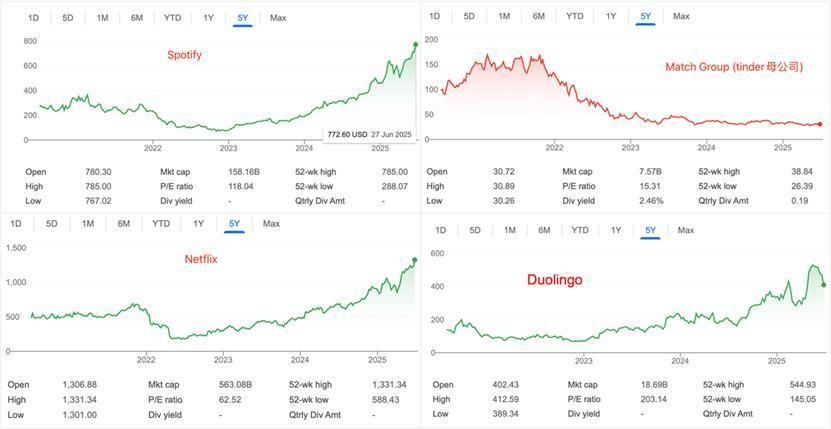
This is a relatively "pure" business model, with simple growth logic, low corporate operating costs, and highly predictable performance, and people can almost use a formula to predict the company's future revenue growth:
Subscription revenue = MAU * paid rate * ARPPU.
But this seemingly perfect business model has a fatal flaw—growth. This pure business model, with its core product being just an APP, cannot allow this APP to continue expanding, which is the original sin.
To maintain rolling growth, it depends on two upper limits, namely: team capability upper limit and business model upper limit. Duolingo can obtain high market valuation, the primary factor is that these two upper limits have not yet been reached:
First, team capability upper limit:
We externalize it through qualitative analysis of the company's product evolution:
The highlights of Duolingo's product design have been described earlier, and excellent incentive mechanisms ensure user stickiness. User stickiness is the cornerstone of growth.
Duolingo's team has two bright achievements in user growth—unique user notification mechanism (PUSH) and event marketing.
User PUSH is often disliked by users on most APPs, especially now that personal privacy is increasingly valued, many users choose to actively turn off push. But most users do not dislike Duolingo's push. According to feedback from multiple forums, Duolingo's push copy is rich, the push content closely follows the user's learning progress, and "urges" users to learn in various ways, playing the role of a proud little assistant in the user experience, and is therefore welcomed by users.
In terms of event marketing, Duolingo has an extraordinary sensitivity to event marketing. Before the second season of "Squid Game" was launched, Duolingo cooperated with Netflix to launch the "Learn Korean in class, or else" activity. At the beginning of this year, the "big escape" of TikTok users, regardless of whether Xiaohongshu benefited or how much TikTok suffered, Duolingo was one of the biggest beneficiaries.
In addition, the average daily learning time of Duolingo is about 10-15 minutes, which is almost "fragmented time" in people's daily lives. Think about it: spending half an hour on your phone during commuting may bring a slight sense of guilt, but using Duolingo can gain a sense of achievement in learning. This psychological difference in obtaining a sense of achievement is the key to its user stickiness.
In summary, with super high user stickiness, even if Duolingo's marketing expenses account for only 13%, user growth will form a snowball effect and continuously convert into subscription users.
Second: Business Model Ceiling:
In addition to its own benign growth, as a language learning tool, Duolingo also absorbs the valuation logic of the offline language learning track.
It is well known that in the real world, regardless of the country, the cost of language learning is not low. Learners not only need to study for years but also pay a considerable financial cost.
We conducted a simple survey on a learning cost discussion post in the "r/languagelearning" section of the Reddit forum. In terms of financial cost, it varies according to different languages, learning methods, and learning purposes, but generally, the cost is far higher than the subscription cost of Duolingo for 3-5 years.
From our research, offline foreign language learning methods are more diverse, and more resources can be used, but corresponding language learning is also more expensive.
The cost given by multiple users is at least over $100 per month, and this is only the cost of one learning method. If you enroll in classes, purchase paper and electronic learning resources simultaneously, the monthly cost will exceed $200. The cumulative learning cost of completing a language may be as high as tens of thousands of dollars.
And Duolingo, according to the first quarter financial report of 2025, the monthly subscription cost per user is only $8.8 (including one-time paid content and monthly subscription fees), the monthly price of the basic subscription product is $12.99/month and $84/year, and the more affordable family plan is $9.99/month and $119.88/year. In comparison, Duolingo's cost is far lower than offline learning costs.
How much is a lifetime cost for a language learner? Traditional offline learning is already very mature: the monthly cost of offline learning for one person is $200, and if the learning duration needs to be 3 years, the learning cost is $7200.
In comparison, a Duolingo user with a subscription cycle of 3 years at $12.99/month has an LTV of 252~467 dollars, which is only 1/9 of offline.
From the perspective of market size, according to the current user base, Duolingo's growth space may still be 15~28 times—according to third-party agency estimates, the global foreign language learning population exceeds 1.5 billion, most of whom are English learners. The market valuation in 2024 is between $61.7 billion and $97.8 billion.
Considering Duolingo's 130 million monthly active users and $18.3 billion market value, its business model has not yet touched the growth ceiling. Moreover, in the online language learning field, Duolingo is currently in an absolutely leading position, lacking direct competitors of comparable size.
Among non-professional language learners, Duolingo "low-cost strikes" traditional expensive market participants, which is another core source of its valuation space.
05 Duolingo's "BUG"
As a classic internet product that emphasizes "user growth," Duolingo is successful; but as a language learning tool, it is not considered successful.
Although the official claims that the app supports learning in more than 40 languages, only mainstream languages such as English, French, and Spanish have enough content for consumption (yes, users consume content on Duolingo). For small languages like Arabic, even if users complete all courses, they may still not have practical communication and writing skills.
By comparing Duolingo with professional language learning products, we can more clearly see where its shortcomings lie:
Mango Languages is also a language learning app, with rich resources for over 70 languages, including support for small languages like Arabic, Icelandic, and Punjabi.
Compared to Duolingo, Mango focuses on practical learning based on conversations, emphasizing real-world communication skills, guiding users on how to construct sentences and engage in meaningful conversations. Mango's other feature is that it includes cultural notes and grammar explanations, providing valuable background information to help learners understand not only the language itself but also the cultural differences behind it.
Secondly, Mango emphasizes oral practice, providing users with pronunciation quality comparison through content recorded by real native professionals. High-quality audio and voice comparison tools provide excellent resources for improving pronunciation and listening comprehension, while Duolingo's oral practice reference is through computer synthesis.
But Mango does not have Duolingo-style gamified learning interface, and users usually need about 20 minutes for Mango's courses, while Duolingo's courses usually only take 5-10 minutes.
Duolingo's gamified learning process, lack of content in advanced courses, and strong community and social functions make it very suitable for daily learning and habit formation as an "unsupervised learning" tool. Some users jokingly call Duolingo a learning product that satisfies emotional needs.
06 Is the AI Boom an Opportunity or a Challenge?
2023 is the first year of generative AI, and Duolingo has caught up with this wave, launching the AI-driven advanced subscription tier Duolingo Max in 2023, with main features being Explain My Answer, Roleplay, and Video Call with Lily.
In the first quarter financial report of 2025, management revealed that the penetration rate of Duolingo Max among paid subscription users has reached 7%.
In addition to application scenarios for ordinary users, the more valuable application of generative AI is data (content) generation. Language learning requires a considerable amount of content (language learning materials and question banks). Duolingo's traditional production method is manual plus some automated programs. Content generation is precisely the "talent" of generative AI. With the help of AI, Duolingo has almost achieved automated generation of learning content for all subjects.
Duolingo's AI strategy "AI First" faced huge criticism in the first quarter of 2025 due to layoffs, which is an inevitable development of technology, but this will not affect the company's determination to align with AI. If you don't change yourself, you can only wait for competitors to change you.
In this wave of AI boom, competitors like Speak, Grammarly, and even some Chatbots can replace Duolingo in certain aspects, and even do better than Duolingo in utilizing AI.
More dramatically, with Duolingo's successful case in front, capital has seen the "free + premium + AI" future with unlimited potential. Speak and Grammarly, the leaders of the AI era, received $78 million and $1 billion in financing in December 2024 and May 2025, respectively, and the investors are well-known internet institutions.
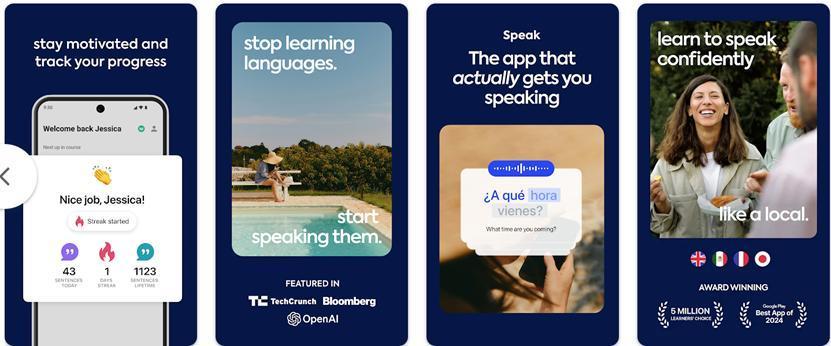
Among them, Speak is particularly noteworthy, as it is a product that competes almost comprehensively with Duolingo in terms of functionality. With the help of AI, it gained significant attention in 2023 and even surpassed Duolingo in store rankings in multiple countries.
Speak's biggest highlight is Duolingo's weak point of 1-on-1 oral practice. Backed by OpenAI, Speak relies on its more realistic AI dialogue experience to directly impact Duolingo's oral practice and Roleplay functions.
Among language learners, although Duolingo has excellent user experience, as mentioned in the previous section on whether Duolingo is a qualified language learning product—it has shortcomings in deep language courses and insufficient oral practice content.
Competitors have gone deeper in technology than Duolingo and have begun to use better AI technology to solve user needs for content generation and immersive oral practice, which is the most urgent issue Duolingo currently needs to face.
At the end of the article, Callback the original intention of this article, is Duolingo's 200 times PE a bubble or a rational market choice? Combining the analysis of business model and market space in this article, we may conclude that the market is not irrational, but pays a high premium for its extremely high user stickiness, mature and high-profit business model, and huge growth potential in the broad education market. Behind this 'miracle' is the perfect combination of product, business, and market logic.
This article is based on public information and is for information exchange only and does not constitute any investment advice.

The copyright of this article belongs to the original author/organization.
The views expressed herein are solely those of the author and do not reflect the stance of the platform. The content is intended for investment reference purposes only and shall not be considered as investment advice. Please contact us if you have any questions or suggestions regarding the content services provided by the platform.