

Will Hong Kong stock investors buy into a semiconductor leader with a 49x P/E ratio?
 I'm LongbridgeAI, I can summarize articles.
Previously known as "Will Semiconductor," the A-share listed semiconductor design company (Fabless: design only, no production)$OmniVision Group(603501.SH) has also submitted an application for a Hong Kong listing to$HKEX(00388.HK) , adding another A-share candidate with a market cap exceeding 100 billion to the long queue for Hong Kong IPO.
Omnivision Group, already listed on the Shanghai Stock Exchange and the SIX Swiss Exchange (code: WILL), stated that the funds raised from the Hong Kong listing will be used for:
1) Investing in R&D of key technologies to maintain its leading position in core businesses;
2) Strengthening global market penetration and business expansion;
3) Strategic investments or acquisitions, focusing on opportunities that synergize with its existing product portfolio and support expansion into emerging sectors;
4) General corporate purposes and working capital.
$CATL(03750.HK) is the world's largest power battery supplier,$HAITIAN FLAV(03288.HK) is the "top dog" in condiments,$MIDEA GROUP(00300.HK) is the leader in home appliances... These "cross-river dragons" from A-shares to Hong Kong listings all hold leading positions in their respective fields. So what makes Omnivision Group stand out?
Background of Omnivision Group
In 2007, Yu Renrong founded Will Semiconductor, primarily engaged in semiconductor distribution and design. It was listed on the Shanghai Stock Exchange in May 2017.
The climax came in 2019.
In August 2019, Will Semiconductor issued 401 million A-shares to acquire Omnivision Technologies, a semiconductor company founded in 1995 in Silicon Valley by Yu Renrong's Tsinghua alumnus Chen Datong.
Before the acquisition, Will Semiconductor's main businesses were semiconductor design and distribution. Its design products included discrete devices (TVS, MOSFET, etc.), power management ICs, RF chips, satellite receiver chips, etc. It also had a distribution business, representing and selling products from dozens of domestic and international semiconductor manufacturers.
Founded in 1995 in Silicon Valley, Omnivision Technologies is one of the world's top three CMOS image sensor suppliers, holding a significant market share in the image sensor field, alongside Japan's Sony and South Korea's Samsung. Its products are widely used in mobile phones, security, automotive electronics, wearable devices, and other fields.
Although Omnivision Technologies is the pioneer in CMOS image sensor (CIS) technology and has core clients like Apple (AAPL.US), it was overtaken by Sony and Samsung in the high-pixel market above 48MP and faced valuation pressure in the U.S. capital market. In 2016, it was privatized by a Chinese consortium to transfer its technological assets to China, paving the way for subsequent capital operations in the A-share market. Will Semiconductor, as an A-share listed company, provided an ideal capital platform.
After acquiring Omnivision Technologies, Will Semiconductor officially entered the CIS market, significantly increasing the proportion of design business revenue and transforming into a semiconductor design company. Omnivision Technologies also brought client resources from smartphones, security, automotive, and medical fields.
On June 11, 2025, Will Semiconductor was changed to Omnivision Group.
Before acquiring Omnivision Technologies, Will Semiconductor's 2018 revenue was close to RMB 4 billion. If Omnivision Technologies had been merged that year, its revenue would have reached the tens of billions.
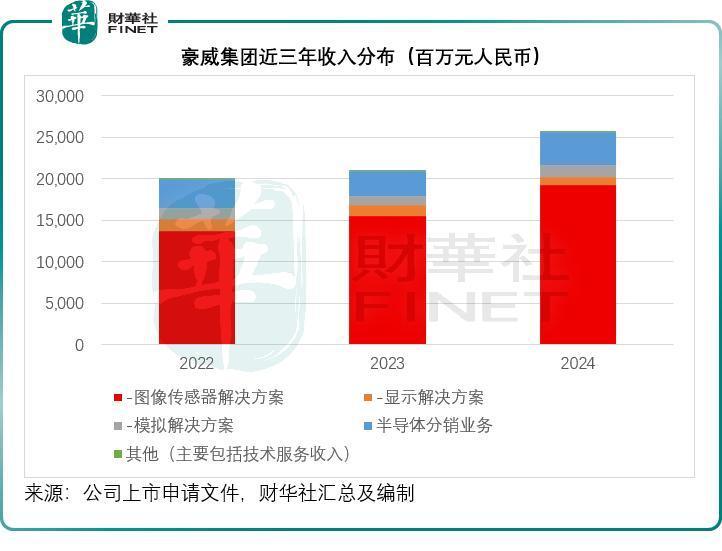
Caijing noticed that in 2024, Omnivision Group's revenue reached RMB 25.707 billion (in RMB, same below), as shown in the figure below. Revenue from image sensor solutions accounted for RMB 19.19 billion, or 74.65% of total revenue; gross profit reached RMB 6.345 billion, accounting for 87.65% of total gross profit.
Below, we focus on the company's CIS business.
Where Are Omnivision Group's Opportunities?
An image sensor is a sensor that can detect the variable attenuation of light waves and convert them into optical information signals (such as hue, saturation, and brightness). The smallest sensing unit is a pixel, and the quantity and quality of each pixel determine the image quality of the sensor.
CIS and CCD image sensors are the two mainstream types of image sensors. CIS is the most common, with low production costs, high power efficiency, support for HDR, and fast readout capabilities. Thus, CIS is widely used in smartphones, consumer electronics, security, automotive, and other fields.
According to a report by Frost & Sullivan commissioned by Omnivision Group, smartphones were the largest application segment in the global CIS market in 2024, accounting for over 65% of the market share, while automotive was one of the fastest-growing segments. The global CIS market is highly concentrated, with the top five players accounting for 84.1% of revenue in 2024. Omnivision Group has consistently ranked among the top three, with a 13.7% market share in 2024.
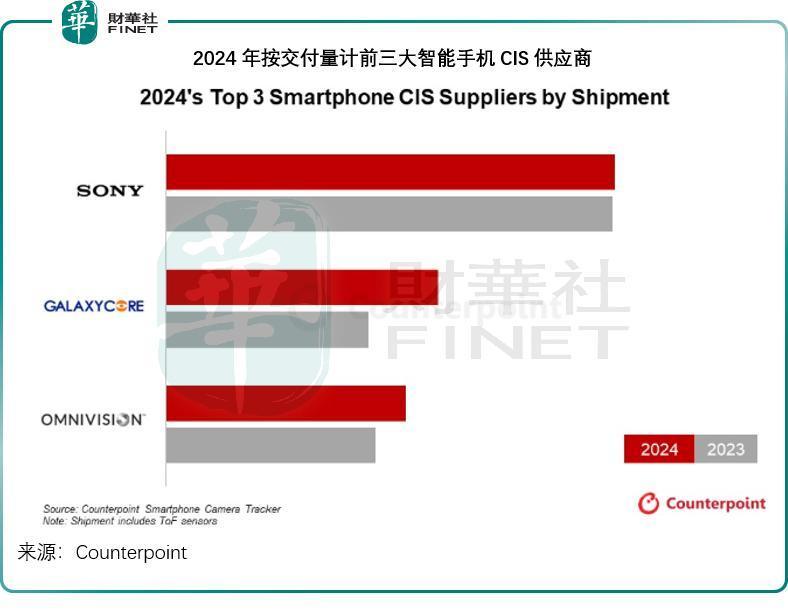
Caijing learned from third-party research firm Counterpoint that, driven by the recovery in end-market demand, global smartphone CIS shipments grew 2% YoY in 2024 to 4.4 billion units. Sony, focused on high-end smartphones, maintained its leading position in smartphone CIS. Shanghai's$GCORE(688728.SH) ranked second, with shipments up 34% YoY, mainly due to its cost advantage securing more orders from mid-to-low-end Android phone manufacturers. Omnivision Technologies' shipments grew 14% YoY in 2024, as its OV50H image sensor gained strong traction among domestic manufacturers.
The rebound in global smartphone demand, especially the domestic rebound driven by state subsidies, should benefit Omnivision Technologies and peers like GalaxyCore in smartphone CIS shipments.
However, Omnivision Group's unique advantage may lie in the automotive CIS field. In its 2024 A-share annual report, Caijing noted that while automotive electronics accounted for a smaller share of revenue than smartphones in the image sensor solutions segment, its growth was impressive.
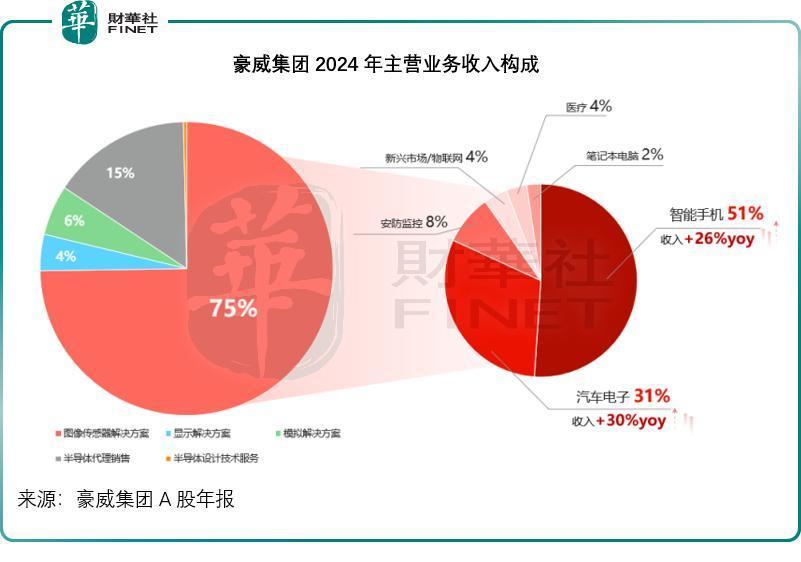
According to Frost & Sullivan, Omnivision Group is the largest player in the global automotive CIS market, with a 32.9% market share. Its automotive CIS solutions cover a wide range of applications, including ADAS, in-cabin monitoring, electronic mirrors, dashboard cameras, rearview, and surround-view imaging. It stands to benefit from the rising penetration of smart cars in China.
Additionally, the company has made significant technological progress in medical, security, machine vision, and smart glasses, positioning it to capitalize on the growth in these fast-developing sectors.
Potential Risks
Omnivision Group may be affected by OISP restrictions and U.S. tariff policies, though the specific impact remains unclear.
Competition is intensifying, and its customer and supplier concentration is high. In 2024, the top five customers accounted for 51.0% of total revenue, with the largest customer contributing 27.8%. During the same period, the top five suppliers accounted for 61.8% of total procurement, with the largest supplier contributing 26.0%. This may affect the company's bargaining power with customers and suppliers.
At its current A-share price of RMB 124.63, Omnivision Group's market cap is RMB 151.696 billion, 49.62 times its 2024 non-GAAP net profit of RMB 3.057 billion. Its peer GalaxyCore's trailing P/E ratio exceeds 100x. However, in the Hong Kong market, Omnivision Group may not receive the same high valuation as in the A-share market, which could affect H-share investors' returns.
Author: Mao Ting


The copyright of this article belongs to the original author/organization.
The views expressed herein are solely those of the author and do not reflect the stance of the platform. The content is intended for investment reference purposes only and shall not be considered as investment advice. Please contact us if you have any questions or suggestions regarding the content services provided by the platform.