

Busy-style snack retail: Industry disruptor or a game of passing the parcel?

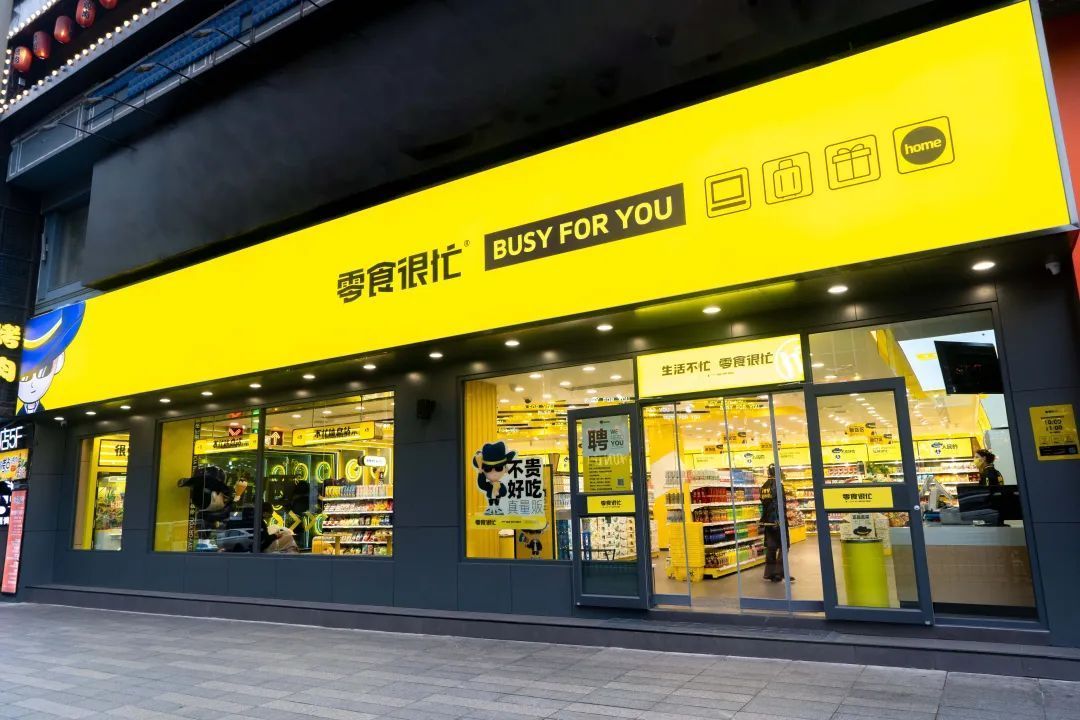
From 2021 to 2024, Mingming was very busy and quickly completed five rounds of financing. During this period, in 2023, the two major brands "Snacks are Busy" and "Zhao Yiming Snacks" also completed a merger to form Mingming is Busy. Just a year later, in April 2025, Mingming is Busy disclosed its prospectus on the Hong Kong Stock Exchange, planning to go public this year, a development that can be described as rapid.
This rapidly growing snack wholesale leader seems to follow the creed of speed in all aspects. In the past three years, its revenue was 3.9 billion, 10.3 billion, and 39.3 billion, growing nearly tenfold. Even considering the scale jump brought by the 2024 merger, the same-caliber revenue growth rate in 2024 was about 100% year-on-year.
On the other hand, the long-term gross profit margin of only 7.5% seems to carry low prices to the end. As a chain retailer, low prices are the hardest truth, but an overly low gross profit margin means it cannot withstand any major shocks, and the sustainability of the business model is in doubt.
Therefore, is this a new business model's overwhelming disruption of tradition, or a game of passing the parcel after rapid capital maturation, has sparked increasingly fierce debate.
01 A Frenzy That Disrupts Cognition and Doesn't Slow Down
From the operating indicators and financial data disclosed in the prospectus, Mingming's past performance can definitely be described as excellent.
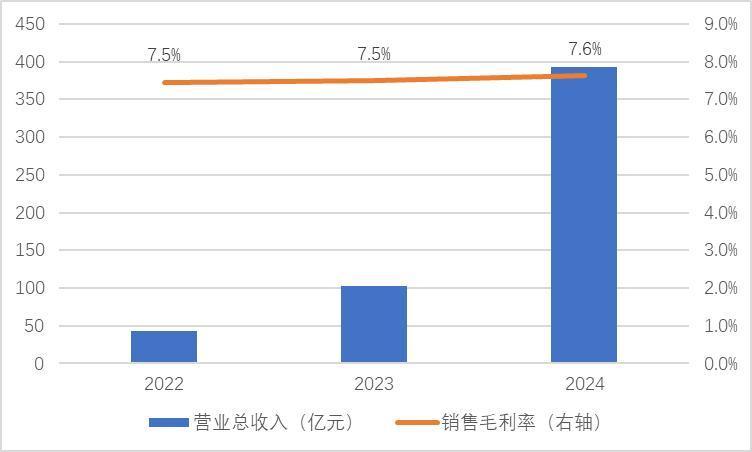
Figure: The stark contrast between Mingming's high revenue growth and low gross profit margin. Source: Company prospectus
1. Rapidly Expanding Business Model
As of 2024, the company had 14,000 stores, while the accumulated number of stores operated by Bestore and Laiyifen over the years was only about 6,500. It has covered 28 provinces and all tier-level cities in China, with 58% of the stores located in counties and towns, achieving a 66% coverage rate in Chinese counties:
● The SKU is twice that of supermarkets of the same scale, with over 3,300 SKUs in stock, and more than 1,800 SKUs per store.
● From 2022 to 2024, the company's franchisees expanded rapidly, with individual franchisee revenue of 4.27/3.02/5.37 million yuan, and the average daily order volume increased from about 380 to 450 orders, without sacrificing single-store revenue to expand stores.
● From the perspective of volume and price split, the average price per order per store is about 30 yuan, with over 1.6 billion transactions annually, and a GMV of 55.5 billion yuan, ranking fourth among Chinese chain retailers.
2. Financial Indicators Also Follow the Creed of Speed
The company's operations are very asset-light due to the pure franchise model:
● Inventory turnover days decreased from 15.7 days in 2023 to 11.4 days in 2024. Bestore, which also sells snacks, takes about 50 days to turn over inventory once; this rapid turnover level is comparable only to Japan's 7-Eleven.
● In 2024, the total asset turnover rate reached an astonishing 4.7, raising ROE to a relatively high level of 16% with only a 2% net profit margin.
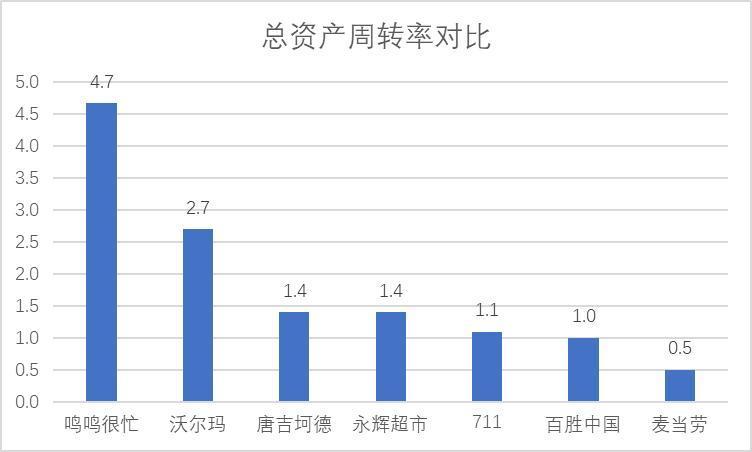
Source: Company prospectus
But the seemingly rapid growth also hides concerns in the operating and financial data:
● With 14,000 stores, the total number of snack wholesale stores in China is about 40,000, and Mingming already has nearly 40% market share. The second-largest player, Wancheng, also has 12,000 stores, leaving limited space for future store openings and integration. How much growth space is left for secondary investors?
● A gross profit margin of about 7.5% is the sharpest sword, but once turnover declines, it will quickly collapse the entire system from within; for example, a fierce battle between the first and second players?
● In 2024, accounts receivable reached nearly 2.5 billion yuan, resulting in negative operating cash flow, which is uncommon for a business with good cash collection. Is there a risk of pressuring franchisees to stock up for listing purposes?
● The pure franchise model requires an investment of nearly 800,000 yuan to open a new store. The reduced subsidy and scarcity of good locations have extended the payback period for franchisees from 1.5 years to 2.5 years.
02 New Consumption Gives Snack Wholesale a Chance to Turn Decay into Magic
In terms of static financial data and business model, snack wholesale represented by Mingming is indeed very successful. Wancheng Group's market value once exceeded 33 billion yuan (currently around 30 billion yuan), surpassing Salted Fish, Three Squirrels, Qiaqia Food, and Juewei Food, becoming the leader in the A-share leisure food sector.
The two brothers together dropped a heavy bomb on the long-dormant snack industry, opening the door to new consumption.
1. Snacks are inherently a poor industry
Food and beverages are the largest consumer sub-industry, with a domestic scale of 8 trillion yuan. However, before this year, leisure snacks were always at the bottom of the market's disdain chain. If we consider the scene, leisure snacks in the sinking market are the lowest of the low.
According to Euromonitor, the Chinese leisure snack market is about 250 billion yuan (if leisure snack beverages are considered, the market size is 370 billion yuan), accounting for only 3% of the food and beverage industry, and has not grown for four consecutive years.
The business model is also mediocre. Unlike the addictive nature of alcohol, enviable prepayments, and appreciating inventory, or beverages with the dream of billion-dollar single products, or the excellent competitive landscape of dairy products, snacks have very low industry concentration due to the diverse tastes and preferences of consumers and their natural love for novelty (such as the rapid growth of konjac products this year), leading to the collapse of the barrier stories told by all food companies.
Reviewing the history of Chinese leisure food, under the background of "difficult to satisfy all tastes," the industry gradually became a vassal of channels, with new categories often as fleeting as a flash in the pan. The roller coaster stock prices of snack brands like Bestore and Zhou Hei Ya in the past are well-known to everyone.
2. New consumption unexpectedly gave snack wholesale a chance
"New consumption" brought more severe challenges to the snack industry: 1) Gradually returning to the essence of commodities, buying higher-quality goods with less money became the consumption orientation, pursuing the ultimate cost-effectiveness; 2) The main body of the change in consumption marginal discourse power is Generation Z and the vast population outside the first and second tiers, refusing to pay IQ tax for high and mighty channels and brands.
Obviously, the traditional supermarket model can only fall into losses because the model is still brand-occupying shelves, and retailers make money by renting shelves and charging display fees and barcode fees, with a strong paternalistic flavor. Supermarkets were first fully impacted by e-commerce, with snacks becoming one of the most profitable areas for Pinduoduo, and then their equity was repeatedly transferred among various new retail models.
However, e-commerce has never been able to solve the low unit price, small batch, multi-category, and immediacy needs, so leisure food still maintains a high offline consumption ratio. According to statistics, in 2024, less than 15% of consumption scenarios were online, far lower than the overall e-commerce penetration rate of 30%.
Ultimately breaking the deadlock and turning challenges into opportunities is the snack wholesale model, a domestic innovation. Although hard discount stores exist globally, snack wholesale on such a large scale only appears in China, and it started from the sinking market rather than the high-line market.
Their success lies in thoroughly revolutionizing the channel and their own profit model, minimizing channel markups to solve the cost-effectiveness problem, acting as buyers to address the issue of changing consumer tastes, and finally presenting a concentrated offline store to meet immediate multi-category needs, while keeping their own marketing expenses extremely low, maximizing benefits for consumers.
The first principle of the retail industry is efficiency. Further breakdown shows that retail satisfies the consumer experience from the four dimensions of "more, faster, better, and cheaper." The reason why snack wholesale can achieve such rapid success is indeed because it has achieved the ultimate efficiency under the new consumption requirements.
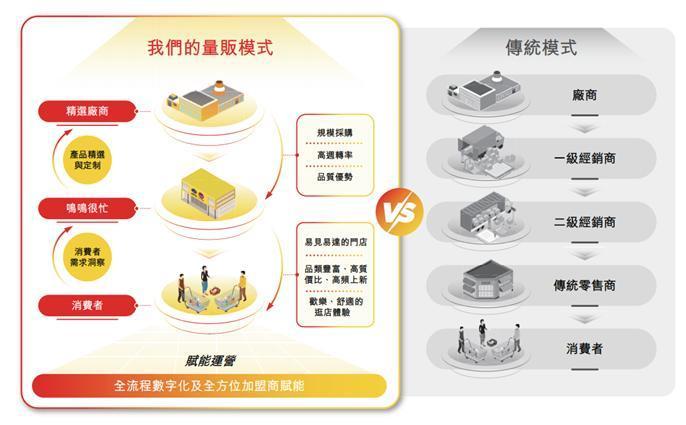
Figure: Snack wholesale is a thorough revolution of the channel. Source: Company prospectus
Ultimately, it comprehensively achieves more, faster, better, and cheaper, allowing Generation Z consumers to spend less than 40 yuan to buy a basket full of happiness. According to the data disclosed by Mingming is Busy:
● More: As mentioned earlier, the SKU of snack wholesale stores is twice that of supermarkets of the same scale, with nearly 2,000 SKUs per store, and over 100 new products iterated monthly, always fresh.
● Faster: This is easy to understand. With tens of thousands of stores, the coverage radius is about 1.5 km. Those who have experienced the Snow King bombing should be familiar with it.
● Better: The products that attract customers in the store are low-priced well-known brands, and other white-label products are also selected by the company. About 25% are customized products. The company has nearly 200 people in the selection team, and franchisees can also submit selection requests, better starting from the consumer's perspective, and regularly eliminating products with low repurchase rates.
● Cheaper: By reducing at least two layers of suppliers, purchasing from manufacturers and directly delivering to terminal stores, and with the scale effect of tens of thousands of stores, the total markup rate of snack wholesale channels + franchise stores is only 30%, far lower than the traditional channel markup rate of over 60%. Therefore, snack wholesale stores can easily be 25% cheaper than offline supermarkets for the same products, providing them to consumers in bulk, achieving a consumer unit price of 30-40 yuan.
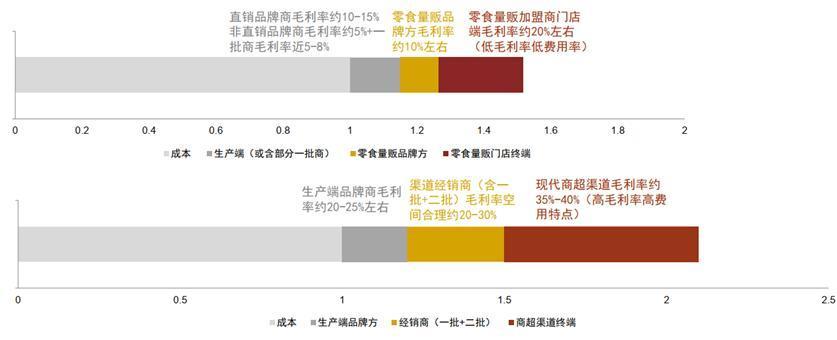
Figure: Analysis of markup rates for snack discount stores and supermarket channels. Source: CICC
The efficiency of fast-moving consumer goods has been greatly improved by relying on information logistics and other technical facilities, and the dominance of the industry chain has gradually shifted from manufacturers to consumer ports. In the least favored leisure snack segment, because the retail segment was the first to move from operating shelves to operating products, wholesale retailers became consumer agents, significantly improving channel efficiency, and consumer utility was maximized.
Snack wholesale not only subverted traditional retail channels in line with new consumption trends, but even extended its reach to change brands, reorganizing the industry chain. According to the latest grassroots research, companies like Salted Fish and Weilong have achieved rapid growth in revenue and profits after embracing snack wholesale.
03 How to View Hidden Concerns? At Least There Is Still a Battle Between the North and South
Although some people have started talking about the overseas expansion of snack wholesale, such as Mingming having opened more than 500 stores in Vietnam, the main battlefield of this model in the medium term must be in China, because the food industry itself is a category that is difficult to do cross-border business, and there are very few globalized food companies.
All the hidden concerns mentioned at the beginning, except for short-term cash flow issues, are based on the speed of new store openings. As long as there is enough space for new store openings or industry integration, the business model is not only established but may also run more smoothly.
But once there is a problem with store expansion, all advantages will instantly turn into disadvantages, because a gross profit margin of less than 8% and a net profit margin of 2%, as well as a gross profit margin of less than 20% for franchise stores, both rely heavily on high turnover. This means the company's strategic tolerance rate is approximately 0.
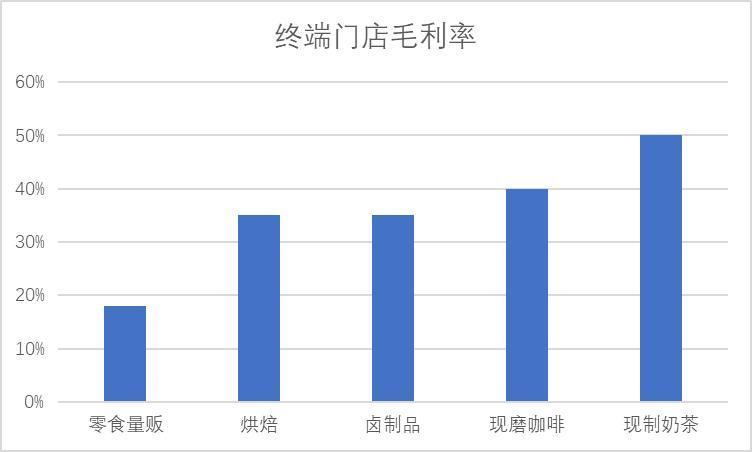
Figure: Gross profit margins of different leisure food and beverage chain franchise stores. Source: Jinduan Research Institute
1. Estimating the Upper Limit of Domestic Store Openings, Not Far from the Limit
From 2021 to 2024, Mingming is Busy is just a microcosm of the rapid development of the snack wholesale industry. In 2021, there were less than 4,000 stores nationwide, and by the end of 2024, there were more than 40,000 stores nationwide, with the number of stores increasing tenfold in four years.
The core question is, how many more stores can be opened in the future?
It can be benchmarked against new consumption models such as freshly made tea and freshly ground coffee. Optimistically, the total number of stores in China is unlikely to exceed 100,000.
The domestic market size of freshly made tea is about 300 billion yuan, with a total of about 400,000 stores, which can calculate a single-store revenue of 800,000 yuan, a reasonable number; the domestic market size of freshly ground coffee is about 1800 billion yuan, with a total of about 190,000 stores, which can calculate a single-store revenue of 1 million yuan, which can also match experience data.
Therefore, the upper limit of the number of snack wholesale stores = the market size of leisure snacks / single-store revenue. Since Mingming is Busy's single-store revenue is about 4 million yuan, assuming that other competitors in the industry are relatively weaker, and store density naturally leads to a decrease in same-store revenue, assuming a single-store standard income model of 3 million yuan, the upper limit of the domestic market size of leisure snacks mentioned earlier is 250 billion yuan, and the single-store revenue is 3 million yuan, then the upper limit of the number of stores in China is 80,000 to 90,000, which means that most leisure snacks must go through this channel.
Another estimation method is to use the Hunan market as a sample. Hunan has about 5,000 stores, and the national population is 21 times that of Hunan, but the snack buying habit is slightly weaker, so the upper limit of snack wholesale stores is unlikely to exceed 100,000, which is basically the same as the number estimated above.
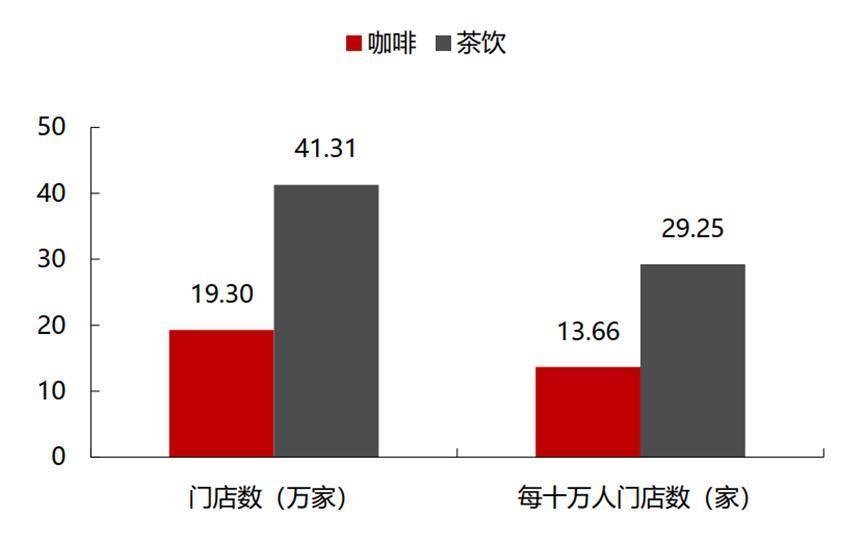
Source: Narrow Door Restaurant Eye, Minsheng Securities
2. Although It Is a New Model, There Is Little Difference Between Snack Wholesale Stores
From the establishment of the first snack wholesale store, Wife's Husband, in 2014, the industry has only developed for ten years. However, there are already more than a dozen brands with chain effects, and under the integration of Wancheng and Mingming is Busy, a two-strong pattern has formed.
Both are rapidly expanding. Unlike Mingming, Wancheng is integrating under its own capital. From the early days of the industry's rise in 2022, Wancheng integrated Wife's Husband, Good Want, Laiyoupin, Lu Xiaochan, and Yadi Yadi, reaching 12,000 stores by the end of 2024, mainly distributed in the eastern and northern regions.
Past competition was temporarily not fierce because, on the one hand, the industry space was extremely large, and on the other hand, they were developing in their respective regions.
With Mingming completing the merger with Zhao Yiming and Snacks are Busy. Mingming and Wancheng's market share reached nearly 70%.
From the initial numerous brands to the rapid convergence to two strong players, the industry's simple history shows that although this industry is relatively overwhelming compared to traditional retail, there is basically no significant difference between brands within the industry. Before the merger, both Zhao Yiming and Snacks are Busy had monthly sales of about 400,000 yuan per store, with little difference, and this year Wancheng's net profit is expected to be 1 billion yuan, with little difference in profitability compared to Mingming.
In terms of products, consumers have no brand loyalty to various "Ming" brands, and they go wherever is more cost-effective. This leads to rapid industry expansion, point grabbing, homogeneous competition, and mergers and acquisitions, reminiscent of the hundred-group war in the early days of the Internet and the current tea battle, falling into the fate of homogeneous competition, all wanting to be the one who can laugh last and be the largest in scale.
3. Homogeneous Competition, There Must Be a Battle Between the North and South When the Ceiling Arrives
Industry insiders revealed that Mingming plans to open nearly 5,000 new stores in 2025, and Wancheng Group plans to open 4,000 stores. If this speed is reversed, there will be 50,000 snack wholesale stores nationwide in 2025, with the main expansion being the two leading companies, Mingming is Busy and Wancheng, because their businesses are already quite profitable. Mingming also wants to raise funds through an IPO on the Hong Kong Stock Exchange, and Wancheng itself is an A-share listed company, both of which can be regarded as players with unlimited bullets.
As the domestic store opening ceiling of 100,000 stores approaches, it is no longer about developing in their respective territories, but about fighting on the same street. This means that there must be a battle between the two leading brands. Currently, the overlapping area is only about 20%, but the intensity of future competition can be predicted by referring to the close battle between Kudi and Luckin.
This brings us back to the beginning. Currently, the business model is established, and everyone is seeking profits from the channel to feed back new consumers, leaving only thin profits for operators, and making up for it through high turnover; the current industry same-store revenue has already shown single-digit declines in the first half of this year, and the industry's store opening ceiling may be lower than the estimate in the previous section.
If the industry quickly falls into a stock mode, a price war between snack wholesale brands may be disastrous. A price reduction of about 5% is enough to plunge the entire industry into losses.
In addition, to further expand stores, brands will inevitably need to involve more incremental channels in first- and second-tier cities, but these markets have very strong competitors. For example, Sam's Club, which has developed rapidly in recent years and is asset-heavy, has more than a dozen expansion plans this year, and brand manufacturers have not been sitting idly by. For example, Three Squirrels acquired Love Snacks and is also accelerating to seize this track.
As new consumers, we are very welcome to the new model of snack wholesale, but whether the industry can develop rapidly and with high quality as described in the prospectus, we believe it should take longer to verify. In the upcoming fierce competition, players will no longer be able to focus all their energy on opening stores and grabbing positions, but on establishing brands, managing their own products well, and ultimately establishing differentiated advantages. The lessons left behind by rapid development will eventually be made up.
This article is based on public information and is for information exchange purposes only and does not constitute any investment advice.
$inm(605179.SH) $Bestore(603719.SH)
The copyright of this article belongs to the original author/organization.
The views expressed herein are solely those of the author and do not reflect the stance of the platform. The content is intended for investment reference purposes only and shall not be considered as investment advice. Please contact us if you have any questions or suggestions regarding the content services provided by the platform.
