

Global Auto Market | Australia H1 2025: Chinese Brands Accelerate Rise, BYD Enters Top 5

In June 2025, the Australian automotive market achieved year-on-year growth for the second consecutive month, with total sales reaching 127,437 units, a 6.2% increase, setting a seven-year high for the same period.
Chinese car brands showed strong growth, with China-made models accounting for 23% of sales in Australia. BYD ranked fifth in the sales chart, setting a new record for Chinese brands in the local market.
Meanwhile, brands like GWM, Chery, and Geely also made significant breakthroughs in multiple segments, reshaping the Australian automotive market landscape.
01
Australia
Overall Market Performance and Brand Performance
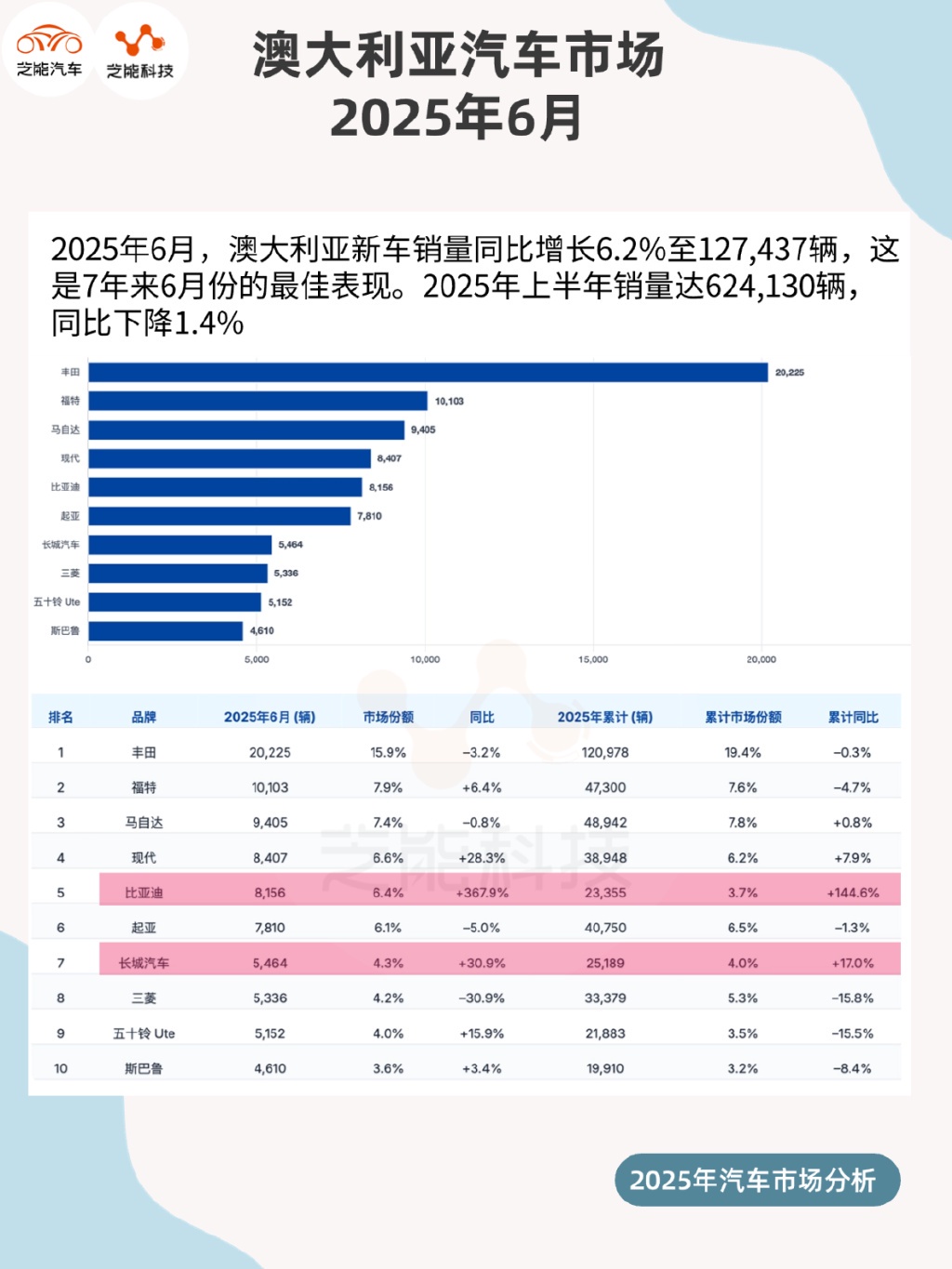
In the first half of 2025, the Australian automotive market recorded cumulative sales volume of 624,000 units, a slight year-on-year decline of 1.4%. However, June sales rebounded to 127,437 units, up 6.2% year-on-year. This marks the first time since 2018 that June sales exceeded 127,000 units.
By vehicle type:
◎ SUVs and light commercial vehicles performed strongly, with year-on-year growth of 15.1% and 11.3%, respectively, accounting for over 83% of the market.
◎ Traditional sedan sales fell by 21.9%, with market share dropping to 12.9%.
By powertrain type:
◎ Pure electric vehicle sales in June reached 13,169 units, up 37.6% year-on-year, with market share rising to 10.3%;
◎ Plug-in hybrid vehicles surged 219.1% due to a popular model, capturing 4.9% market share.
◎ Gasoline vehicles, the largest powertrain type, saw a 3% decline, with sales of 48,867 units;
◎ Diesel vehicles grew slightly by 5.5%, reaching 38,939 units;
◎ Hybrid vehicles remained almost unchanged, with only a 0.1% increase.
By import source country:
◎ Japan remained the largest source, but sales fell 10.3% to 31,055 units;
◎ China surged to second place with 29,933 units, up 60.5%, surpassing Thailand for the first time. Thailand grew 5% to 27,802 units. South Korea and Germany saw market share declines.
By brand performance:
◎ Toyota remained first but saw market share drop to 15.9%, a significant decline from earlier in the year.
◎ Ford ranked second, growing 6.4% to 10,103 units.
◎ Mazda remained stable in third place.
◎ Hyundai jumped to fourth with 28.3% growth, surpassing its sister brand Kia for the first time.
◎ BYD ranked fifth with 8,156 units, up 367.9%, setting a new record for Chinese brands in Australia.
◎ Tesla sales dipped slightly to 4,589 units, ranking 11th.
By model ranking:
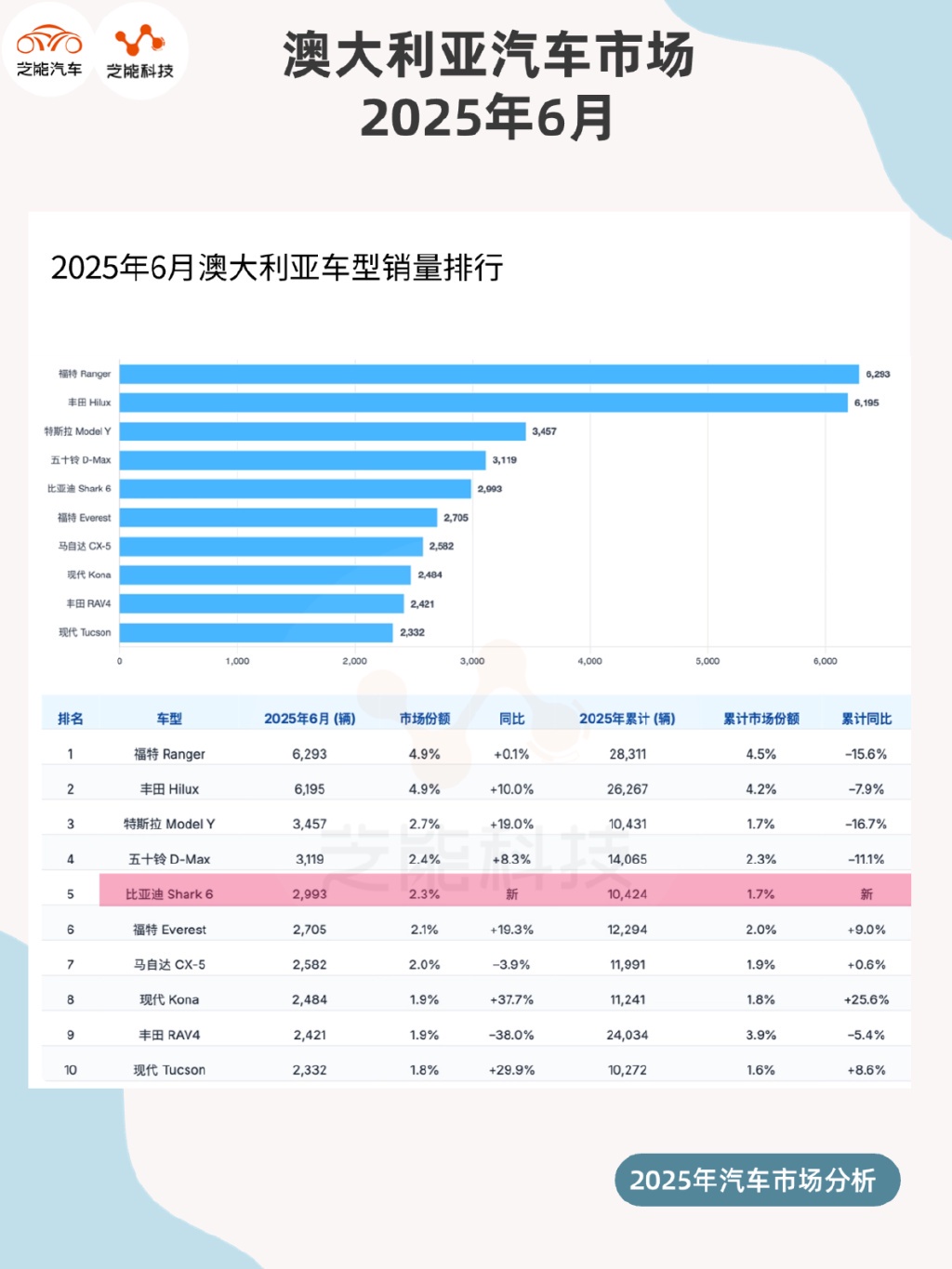
◎ Pickups remained dominant, with Ford Ranger and Toyota Hilux leading at 6,293 and 6,195 units, respectively.
◎ Tesla Model Y ranked third as the top-selling SUV in June, with 3,457 units.
◎ BYD's Shark 6 entered the top five for the first time, ranking fifth with 2,993 units, becoming the dark horse among Chinese brands.
02
Chinese Brands Continue to Rise,
Diverse Model Performance
In June 2025, Chinese car brands performed strongly in Australia, with overall sales up 60.5% year-on-year and achieving historic breakthroughs in brand and model rankings. BYD's June sales reached 8,156 units, ranking fifth, its best performance in Australia.
By model distribution:
◎ Shark 6 sales hit 2,993 units, entering the top five for the first time;
◎ Sealion 7 and Sealion 6 also entered the top 20 with 1,795 and 1,604 units, respectively, showing diversified SUV success.
This comprehensive product lineup reflects BYD's rapid adaptation to Australian consumer preferences and its integration of electrification and smart technology.
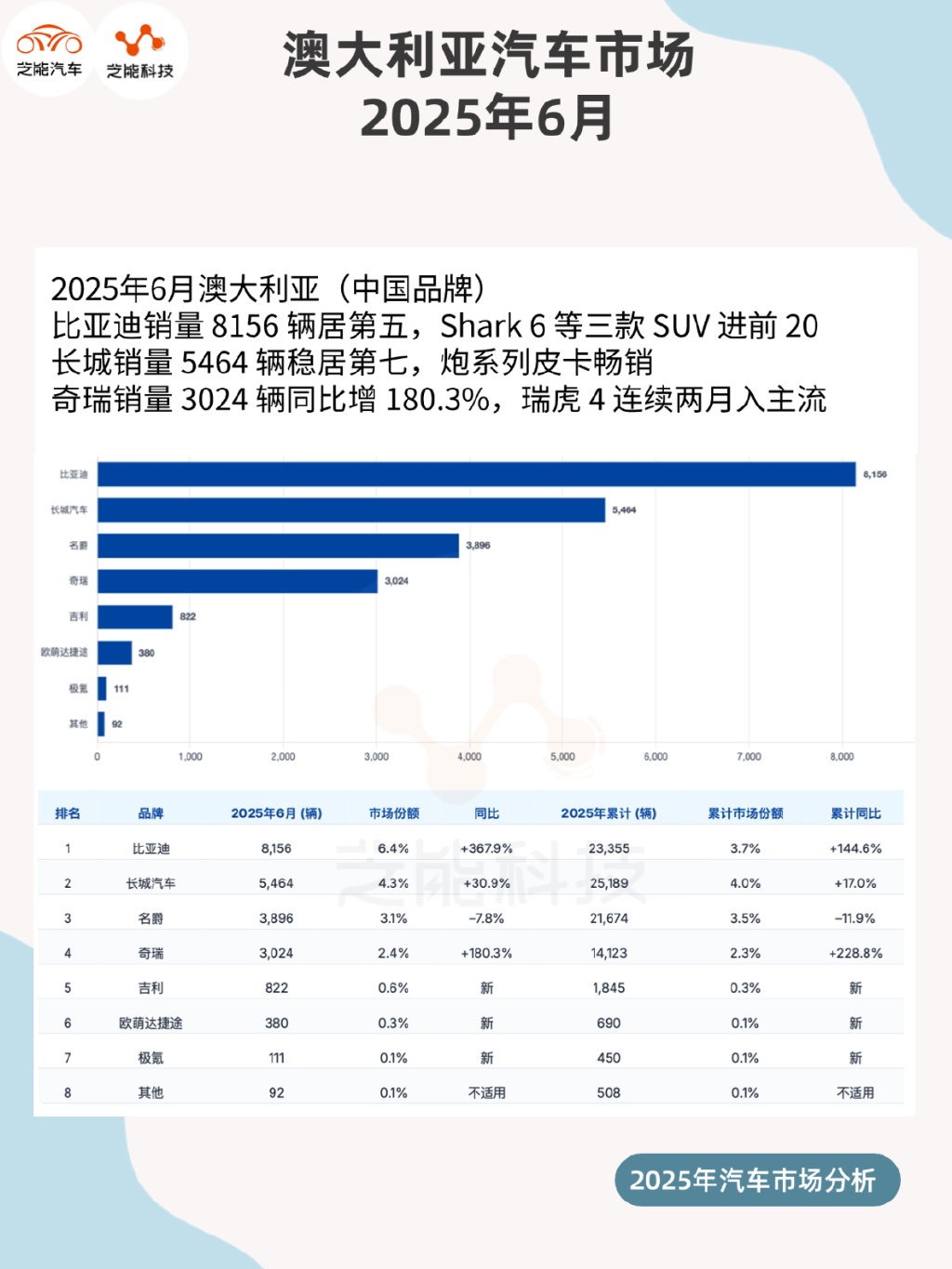
◎ GWM sales grew 30.9% to 5,464 units, ranking seventh. Models like Haval Jolion and H6/GT entered the top 30, covering mainstream small and compact SUV segments. GWM's Cannon pickup also debuted with 980 units, showing potential in multi-purpose vehicles.
◎ Chery set a new record with 3,024 units, up 180.3%, ranking 14th. The Tiggo 4 ranked 18th with 1,768 units, demonstrating strength in the small SUV segment.
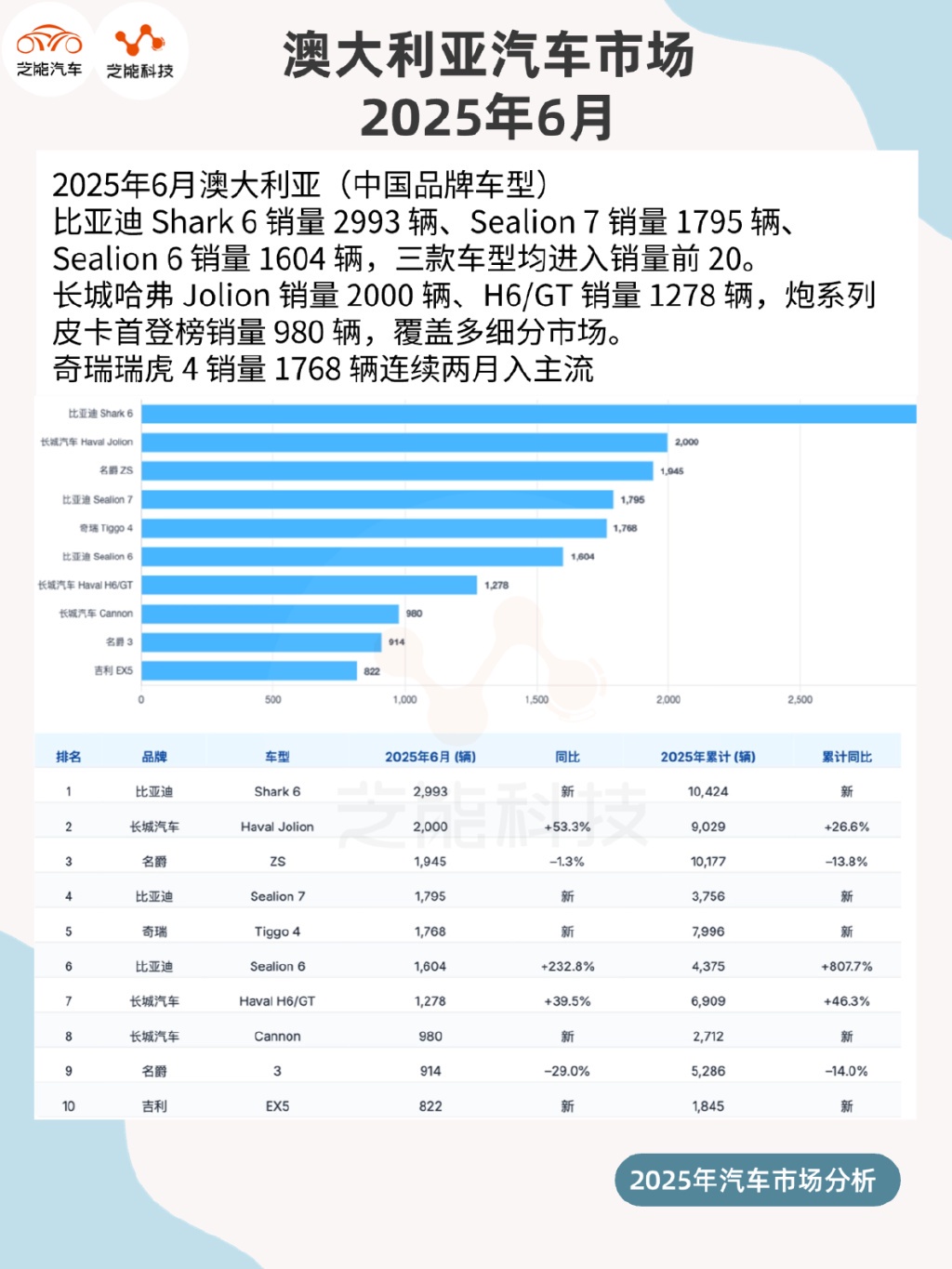
◎ Geely ranked 24th with 822 units. The EX5 model entered the top 50, showing early success in market penetration.
◎ Other Chinese brands like Omoda, JAC, Zeekr, Leapmotor, and Deepal also showed varied performance, with monthly sales in the hundreds. Their product portfolios span traditional ICE, BEV, and EREV, reflecting growing diversity.
Australian consumers are increasingly accepting Chinese brands, attracted by price advantages. In smart cabins, range, and comfort features, Chinese brands now rival joint ventures.
BYD's Sealion 6 and 7 are competitive in the mid-to-high-end electric SUV market with rich configurations, smart features, and pricing.
Summary
June 2025 in Australia showed two trends: traditional market share shifting to emerging brands, and accelerated electrification. Chinese brands are expanding their presence through product diversity, localization, cost advantages, and technology integration.
The copyright of this article belongs to the original author/organization.
The views expressed herein are solely those of the author and do not reflect the stance of the platform. The content is intended for investment reference purposes only and shall not be considered as investment advice. Please contact us if you have any questions or suggestions regarding the content services provided by the platform.
