

 Rate Of Return
The battle in instant retail reignites, third-party delivery services thrive.

When it comes to the hottest sector right now, instant retail undoubtedly takes the crown. Major players are making frequent moves: JD.com privatized Dada and ventured into the food delivery industry, while Meituan and Alibaba consolidated their instant retail businesses, establishing dedicated flash sales divisions and elevating flash sales to a top-tier entry point. Following the first round of "10 billion subsidies" in April, Taobao Flash Sales announced a 50 billion yuan subsidy plan on July 2. On July 5, Meituan pushed out a large batch of coupons to users and revealed that instant retail orders for the day had exceeded 120 million by 22:54.
Compared to the group-buying and food delivery wars of previous years, the current scale and intensity are even greater. There's no doubt that the recent actions of these giants have accelerated the adoption of instant retail, benefiting consumers. However, for these companies' investors, times might be tough—it's an insanely cutthroat competition.
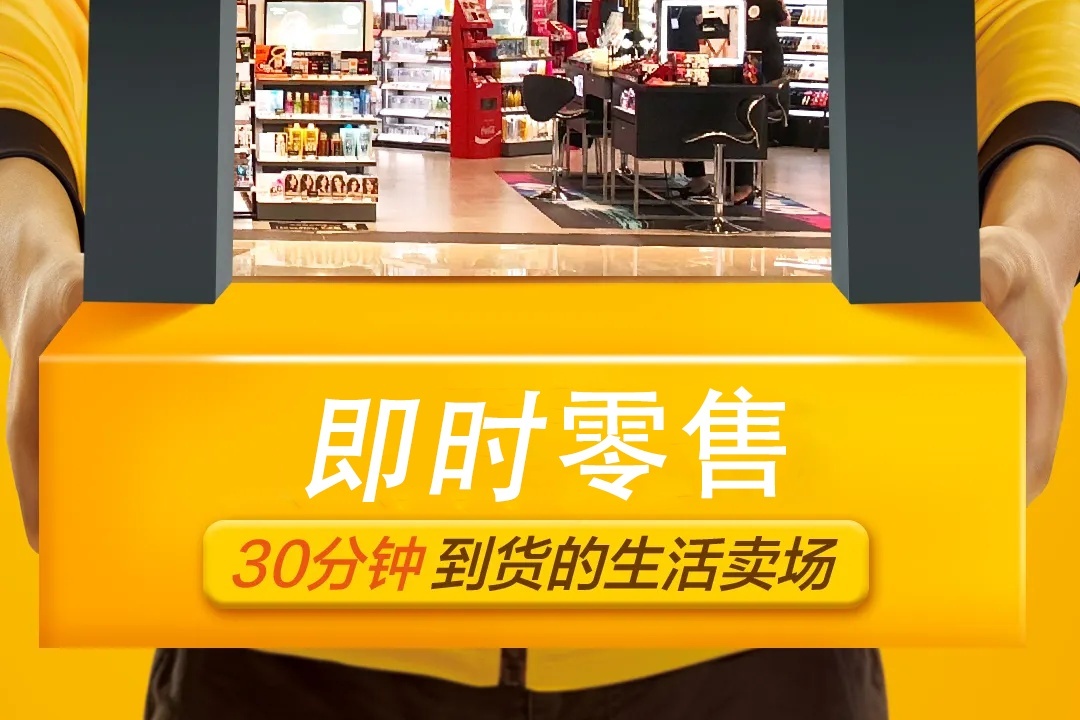
With the explosive growth of instant retail, the related instant delivery sector is thriving, experiencing significant business volume growth. The strategic value and potential of instant delivery are becoming increasingly apparent.
According to the "China Logistics and Supply Chain Development Report (2024-2025)" released by the China Federation of Logistics & Purchasing, China's express delivery volume reached 175.08 billion parcels in 2024, a 21.5% year-on-year surge, with daily processing exceeding 480 million parcels. Among these, instant logistics orders exceeded 48 billion, up nearly 15% year-on-year.
With the onset of the instant retail war this year, estimates based on disclosed data suggest peak daily orders have surpassed 200 million. If this trend continues, instant retail orders could soon match or even exceed e-commerce delivery volumes in the long run.
The logistics industry has never been considered a glamorous business model. Even as a tough business, during the e-commerce era, third-party logistics companies like SF Express and ZTO managed to turn profits and achieve market caps in the hundreds of billions through cross-platform fulfillment, resource allocation, and economies of scale.
In the instant retail era, instant delivery is growing even faster than e-commerce did a decade ago. However, the landscape differs from the e-commerce era, where JD Logistics was the only major platform to build its own logistics network, while third-party logistics dominated. In instant delivery, platforms like Meituan, Ele.me, and JD.com, which control significant demand, have opted to build their own closed-loop delivery systems. The only third-party players with full-platform fulfillment capabilities are SF City Express and Dada, though Dada has been privatized by JD.com, while FlashEx and UU Paotui primarily handle C2C deliveries.
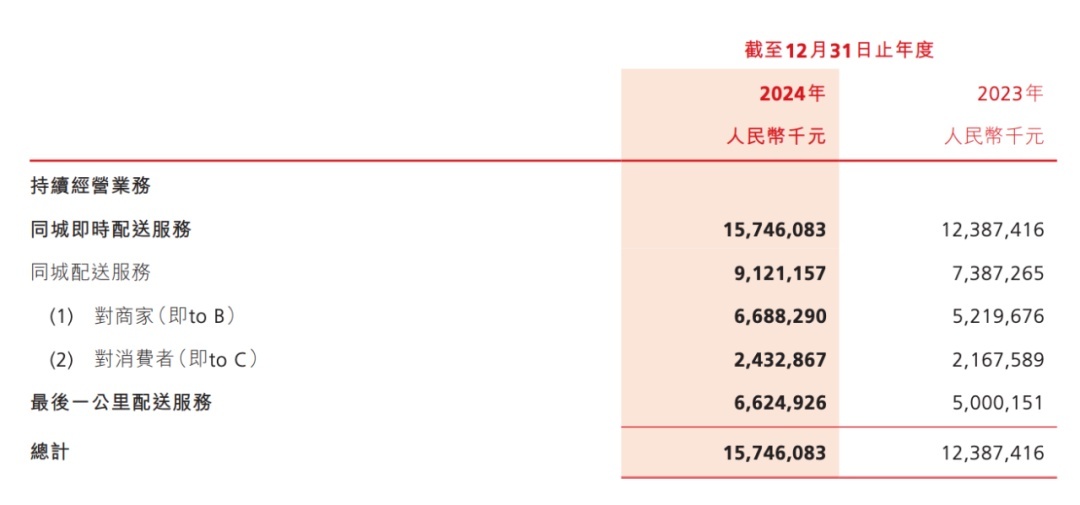
Figure: Revenue breakdown of SF City Express's three business segments.
In the short term, this dynamic may squeeze third-party instant delivery players, but in the long run, I believe platform and third-party delivery will coexist more cooperatively than competitively, with third-party instant delivery retaining significant potential.
First, the pros and cons of platform-owned logistics are clear. The advantage is greater control and better user experience, but the downside is the difficulty of expanding beyond the platform, as external clients may hesitate to entrust orders and data to a competitor's logistics arm.
This is even more pronounced in instant delivery. Brands competing with food delivery platforms won’t bind their logistics to them, leaving high-quality orders in the hands of third parties. For example, SF City Express has consistently led in market share for key account (KA) partnerships. Major clients like McDonald's, KFC, Pizza Hut, Luckin Coffee, Sam's Club, Chagee, Xiaomi, and Huawei not only use SF City Express for private domain deliveries but also for orders placed on food delivery platforms.
Second, platform-owned instant delivery faces tidal effects due to single-platform fulfillment, making it costlier to maintain in-house fleets compared to third parties. Take food delivery industry as an example: demand spikes during meal times strain capacity, while off-peak hours leave resources idle. This resembles the pre-cloud computing era, where companies scaled servers up and down, leading to inefficiencies. This is why Meituan Delivery and Ele.me Delivery, despite their scale, barely break even or even lose money on logistics. In contrast, third-party instant delivery, like cloud computing, can flexibly fulfill orders across platforms and scenarios, maximizing resource utilization and serving as infrastructure for platform ecosystems. Platforms like Douyin E-commerce and WeChat E-commerce, which lack their own fleets, already partner with third-party instant delivery providers to cut costs. Additionally, platform fulfillment closure rates are declining—Meituan's has reportedly dropped from 90% to around 60%, while Ele.me's is below 50%. This means platforms also need third-party instant delivery to supplement their capacity.
Overall, I believe third-party instant delivery will benefit immensely from the rapid growth of the instant retail market. Beyond meeting the infrastructure needs of merchants and platforms in instant retail, SF City Express also boosts order density through C2C and last-mile delivery services, creating temporal and spatial synergies for economies of scale. As a result, SF City Express has become the first in the industry to achieve profitability, posting profits for two consecutive years.
This validates the value of third-party instant delivery—not just as a supporting player in instant retail but as a logistics business model capable of complex scenario deconstruction and resource integration, evolving into a comprehensive solution provider.
SF City Express's 2024 performance shows total revenue of 15.7 billion yuan, with a nearly 30% year-on-year growth rate—a very promising figure. With the instant delivery sector booming, it’s expected to maintain strong growth in the coming years, making it worth watching.
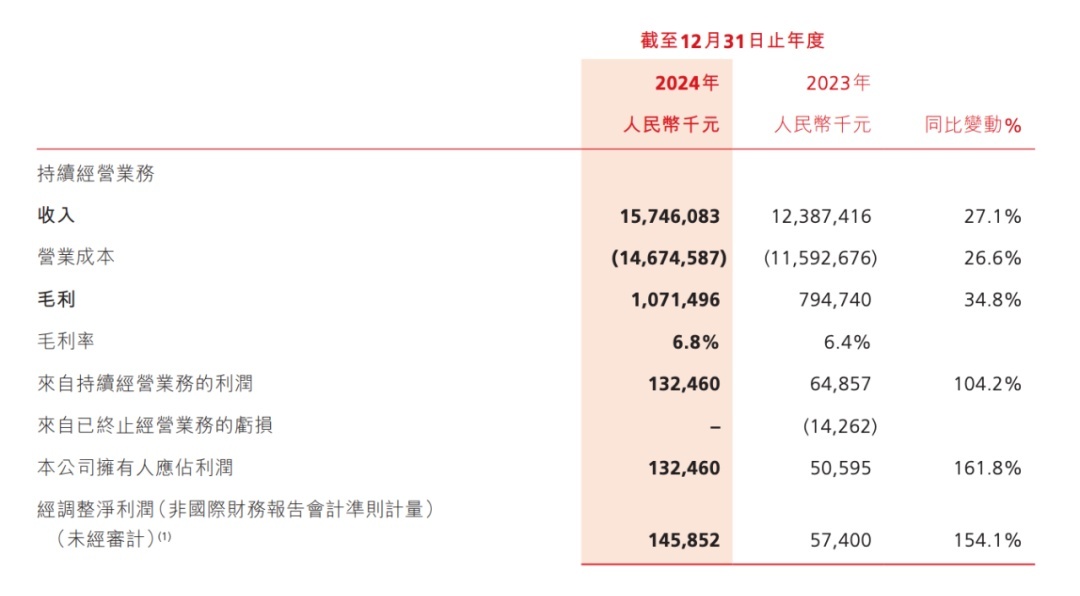
Figure: SF City Express's 2024 revenue, gross profit, and net profit data.$SF INTRA-CITY(09699.HK) $MEITUAN(03690.HK) $BABA-W(09988.HK)
The copyright of this article belongs to the original author/organization.
The views expressed herein are solely those of the author and do not reflect the stance of the platform. The content is intended for investment reference purposes only and shall not be considered as investment advice. Please contact us if you have any questions or suggestions regarding the content services provided by the platform.
