

The food delivery battle among Meituan, Alibaba, and JD.com, Goldman Sachs has simulated three possible outcomes.
 I'm LongbridgeAI, I can summarize articles.
Source: Dong Ge's E-commerce Interpretation
Author: Jin Shan
Starting in July, a new round of food delivery wars has begun.
Meituan and Alibaba were the first to start the battle over the weekend. On July 2, Taobao Flash Sale announced a 50 billion subsidy plan, and three days later released a large number of "15 yuan off 11 yuan" coupons. Meituan also quickly responded by launching a 0 yuan self-pickup for milk tea and snacks.
Milk tea and coffee shop staff complained that they couldn't keep up, with several meters of order slips appearing in the store. Consumers began to frantically take advantage of the deals, even achieving 0 yuan purchases.
After one round, both sides announced their achievements. Late at night on July 5,Meituan Waimai announced that the daily order volume for instant retail exceeded 120 million, with over 100 million dining orders, setting a new industry peak. On July 7, Taobao Flash Sale and Ele.me jointly announced that daily orders exceeded 80 million, with over 13 million non-dining orders, and Taobao Flash Sale's daily active users exceeded 200 million.
JD.com, realizing it was late, decided to continue increasing its investment. On July 8, JD Waimai announced the official launch of the "Double Hundred Plan," investing over 10 billion yuan to support more category benchmark brands to achieve sales of over one million.
Everything is for growth. This food delivery war, initiated by JD.com, seems to have reached an uncontrollable stage. All platforms want to become a super consumer entry point. Goldman Sachs conducted a round of simulations based on this food delivery war, and in all three outcomes, Meituan's position is difficult to shake.

Outcome One: Meituan Successfully Defends
This is Goldman Sachs' baseline forecast and the most probable scenario. Meituan wins this food delivery war.
Based on order volume,the market share of food delivery is Meituan 55%, Alibaba 35%, JD.com 10%.
Wang Xing had previously expressed his determination. "We will win this war at all costs."
Meituan's moat has three points, which are the main reasons it is likely to win: high-frequency user habits, deep barriers in the sinking market, and rider fulfillment certainty.
The food delivery war is fierce, but Meituan has always been the largest food delivery platform. If Alibaba and JD.com's subsidies cannot continue, consumers will eventually return to Meituan to place orders. Data shows that in 2024, Meituan's transaction users exceeded 770 million, already half of the national population.
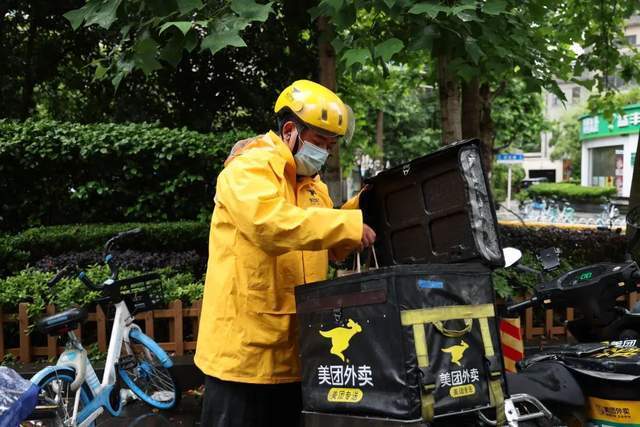
Meituan's current strategy is to consolidate its advantages downward and improve quality upward.
Meituan has now closed its preferred business and is fully betting on the instant retail Meituan Flash Sale business. During the 618 period, Meituan Flash Sale saw the transaction volume of nearly 850 brands double, and the GMV of over 100 categories doubled.
"Raccoon Kitchen" focuses on transparent kitchens, addressing the pain points of food delivery safety, with the entire process visible and traceable.
Different brands can open together. Meituan will build offline kitchen bases, where merchants "move in with their bags," providing venues, hardware, and digital operation support. Meituan will conduct cloud monitoring live broadcasts, with the entire back kitchen operation live broadcast without dead ends, allowing consumers to watch the cutting, cooking, and packaging processes in real-time. Daily procurement lists, cleaning records, and quality inspection reports are publicly available, forming a traceable archive. Consumers can order across stores, selecting dishes from multiple brands in a single order, with unified delivery by riders, saving multiple delivery fees. As of July 2025, 10 stores have been operated in Beijing and Hangzhou, attracting over 100 catering brands such as Lao Xiang Ji, Quanjude, Dicos, and Yunhaiyao.
Meituan's victory will not be easy and will come at a heavy cost.
Due to increased subsidies and social security costs, Meituan's profit per order may drop from 1.5 yuan to 1.0 to 1.2 yuan. Based on the outcome of previous food delivery wars, long-term profits will improve.

Outcome Two: Alibaba and Meituan Duopoly
In the second outcome simulation, Alibaba will catch up and form a strong pattern with Meituan.The market share of food delivery is Meituan 45%, Alibaba 45%, JD.com 10%.Ultimately, Meituan's profits will further decline, Alibaba will have short-term losses but long-term opportunities to break even, and JD.com will struggle to achieve scale effects in the competition.
Alibaba wants to use instant retail to consolidate its current core consumption scenarios into a super consumer app. This way, traffic can be reused, and the fragmented parts of the business can be united.
Alibaba's advantage lies in its "thick blood bar," with high net profits and abundant funds. If it fights a protracted war, it will be unfavorable for JD.com and Meituan.Data shows that Alibaba's non-GAAP net profit for fiscal year 2024 is 157.5 billion, Meituan's adjusted net profit under non-IFRS for 2024 is 43.772 billion yuan, and JD.com's non-IFRS net profit for 2024 is 41.359 billion yuan. However, Alibaba has many businesses, and the actual investment in food delivery is unknown.
Whether Alibaba's various ecosystems can effectively combine and collaborate is a major test. In the past, the businesses of each sector were relatively fragmented, making it difficult to achieve a 1+1>2 effect. Alibaba has now completed a round of traffic integration, embedding Ele.me and Fliggy into the Taobao main site, driving a daily active increase of 50 million within 5 months, and plans to invest 32 billion from April to December 2025 to strengthen instant delivery.
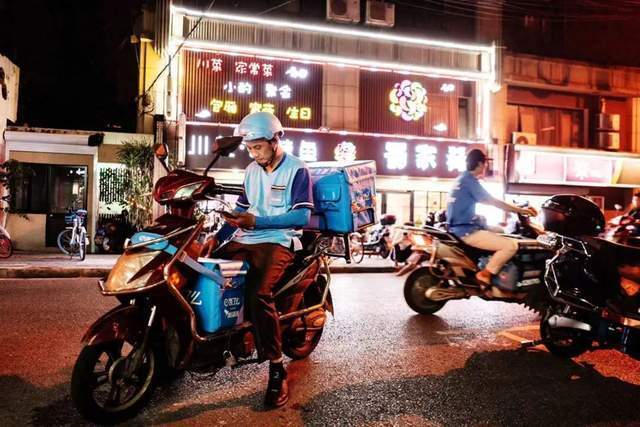
Alibaba's current shortcomings are in rider costs and merchant supply.Meituan has more riders and a higher 30-minute delivery rate than Alibaba; at the same time, Alibaba's fulfillment costs are higher, with data showing that the average delivery cost per order is 4.13 yuan, while Meituan's optimized cost is about 3.2 yuan. The lack of scale effects puts pressure on the average profit per order. Meituan has more merchants.
To achieve this result, Alibaba may need high ecosystem collaboration and reduced fulfillment costs. Otherwise, large-scale subsidies will be difficult to sustain until the end.
It is necessary to maximize the current advantages, forming a deep closed loop of Taobao traffic, Ele.me fulfillment, and brand product pools. Subsidies increase order volume and user stickiness, forming scale effects to reduce rider costs. Increase the proportion of non-dining, improving profit margins.

Outcome Three: Tripartite, JD.com Breaks Through
In the third outcome, JD.com finally breaks through and gets a seat at the table. In terms of order volume, the market share of food delivery is Meituan 50%, Alibaba 30%, JD.com 20%.JD.com was the first to start the food delivery war, but did not expect Alibaba to join the battlefield later, bringing in a strong opponent.
Perhaps for JD.com, the more important role of food delivery is to attract traffic. As a traffic engine, food delivery provides users and increases stickiness for e-commerce business.
Liu Qiangdong once stated at a sharing session that 40% of consumers who order food delivery from JD.com will go to buy JD Mall's e-commerce products,"The money we lose on food delivery is more cost-effective than buying traffic from Douyin and Tencent."
Data shows thattwo-thirds of JD.com's marketing expenses are used for customer acquisition,with JD.com's marketing expenses reaching 47 billion yuan in 2024. The money spent on acquiring users may be more economical compared to food delivery subsidies.
JD Waimai focuses on quality, strictly selecting dine-in restaurants such as Haidilao and Starbucks. In four months, nearly 200 brands have achieved sales of over one million, with JD.com holding a 45% share in the quality food delivery market. In the sinking market, JD.com's barriers are not as deep as Meituan and Alibaba.

In the non-dining category, JD.com can cut a piece of the cake.
JD.com's heavy asset investment will form an advantage in the 3C scenario of instant retail, building a differentiated network with full-time riders and JD Logistics' idle capacity at noon, focusing on high-ticket categories.
In the instant retail battlefield, the three companies each have their advantages, forming differentiated competition.

Conclusion
September this year will be an important turning point in the food delivery war. Because subsidies are now concentrated on beverages, when autumn comes, the demand for drinks in the north will decrease, and the impulse consumption brought by subsidies will also decrease. This will be the real test of user loyalty. By September, after several rounds of burning money, there will be some results, and the competition in food delivery will become more rational.
The food delivery war between Meituan, JD.com, and Alibaba has already burned a lot of money, and in the future, it will have varying degrees of impact on the profits of the three companies.
Goldman Sachs estimates that in Q2 this year alone, Meituan, JD.com, and Alibaba will invest 25 billion yuan in food delivery, and in the 12 months from July this year to June next year, Alibaba's food delivery business will lose 41 billion yuan, JD.com will lose 26 billion yuan, and Meituan's EBIT will decrease by 25 billion yuan.
Pinduoduo, which did not participate, saved a sum of money and may focus on launching an offensive in domestic and international e-commerce.
The losses in food delivery have already been regarded as marketing expenses by JD.com and Alibaba, used to attract traffic for e-commerce business.
The essence of the endgame of the food delivery war is a three-dimensional war of efficiency, collaboration, and mindset. The three giants are shifting from a "price war" to a "system capability war," exchanging short-term losses for long-term patterns. Meituan needs to cross the cost swamp, Alibaba bets on ecosystem integration, JD.com bets on the quality track, and the user retention rate and AI efficiency increase in Q3 2025 will be a turning point signal.
References:
1. Goldman Sachs: China's Food Delivery War '
2. Jinduan: Why Did Alibaba and Meituan Suddenly Increase Their Investment in Instant Retail?
3. Whale Business: The "Second Half" of Local Life: The Offensive and Defensive Paths of Alibaba, JD.com, and Meituan
4. Lieyunwang: Meituan, Quietly Made a Move
5. Wang Zhiyuan: Meituan and Alibaba Begin to Bet Heavily on the Future
6. Leopard Change: An Epic Food Delivery Coupon War


The copyright of this article belongs to the original author/organization.
The views expressed herein are solely those of the author and do not reflect the stance of the platform. The content is intended for investment reference purposes only and shall not be considered as investment advice. Please contact us if you have any questions or suggestions regarding the content services provided by the platform.