
Old drugs underpin, new drugs surge. After earning over 600 million yuan in half a year, Gan & Lee Pharmaceuticals is stirring up the next performance storm.
 I'm LongbridgeAI, I can summarize articles.
The growth momentum of Gan & Lee Pharmaceuticals continues.
According to the financial report, the company achieved operating revenue of 3.045 billion yuan last year, a year-on-year increase of 16.77%; net profit attributable to the parent company was 615 million yuan, a year-on-year increase of 80.75%; and non-GAAP net profit attributable to the parent company was 430 million yuan, a year-on-year increase of 44.85%.
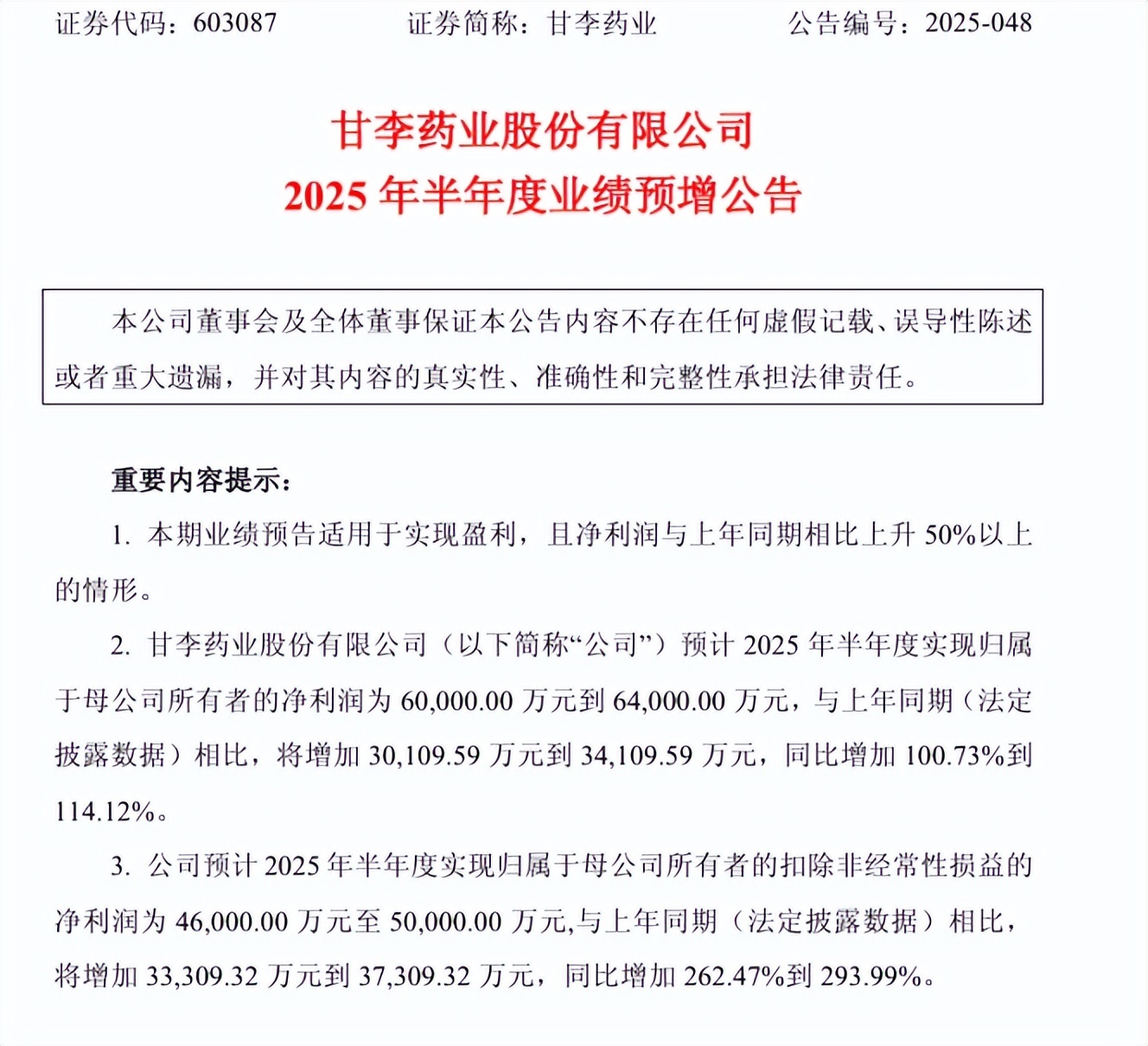
Recently, Gan & Lee Pharmaceuticals also released a pre-announcement of its 2025 semi-annual performance growth. The announcement shows that the company expects to achieve a net profit of 600 million to 640 million yuan in the first half of this year, a year-on-year increase of 100.73% to 114.12%; non-GAAP net profit is expected to be 460 million to 500 million yuan, a significant year-on-year increase of 262.47% to 293.99%.
Such performance growth further proves that cyclical challenges are only temporary.
Gan & Lee Pharmaceuticals Rises Amid the Deepening of Centralized Procurement
In recent years, one factor that cannot be ignored in the development of Gan & Lee Pharmaceuticals is centralized procurement. Behind the company's performance growth, the pressure from centralized procurement is gradually transforming into an indispensable driving force.
During the "pressure" phase, the relatively aggressive price reduction strategy squeezed the profit margins of pharmaceutical companies. It is reported that in the 2021 insulin-specific centralized procurement, six insulin products from Gan & Lee Pharmaceuticals, including insulin glargine injection (Chang Xiu Lin), insulin lispro injection (Su Xiu Lin), protamine zinc recombinant insulin lispro mixed injection (25R) (Su Xiu Lin 25), and insulin aspart injection (Rui Xiu Lin), which contributed over 90% of the company's performance, were all selected, with an average price reduction of 65.33%.
As a result, Gan & Lee Pharmaceuticals also suffered its first annual loss since its listing in 2022, and the company's profits remained at low levels for a long time, struggling to return to peak levels.
However, it is worth noting that while product prices fell in centralized procurement, the "volume" saw a significant increase. The financial report shows that from 2020 to 2023, the sales volume of Gan & Lee Pharmaceuticals' insulin preparations increased from 29.8665 million units to 73.2107 million units.
Regarding this, Gan & Lee Pharmaceuticals believes that "although centralized procurement price reductions have increased sales volume, the short-term growth in sales volume cannot yet compensate for the impact of price reductions on revenue." In this context, if the company can transform "trading price for volume" into "both volume and price rising," Gan & Lee Pharmaceuticals still has a chance to turn the situation around.
Subsequent centralized procurement has provided Gan & Lee Pharmaceuticals with opportunities. Specifically, centralized procurement in recent years has evolved from pilot programs to widespread implementation and then to further deepening. During this process, the market penetration rate of selected products has continuously increased, and centralized procurement policies have been adjusted and optimized accordingly, with signs of price adjustments emerging.
Gan & Lee Pharmaceuticals has become a beneficiary of this new trend.
In the 2024 insulin follow-up centralized procurement, all six insulin products from Gan & Lee Pharmaceuticals were selected, with an average price increase of 31%. Additionally, the company secured a total of 46.86 million units for the first year's agreement volume, a 32.6% increase compared to the previous centralized procurement agreement volume. Among them, the agreement volume for third-generation insulin products was 43.55 million units, an increase of 11.56 million units compared to the previous centralized procurement, accounting for 30% of the total third-generation insulin products. Gan & Lee Pharmaceuticals' market share of third-generation insulin also increased from 8% in 2021 to 30% in 2024, gradually approaching the market share of Novo Nordisk's related products (40.2%).
At the same time, the company's international expansion has also started. According to the 2024 annual report, Gan & Lee Pharmaceuticals has carried out international cooperation and business activities in more than 20 countries and regions along the "Belt and Road," including Turkey and Kazakhstan. In addition, the company is accelerating the certification of its products in Europe and the United States, continuously expanding its market share and influence in the international market. In 2024, Gan & Lee Pharmaceuticals' export volume continued to rise, with international revenue reaching 528 million yuan, a year-on-year increase of 23.89%.
Clearly, the two major driving forces—centralized procurement and international expansion—are helping Gan & Lee Pharmaceuticals reach a highlight moment. Behind these two driving forces lies another decisive factor—R&D capabilities.
The Ambition of Gan & Lee Pharmaceuticals: Continuous Innovation, Unstoppable Growth
Whether in centralized procurement or international expansion, the absolute advantage lies in strong products, which also places high demands on the R&D and innovation capabilities of related companies.
In terms of R&D and innovation, Gan & Lee Pharmaceuticals has a strong technical foundation. It is understood that the company is the first in China to master the industrialized production technology of insulin analogs. Since its establishment, it has adhered to the corporate philosophy of "Quality First, Forever Innovating" and has successfully developed multiple third-generation insulin analog products, covering the long-acting, rapid-acting, and premixed insulin functional segments.
Twenty years ago, Gan & Lee Pharmaceuticals broke the monopoly of foreign companies such as Sanofi with its first domestically developed long-acting insulin analog, Chang Xiu Lin. Today, the company continues to explore the path of leading domestic diabetes drugs through new drug R&D.
Take Gan & Lee Pharmaceuticals' investigational Class 1 new drug Bofan Glutide Injection as an example. According to reports, this product is a glucagon-like peptide-1 receptor agonist (GLP-1RA) indicated for type 2 diabetes and obesity/overweight weight management, and has made positive progress in clinical research.
The financial report reveals that in June 2024, Gan & Lee Pharmaceuticals completed a Phase IIb clinical trial of Bofan Glutide Injection for obesity/overweight weight management in China and reported the trial results at the annual ObesityWeek 2024 conference in the United States in November 2024. The research results showed that Bofan Glutide Injection administered every two weeks (Q2W) achieved weight loss effects in obese/overweight subjects, with the highest dose group achieving an average weight loss of 17.3% after 30 weeks of treatment, and the drug demonstrated good safety and tolerability.
In a non-head-to-head comparison with similar competing drugs, the Phase II clinical data of Bofan Glutide Injection administered every two weeks (with a placebo-adjusted weight loss of 16.3% at 30 weeks) surpassed the performance of the weekly GLP-1R/GIPR dual agonist Tirzepatide in the SURMOUNT-CN Phase III study in the Chinese obese population (with a placebo-adjusted weight loss of 15.1% at 52 weeks) and the weekly GLP-1R/GCGR dual agonist Mazdutide in the GLORY-1 Phase III study in the Chinese obese population (with a placebo-adjusted weight loss of 14.4% at 48 weeks).
In addition, in the treatment of type 2 diabetes, Gan & Lee Pharmaceuticals completed a Phase IIb clinical trial of Bofan Glutide Injection for type 2 diabetes in China in July 2024. The research results showed that after 24 weeks of treatment in type 2 diabetes patients, Bofan Glutide Injection demonstrated more prominent effects in reducing HbA1c (glycated hemoglobin) and body weight compared to semaglutide (Novo Nordisk's Ozempic®).
Currently, Gan & Lee Pharmaceuticals is also quite confident about its new drug. The company believes that its layout in the GLP-1RA field is forward-looking, and it is actively seeking differentiated competitive advantages for its products. Based on the strategy of dual-indication R&D, biweekly administration, and simultaneous advancement in two countries, Bofan Glutide Injection has already demonstrated promising clinical performance and is expected to become the world's first biweekly GLP-1RA formulation, which also implies considerable commercial potential.
According to the IQVIA database, the market size of the blood sugar-lowering and weight loss fields is expected to reach approximately $210 billion by 2030. At present, the development model of "traditional products as the foundation and innovative products as the leap" is supporting the expansion ambitions of Gan & Lee Pharmaceuticals.
Source: Pharmaceutical Research Society

The copyright of this article belongs to the original author/organization.
The views expressed herein are solely those of the author and do not reflect the stance of the platform. The content is intended for investment reference purposes only and shall not be considered as investment advice. Please contact us if you have any questions or suggestions regarding the content services provided by the platform.