

 Posts
PostsCoinbase's Breakthrough: The Acquisition Spree and Business Integration Amid Anxiety, a Battle for Identity Reshaping

In the first quarter of 2025, Coinbase's financial report presented a challenging picture for investors: as one of the world's largest crypto trading platforms, Coinbase faced significant declines in net profit, shrinking trading volumes, and loss of market share. The core business that once supported its market position is now under unprecedented pressure.
Image source: the big whale
In response to the crisis, Coinbase has demonstrated its determination: rapid acquisitions and cross-sector business integration. Coinbase is driving its business restructuring around the development of Base Chain and the expansion of institutional clients. This also provides an inspiring direction for other CEXs on how to break through existing frameworks and seize future growth opportunities in an increasingly competitive market.
The "CEX Crisis" in the Financial Report
Despite still being one of the world's largest crypto trading platforms, Coinbase's Q1 2025 financial report revealed its anxiety. Total revenue reached $2 billion, a 24.2% year-over-year increase, but this growth clearly failed to offset the pressures it faced,
especially against the backdrop of a 94% plunge in net profit. The $66 million net profit fell far below investor expectations.
Spot trading revenue, once Coinbase's main income source, showed a clear downward trend in this year's report. Institutional trading revenue dropped 30% year-over-year, while retail trading revenue fell 19%. The shrinking trading volumes reflect the severe challenges facing CEX's traditional profit model.
The decline in spot trading volumes is partly due to the cooling crypto market. After January 2024, the price volatility of mainstream crypto assets like Bitcoin and Ethereum weakened. Compared to the highly volatile market environment of the past, investor activity has declined significantly, with both institutional and retail traders no longer trading as frequently as before.

Image source: the big whale
However, beyond price performance, what truly caused a butterfly effect was a series of intertwined factors collectively driving a major reshuffle in CEXs.
The rise of ETFs was undoubtedly one of the key factors. Beyond Bitcoin, major market-cap assets like Ethereum, Solana, and XRP have also launched ETFs in this cycle. These assets once accounted for the majority of Coinbase's spot trading volume. Compared to CEXs' 0.5%+ spot trading fees, ETFs' 0.1%-0.5% annual management fees have led some investors to switch.
The boom in on-chain and meme markets has also accelerated trader migration. The wealth-creation effect in this cycle has made crypto-native users and newcomers increasingly accustomed to on-chain trading, with more users treating CEXs merely as "bridges" for fiat on-ramps/off-ramps and "wallets" for stablecoin storage.
Additionally, decentralized derivatives platforms like Hyperliquid have rapidly emerged, attracting a large number of contract users from heavily regulated regions like the U.S. with more flexible listing mechanisms, higher leverage, and more diverse trading products than compliant platforms like Coinbase, further accelerating user migration to on-chain.
Making matters worse, traditional brokerages like Robinhood have recently announced entries into the crypto market, further eroding Coinbase's market share. Robinhood's primary user base consists of young investors trading traditional financial assets—a demographic already interested in crypto and a key incremental market targeted by CEXs like Coinbase.
But for this group, Robinhood offers a more familiar trading interface and lower fees. Its compliance may also attract crypto whales interested in U.S. stocks, further squeezing Coinbase's future growth space.
When Trading Platforms No Longer Rely on Trading
As traffic and users decline, Coinbase's competitors have realized that relying solely on spot trading can no longer sustain market share.
OKX began building OKX Wallet infrastructure during the inscription wave, aiming to become users' on-chain gateway through seamless product experiences and integrated services. Binance launched Alpha trading rewards to attract on-chain users to BSC, deeply integrating Alpha into its main platform to feed traffic back.
Unlike its competitors, Coinbase hasn't heavily invested in new products but leveraged its compliance and resource advantages to "form alliances," primarily through acquisitions and partnerships, rapidly advancing Base Chain's development and targeting institutional markets to build a new competitive landscape.
Acquire, Acquire, Acquire!
Acquisitions—a common Web2 transformation tactic amid intensifying competition—have become Coinbase's primary strategy to address market challenges and achieve transformation. In just six months, Coinbase used its robust cash flow as a trading platform to acquire Spindl, Iron Fish, Deribit, and Liquifi.
CEO Brian Amsterang stated: "The company has a solid balance sheet and, as a public company, possesses liquid funds for M&A. We will continue to focus on companies that can drive Coinbase's product development and growth."
Notably, these four acquisitions are unrelated to Coinbase's core business. Clearly, Coinbase isn't acquiring to salvage or grow its spot trading business but to explore new growth avenues.
Three acquisitions—Spindl, Iron Fish, and Liquifi—serve one direction: Base Chain's development.
Despite Base Chain lagging behind Solana in the fierce on-chain ecosystem competition in recent years, unlike Solana and BSC's meme-driven retail trader strategy, Base's growth has emphasized "Builder First" from the start. Its ecosystem lead Jesse Pollak has stated publicly that creating a developer-friendly environment is a priority, even above attracting users.
Spindl, Iron Fish, and Liquifi directly focus on empowering on-chain developers. These acquisitions provide comprehensive tools and services—from marketing support and privacy tech to token management—reducing development difficulty and costs on Base Chain.
For developers, promoting applications to users has always been challenging, and traditional ad platforms don't suit decentralized ecosystems. Spindl, acquired in January, is a chain-native ad solution founded by Antonio García Martínez, a core member of Facebook's ad team.
Spindl built an on-chain ad tech stack via smart contracts, enabling developers to run ads and acquire users directly on-chain without relying on centralized platforms or Twitter KOLs. This innovative approach offers greater transparency, control, and lower costs.
Beyond ads, privacy is another pain point. Privacy is highly valued by crypto-native users, with many degens leaving CEXs for on-chain anonymity. But developers face complex privacy tech and implementation hurdles.
In March, Coinbase acquired Iron Fish, a privacy chain using zk-SNARKs to ensure on-chain transaction privacy. The team excels in helping developers build privacy-preserving tools that are secure and compliant.
Post-acquisition, the team will build a privacy module on Base and develop privacy primitives to help developers create secure, transparent, and privacy-preserving apps.
Meanwhile, token issuance and management are complex for crypto startups, involving equity structures, airdrops, vesting, tax compliance, and more. Most developers lack experience here, forcing them to invest significant time and resources beyond core development.

Image source: fortune
Liquifi, acquired in July, addresses this. It provides end-to-end token management services, including equity structuring, vesting, airdrops, and tax compliance.
Notable projects like Uniswap Foundation, Ethena, and OP Labs already use Liquifi for token and airdrop management.
Notably, Liquifi will integrate with Coinbase Prime—Coinbase's institutional platform.
This integration will extend Liquifi's token management, equity design, and compliance services to institutional clients. Amid trends like RWA and tokenized assets, this will greatly benefit traditional financial institutions and public companies issuing on-chain tokens.
Beyond developer-focused acquisitions, Coinbase spent $2.9 billion in May to acquire Deribit, boosting its derivatives market competitiveness.
For trading platforms, derivatives trading is more stable and profitable than spot trading. Derivatives attract high-leverage retail traders and are essential for institutional hedging and speculation. But due to strict U.S. regulations, Coinbase lags far behind offshore competitors here.
With spot trading unable to sustain financials, acquiring Deribit became necessary. Despite the high price, Deribit's institutional user base and leading options market position align perfectly with Coinbase's strategy, providing an ideal springboard into derivatives.
Post-acquisition, Coinbase quickly launched CFTC-compliant perpetual contracts in late June, featuring no quarterly expiry, 24/7 trading, and tight spot price tracking—all based on Deribit's existing products.
"The Amazon of Crypto"
If acquisitions are Coinbase's aggressive breakout from trading revenue ceilings, its ongoing integration and expansion represent a deeper "identity reinvention."
It's redefining crypto's infrastructure like a traditional tech company: not through incentives or chasing volatility but by building settlement networks, payment systems, and identity layers.
This "heavy-lifting, low-profile" transformation is forming a clear outline: a closed loop around stablecoin payments, social wallets, and on-chain transactions, gradually becoming a Web3 hybrid of Apple + Visa + AWS within compliance.
Image source: the big whale
The first pillar is the USDC-based stablecoin payment network. While Coinbase doesn't own USDC issuance, its co-founding role in Centre Consortium with Circle grants it near-equal governance, audit standards, and market expansion influence.
In this profit-sharing structure, Coinbase took over half of USDC's $1.6 billion interest income in 2023—$900 million. But this "protocol-level free ride" also sowed structural tensions—Circle, unhappy with Coinbase's disproportionate gains, adjusted profit-sharing rules in 2024.
Coinbase quickly realized USDC's future requires stronger use cases beyond exchanges.
It shifted from "taking profits" to "building scenes," launching USDC deposit subsidies in Q1 2024 to boost platform holdings. More crucially, it entered Web2 merchant payments, partnering with Shopify to offer USDC payment APIs for on-chain receipts, off-chain settlements, and fiat reconciliation.
This isn't a "can stablecoins pay?" demo but a direct transformation of Coinbase into a payment processor with merchant settlement capabilities—embedding crypto finance into real-world POS and ERP systems.
This pipeline isn't alone. Behind Coinbase is a16z.
a16z isn't just Coinbase's earliest investor but also a long-term backer of Circle (USDC's issuer). It played a strategic role in Centre's design, advocating "stablecoins as TCP/IP for internet finance."
In a16z's vision, Coinbase is the fiat on-ramp, while USDC is the cross-system value protocol. Their synergy—capital, governance, and product—is a systematic attempt to rebuild traditional financial networks (Visa/SWIFT).
If payments are the money gateway, wallets are the identity and traffic gateway.
Coinbase's wallet updates—seedless "Smart Wallets," on-chain identity/NFT displays, quests, and even Lens Protocol integration—aim to create an interactive, sticky "wallet network."
The latest Coinbase Wallet pushes "accounts" into on-chain social and creator economies: integrating Farcaster feeds, short videos, chats, Mini Apps, AI Agents, and friend interactions to build a "crypto social circle" blending trading and socializing.
In Web3's social drought, Coinbase isn't rebuilding Lens but turning traders into socializers, wallets into feeds, and interactions into on-chain consumption—rewriting how users stay on-chain.
This isn't minor optimization. Wallets are users' primary on-chain interface. If Coinbase captures this, it controls not just money but also behavior, identity, and social graphs.
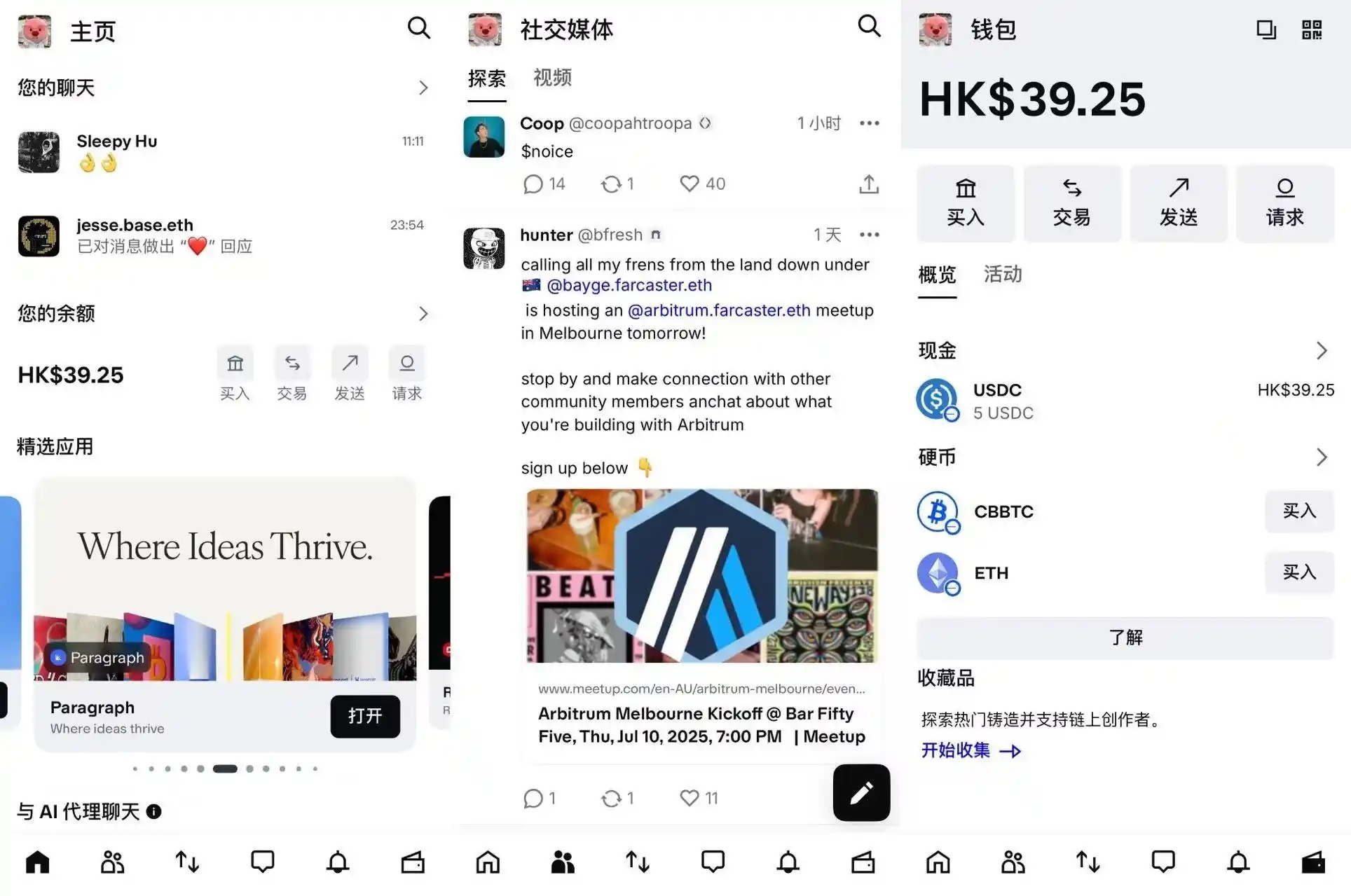
Image source: Blockbeats
The goal is clearly a closed loop with Base Chain.
Coinbase launched Base in 2023, quickly attracting developers and dApps. But retaining users requires more than grants—it needs "built-in wallet access." Directing users to mint, bridge, and interact via wallets, then binding assets via identity/NFTs, creates sustainable traffic.
This model mirrors Web3's "iOS ecosystem": Coinbase Wallet as App Store, Base as iOS, USDC as Apple Pay. Combined, Coinbase can profit not from volatility but from "identity + capital + trading + social" flows—collecting perpetual "on-chain taxes."
Further reading: Faster than Twitter, the new Coinbase Wallet evolves into WeChat
This ecosystem's capital backbone is a16z—advocating Wallet-as-infrastructure and pushing Base's growth.
As retail trading fees decline and high-margin businesses face pressure, Coinbase Prime serves as a "cash flow anchor" for institutions.
Coinbase Prime is an institutional trading, clearing, and custody platform serving 500+ hedge funds, market makers, and asset managers—the primary custodian for USDC.
Though undisclosed, Prime likely claims a significant share of Circle's interest income, stabilizing Coinbase's revenue. If RWA and STO gain traction, Prime could expand into an on-chain Goldman Sachs or BlackRock.
This is Coinbase's fundamental difference from many Web3 exchanges: it doesn't rely on user sentiment but aims to control infrastructure—whether money flows (USDC), account origins (Wallet), or trading endpoints (Base). It wants to be Web3 finance's indispensable node.
Thus, we see a restrained yet visionary path: not competing on fees or listings but building a compliant Web3 core stack for liquidity, identity, and settlement.
Coinbase may not be the liveliest exchange, but it's becoming the most important "settlement-layer company."
While others chase short-term volatility, Coinbase bets on a slow macro cycle: turning crypto into infrastructure, trading into settlement, and users into network nodes. This slow variable may be the capital story that outlasts regulation and markets.
From Crypto Trader to Financial Backbone
Coinbase was once mired in trading slumps and profit crashes. Spot revenues faltered, ETFs eroded mindshare, Robinhood loomed, and users fled to Hyperliquid—CEX's "old order" crumbled.
But Coinbase didn't compete on fees or listings. Instead, it chose a deeper path: acquiring infrastructure, connecting institutional capital, and building on-chain foundations.
Spindl, Iron Fish, and Liquifi—focused on on-chain marketing, privacy compliance, and token management—built Base's developer toolstack. Deribit's acquisition filled its derivatives gap, reclaiming high-value users and institutional funds.
These pieces converge into one vision: Coinbase is no longer an exchange but a financial infrastructure stack. Base is its OS, Wallet the account layer, USDC the money pipe, Prime the institutional engine—a composable, embeddable, trusted "Web3 middleware."
On this platform, it no longer depends on trading volumes but sustains "protocol-level taxes" via identity-payment-trading-social loops. It no longer caters to retail whims but attracts developers, serves institutions, and bridges real-world interfaces.
Its strategy transcends Binance or Robinhood—it's not building another exchange but defining who builds the next financial system:
While others fight fee wars, Coinbase sells crypto's operating system.
This isn't an exit but a reinvention. Its ultimate rival may no longer be Binance but traditional finance itself.
The copyright of this article belongs to the original author/organization.
The views expressed herein are solely those of the author and do not reflect the stance of the platform. The content is intended for investment reference purposes only and shall not be considered as investment advice. Please contact us if you have any questions or suggestions regarding the content services provided by the platform.
