

CMS Pharma bets, MG Biologics sprints for IPO, this time a 'once every four weeks' allergy drug takes the spotlight.

The treatment needs for common diseases such as atopic dermatitis, allergic asthma, allergic rhinitis, and urticaria are fostering a vast market—allergy drugs.
According to Frost & Sullivan data, from 2019 to 2023, the global market size for allergy drugs grew from $45.5 billion to $61.8 billion, with a compound annual growth rate (CAGR) of 8.0%. It is projected to further expand to $122.2 billion by 2032, with a CAGR of 7.9% from 2023 to 2032.
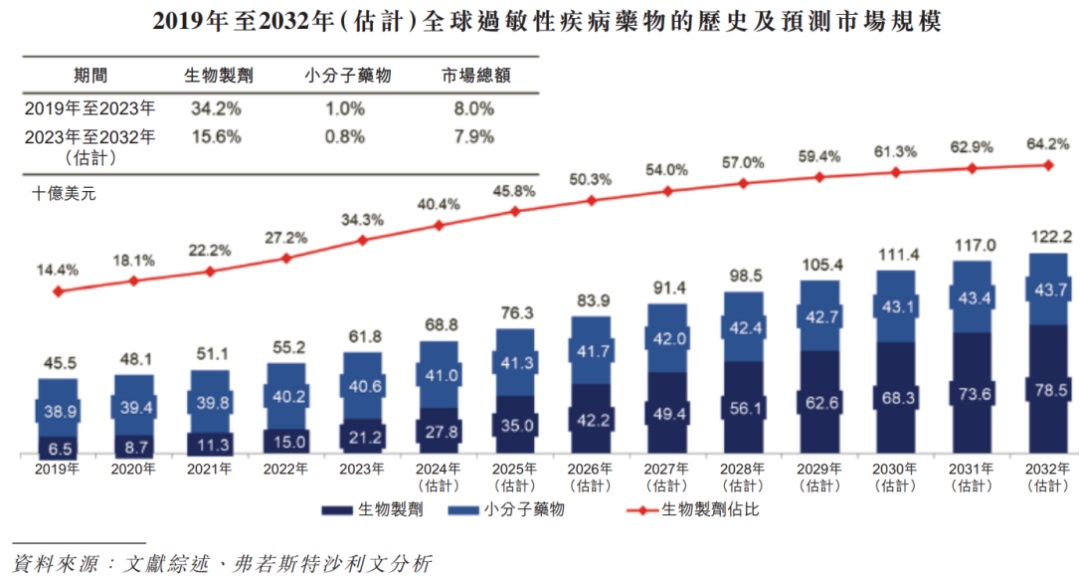
The high incidence and widespread distribution of these diseases ensure that the allergy drug market is not niche, and many small and medium-sized pharmaceutical companies have emerged in this space.
Amid the recent wave of Hong Kong listings by pharmaceutical companies, we’ve noticed some clinical-stage biopharmaceutical firms, less than a decade old, focusing on allergic, autoimmune, and other inflammatory diseases. From obscurity to the spotlight, these companies’ innovative capabilities are on full display under the capital market’s gaze.
A representative example is Hunan MGI Biotechnology Co., Ltd. (hereinafter referred to as "MGI Bio"), which recently submitted its listing application to the Hong Kong Stock Exchange. Founded in 2016, the company has built a pipeline of eight long-acting innovative antibodies targeting key pathways such as IL-4Rα, TSLP, and MASP-2, with its core product becoming a key asset for financing and strategic partnerships.
Which product is poised for rapid commercialization breakthrough?
In terms of financial performance, MGI Bio has little to report.
The prospectus shows that in the first three months of 2023, 2024, and 2025, MGI Bio’s revenues were RMB 8.722 million, RMB 24,000, and RMB 0, respectively, with net losses of RMB 253 million, RMB 178 million, and RMB 27 million. Corresponding R&D expenses were RMB 166 million, RMB 150 million, and RMB 24 million.
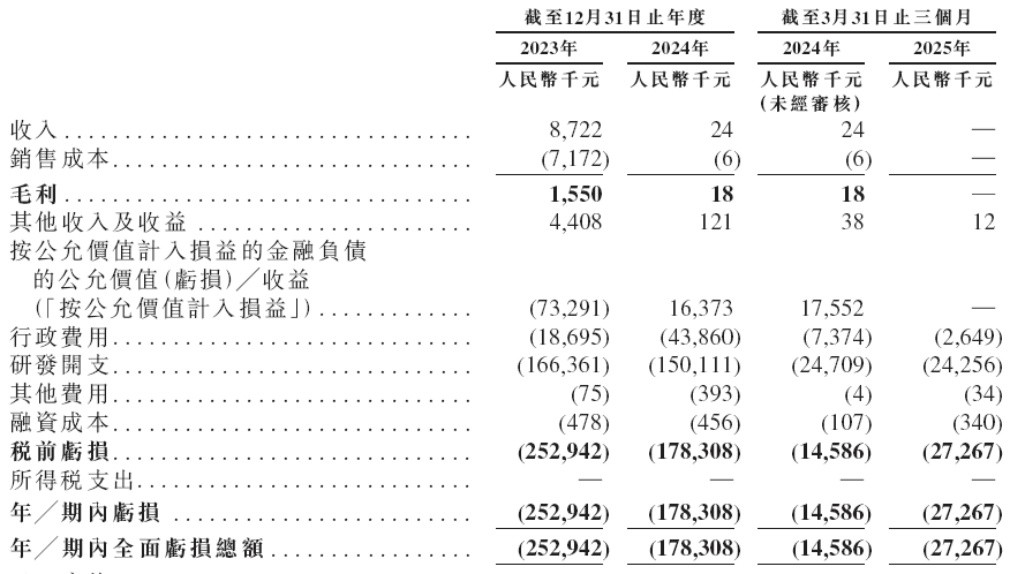
As a clinical-stage, R&D-intensive pharmaceutical company, MGI Bio’s financials are unsurprising. However, how to quickly and effectively fill the commercialization gap warrants deeper consideration.
As mentioned earlier, MGI Bio’s product pipeline is rich, with various candidates at different stages of development. Among them, the product with the highest potential for commercialization and competitive edge stands out. Especially as MGI Bio races toward its IPO, this product could serve as a "door opener" in the capital market.
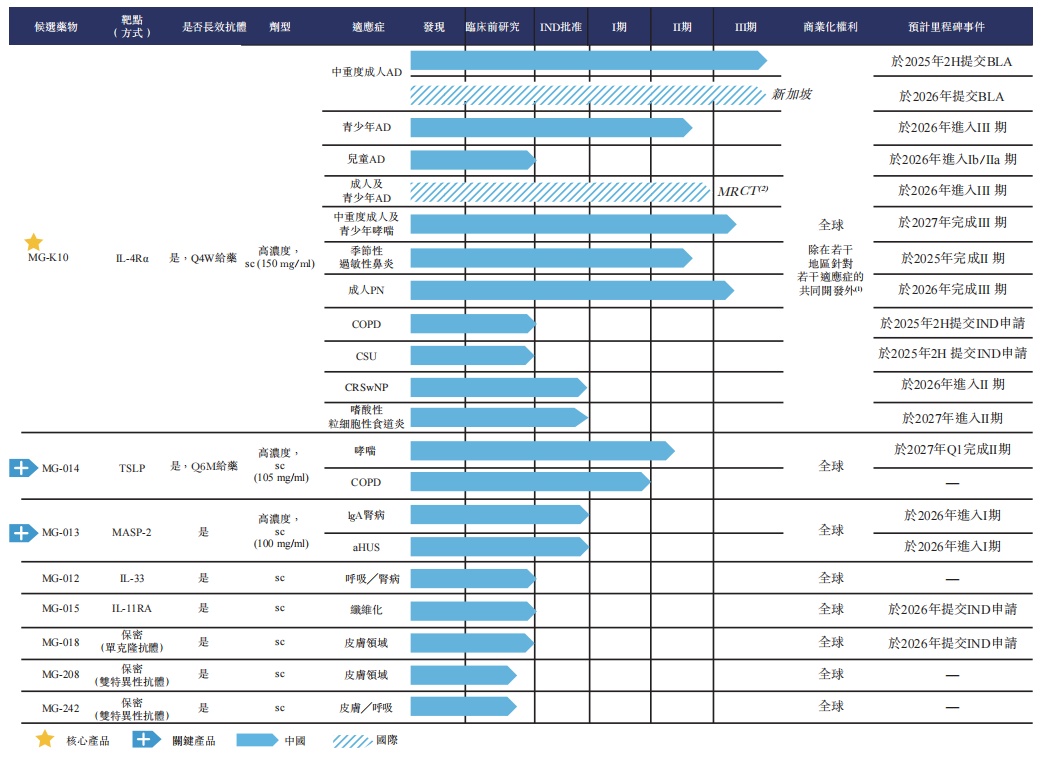
A closer look at the prospectus reveals that MGI Bio dedicates significant space to highlight a core product—MG-K10.
According to the report, MG-K10 is a long-acting anti-IL-4Rα monoclonal antibody (mAb) targeting Th2 inflammation (an immune response triggered by overactivation of helper T cells), including atopic dermatitis, asthma, seasonal allergic rhinitis, prurigo nodularis, chronic spontaneous urticaria (CSU), eosinophilic esophagitis, chronic obstructive pulmonary disease (COPD), and chronic rhinosinusitis with nasal polyps (CRSwNP).
Among these, IL-4Rα-targeted therapy stands out. Compared to traditional treatments (e.g., corticosteroids and antihistamines) and small-molecule targeted therapies (e.g., JAK inhibitors), IL-4Rα biologics and targeted therapies offer better efficacy and safety, significantly reshaping treatment paradigms.
Per Frost & Sullivan, anti-IL-4Rα antibodies are the recommended therapy for moderate-to-severe atopic dermatitis and other allergic diseases, with notable clinical potential. The global market for IL-4Rα-targeted therapies is projected to reach $28.7 billion by 2030, with a CAGR of 21.8% from 2020 to 2030.
A prominent commercial product in the IL-4Rα-targeted therapy space is dupilumab, approved for treating various type 2 inflammatory conditions (including atopic dermatitis, asthma, and CRSwNP). As one of the top 10 best-selling drugs globally, dupilumab generated $14.1 billion in sales in 2024.
Building on dupilumab’s success, multiple IL-4Rα-targeted antibody candidates are in clinical development, including MGI Bio’s MG-K10. Based on clinical progress and efficacy, MG-K10 could make waves.
Assessing MG-K10’s potential through speed and efficacy
R&D speed and product efficacy jointly determine a drug’s ability to capture the market and achieve commercial value. From these dimensions, MG-K10 shows significant promise.
According to Frost & Sullivan, MG-K10 is the only long-acting anti-IL-4Rα candidate antibody validated in Phase III clinical trials among marketed and clinical-stage anti-IL-4Rα antibodies. MGI Bio’s prospectus also reveals plans to complete Phase III trials for MG-K10 in adult atopic dermatitis by the second half of 2025 and submit a Biologics License Application (BLA) to China’s NMPA for this indication.
As clinical development accelerates, the product’s strengths become clearer.
In a Phase II trial for atopic dermatitis and asthma patients, a non-head-to-head comparison showed that 300 mg MG-K10 administered every four weeks (Q4W) outperformed 300 mg dupilumab given every two weeks (Q2W) on most efficacy measures. In other words, MG-K10’s long half-life allows it to achieve equal or superior efficacy with less frequent dosing (Q4W vs. Q2W for existing anti-IL-4Rα drugs).
Additionally, data from Phase I and II trials for atopic dermatitis patients showed that MG-K10 significantly reduces the incidence of common treatment-related adverse events, such as conjunctivitis and injection-site reactions.
Clearly, in product development, MGI Bio is targeting vast market needs (e.g., atopic dermatitis, a high-prevalence, high-burden chronic disease in China, projected to affect 79.4 million people by 2032) and aiming for best-in-class (BIC) status.
This strategy has drawn attention from peers and investors. In January 2025, MGI Bio entered a collaboration with China Medical System Holdings (CMS) for the exclusive commercialization of MG-K10 in China (including Hong Kong, Macau, and Taiwan) and Singapore, along with co-development for certain indications.
Moreover, MGI Bio’s latest funding round in July 2025 raised RMB 260 million in a Pre-IPO round, valuing the company at RMB 2.64 billion post-money.
With partners onboard and fresh capital, MGI Bio’s path forward looks promising. However, given its IPO ambitions, the company likely needs stronger external drivers to address "capital thirst" and advance more product development.
Beyond MG-K10, MGI Bio’s MG-014 and MG-013 are also in clinical stages. MG-014 is an anti-TSLP mAb for asthma and COPD, while MG-013 is an anti-MASP-2 mAb for inflammation caused by lectin pathway complement activation. The company also has preclinical candidates like MG-012, MG-015, MG-018, and MG-208 in progress.
At this stage, product visibility is closely tied to the company’s capital moves.
Conclusion
The current wave of IPOs by innovative drugmakers like MGI Bio reinforces the fact that "the story of innovative drugs never ends in the lab."
The logic of taking innovative drugs beyond the lab is clear. On one hand, clinical advantages matter—for example, the allergy field MGI Bio operates in has evolved from pure target competition to a comprehensive game of "efficacy + convenience + accessibility," pushing companies to focus on BIC (best-in-class) and FIC (first-in-class) products. On the other hand, translating clinical advantages into commercial moats increasingly relies on strategic partnerships and capital support.
As the pharmaceutical industry shifts from a "generic red ocean" to an "innovative blue ocean," capital and patients will cast more precise votes.
Source: Pharmaceutical Research Society
The copyright of this article belongs to the original author/organization.
The views expressed herein are solely those of the author and do not reflect the stance of the platform. The content is intended for investment reference purposes only and shall not be considered as investment advice. Please contact us if you have any questions or suggestions regarding the content services provided by the platform.
