

 Likes Received
When is the right time to start dollar-cost averaging?

Many long-term holders believe in the strategy of dollar-cost averaging (DCA), which involves investing a fixed amount of money at regular intervals. But many people ask: When is the best time to start DCA? Whenever I encounter such questions, I can't help but chuckle.
My answer is always: You can start DCA anytime! Just close your eyes and invest, ignoring the current market conditions.
Of course, I understand the concerns of stock market beginners—fear of buying at the peak or worrying about prolonged market volatility after investing.
However, historical data clearly shows that as long as we persist with long-term DCA, we can achieve outstanding investment results regardless of when we start!
In other words, we should enter the market as early as possible and let time heal the wounds caused by market fluctuations!
Actions speak louder than words, so let’s look at the data.
First, we must clarify that we are considering a long-term investment horizon. For an average working-class family, even if they start at age 25, they have a 40-year investment window until retirement at 65.
Moreover, according to mainstream investment philosophy, even after retirement, a significant portion of assets should remain in the stock market. If life expectancy is 80, there’s still a 15-year investment window post-retirement.
Thus, the average family’s investment horizon can easily exceed 55 years!
Of course, many people may not have extra funds to continue DCA after retirement. But we shouldn’t overlook the fact that their assets will still remain in the market long-term. For example, even if a market crash occurs around retirement, there’s ample time to wait for recovery.
Next, let’s examine the average annualized returns of monthly DCA into the S&P 500 index fund over 40 years, starting at different times.
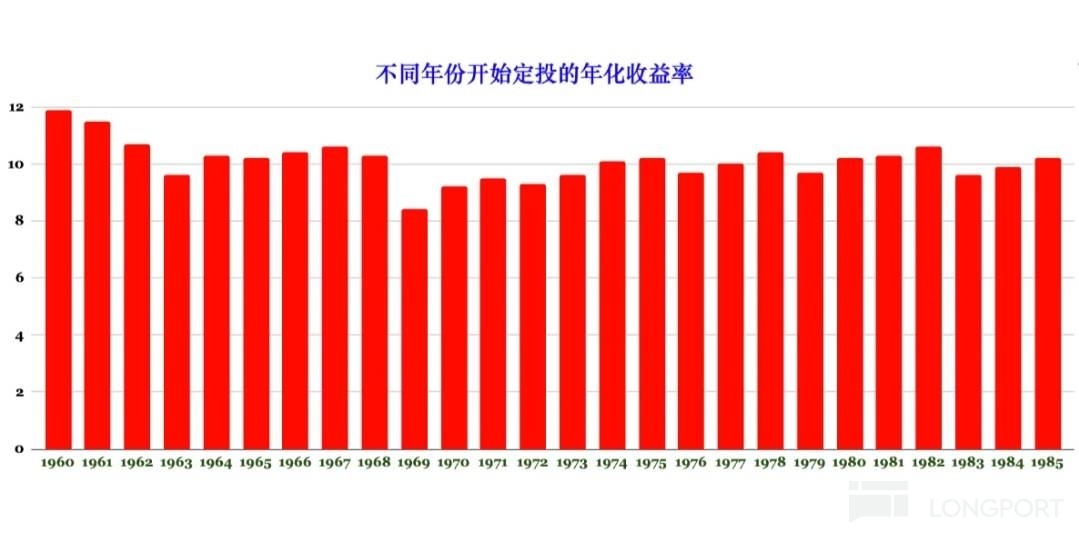
Using an authoritative S&P 500 calculator, we can analyze DCA data starting in January of different years.
From 1960 to 1985 (26 years), the best annualized return was 11.9% (starting January 1960), as the 40-year period ended in early 2000, coinciding with the peak before the dot-com bubble burst.
The worst was 8.4% (starting January 1969), ending in early 2009 during the financial crisis. Even then, holding for another 5 years would raise the return to 9.7%.
Regardless, the gap between the best and worst cases is only 3.5%.
Even in the worst scenario, over 40 years, investing $1,000 monthly ($480,000 total) would grow to $3.6 million—a 650% return. That’s still astounding!
Finally, studies show most investors, especially beginners, are terrible at market timing. They tend to buy high and panic-sell low, leading to dismal results.
Thus, these investors should humbly adopt a disciplined DCA strategy, ignoring market noise.
This approach ensures that, regardless of when they start, consistent DCA can lead to financial freedom!
If you’re still watching from the sidelines, let me remind you: Time is wealth—start DCA today!
$VG S&P 500(VOO.US)$Tesla(TSLA.US) $NVIDIA(NVDA.US) $Netflix(NFLX.US) $Robinhood(HOOD.US) $Coinbase(COIN.US) $Meta Platforms(META.US) $Apple(AAPL.US) $Costco Wholesale(COST.US) $AMD(AMD.US)
The copyright of this article belongs to the original author/organization.
The views expressed herein are solely those of the author and do not reflect the stance of the platform. The content is intended for investment reference purposes only and shall not be considered as investment advice. Please contact us if you have any questions or suggestions regarding the content services provided by the platform.
