

Stellantis 2025 年上半年运营亏损 27 亿欧元


Produced by Zhineng Auto
In the first half of 2025, Stellantis faced its most severe financial pressure since the merger. Revenue, profits, and shipments all declined, with multiple key indicators deteriorating significantly, with North America and Europe being the main drag.
Against the backdrop of electrification transformation and global supply chain restructuring, after the departure of Boss Tang, the company attempted to stabilize the situation by launching new platform models, adjusting incentive strategies, optimizing costs, and accelerating localization.
We need to analyze regional sales changes and management strategies, and further examine the causes of losses and possible improvement paths for the second half of the year. This is indeed a challenging task.

Part 1
Stellantis Faces Its Biggest Financial Challenge,
Regional Markets Underperform
In the first half of 2025, Stellantis reported net revenue of 74.26 billion euros, down 13% year-on-year.
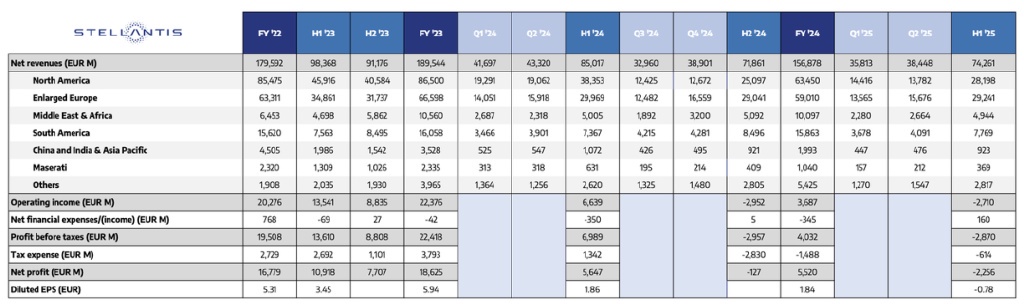
The deterioration in sales and product mix was the main reason for the revenue decline, with sales factors dragging down 9%, and vehicle net pricing and exchange rate factors each dragging down 2%. In particular, in the North American market, affected by tariffs, model exits, and production fluctuations, net revenue fell 26% year-on-year to 28.198 billion euros. Adjusted operating profit dropped to 540 million euros, down 94% year-on-year, with the profit margin shrinking to 0.7%.
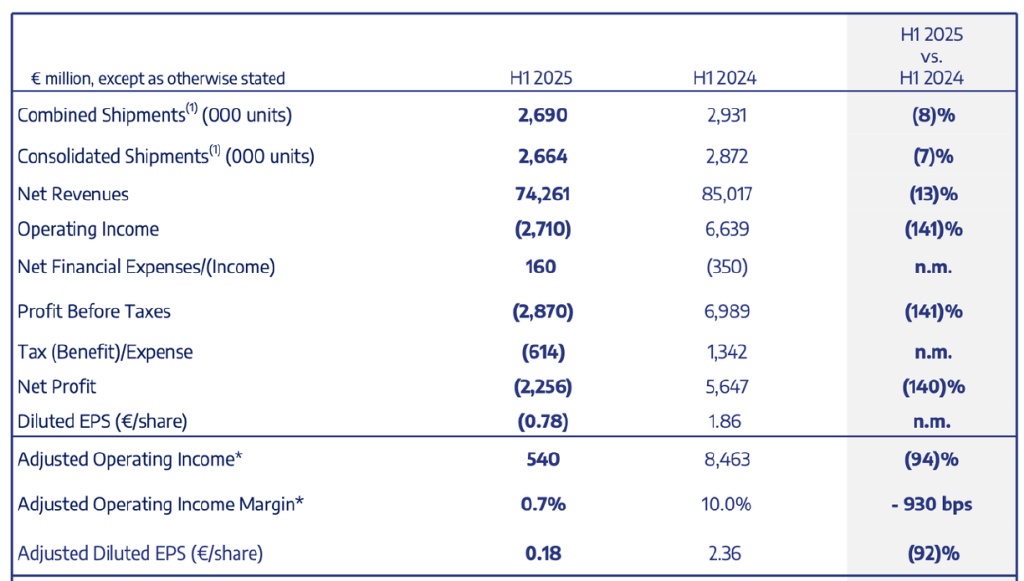
Declining raw material costs provided a buffer, but high incentive and warranty costs, as well as difficulties in fixed cost amortization, systematically suppressed profits.
Industrial free cash flow was -3.005 billion euros, worsening by 2.6 billion euros year-on-year, directly reflecting the contraction in core profitability. As of the end of June 2025, Stellantis maintained 47.2 billion euros in industrial liquidity, providing a cushion for operations in the second half of the year.
Diverging Regional Market Trends
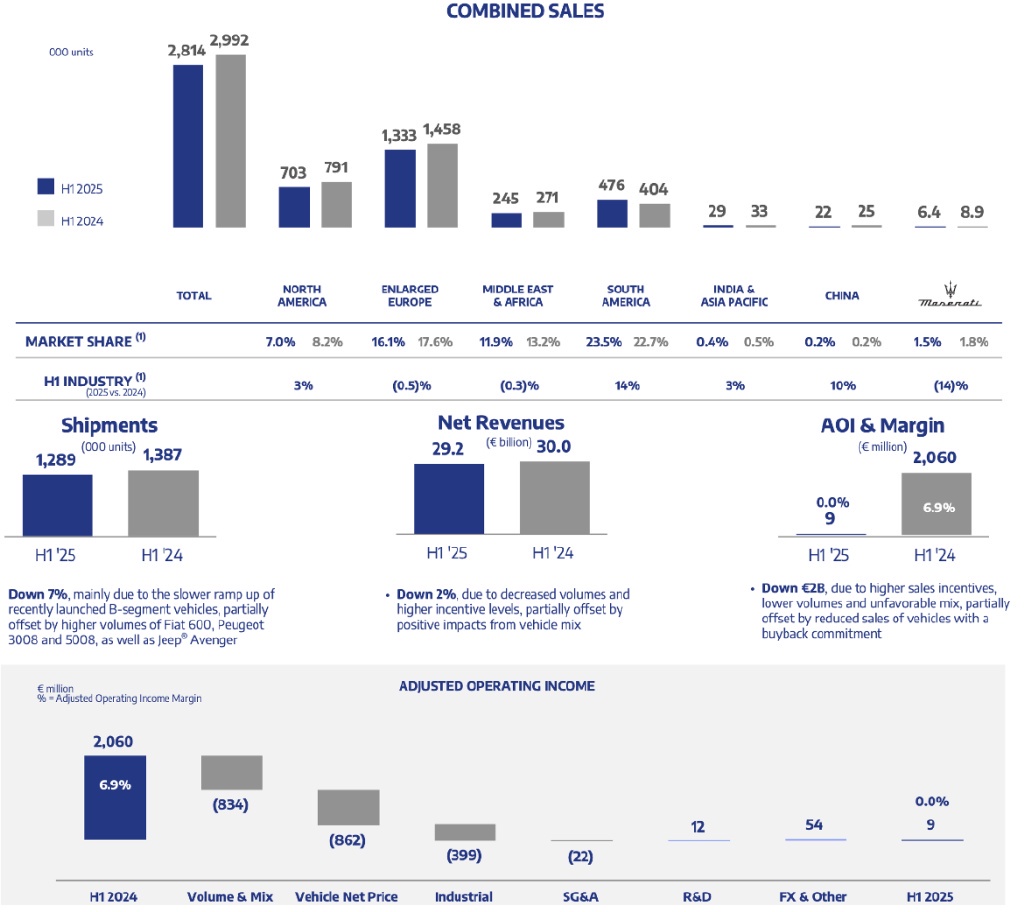
From a regional perspective, Stellantis experienced severe uneven performance:
◎ North America: Shipments fell 23% year-on-year to 647,000 units, mainly due to increased tariffs on imported models and production gaps caused by the discontinuation of models such as the Ram brand. Retail sales of the Ram brand grew 25% year-on-year, with orders up 90%, but this failed to offset the overall decline. Adjusted operating profit in North America was -1 billion euros, with a profit margin of -3.4%.
◎ Europe: Combined shipments fell 7% year-on-year to 1.289 million units. Although sales of models such as the Fiat 600 and Peugeot 3008 gradually recovered, the slow ramp-up of new B-segment models dragged down overall performance. Market share in Europe rebounded to 17%, but incentive costs rose significantly. Operating profit was barely positive at 9 million euros, with a profit margin close to zero.
◎ South America and Middle East & Africa: These were the few bright spots for the company. Shipments in South America grew 20%, with industrial profit reaching 1.188 billion euros and a profit margin of 15.3%. In the Middle East & Africa, commercial vehicle(such as the Berlingo)sales growth drove operating profit to 768 million euros, with a profit margin of 15.5%.
◎ China, India & Asia-Pacific: The market foundation is weak, with combined shipments of only 28,000 units, down 13% year-on-year, and a market share of just 0.4%. Although joint venture models with Li Auto have been launched, their contribution is limited.
In the first half of 2025, the company launched four new models, including the Fiat Grande Panda, Citroën 3 Aircross, Jeep Cherokee, and Ram ProMaster BEV.
The plan for the full year is to launch 10 new models, with the second half focusing on three models based on the STLA Medium platform, as well as the return of several classic internal combustion engine models(such as the Dodge Charger with the Hemi V8 engine). These models are expected to stabilize the North American market.
In terms of electrification, the share of battery electric vehicles (BEVs) in the European market increased by 250 basis points year-on-year. Stellantis maintains a leading position in the hybrid market, with BEV market share ranking second. However, electrification failed to offset the sales gap caused by the decline in traditional models.

Part 2
Analysis of Structural Loss Causes
and Recovery Paths for the Second Half
One of the core triggers for this round of losses was the dual decline in sales and product structure. Combined shipments fell 7% year-on-year to 2.664 million units. North America was the most affected by tariffs and model discontinuations, while Europe was in a product transition period, leading to insufficient capacity utilization. The contraction in fleet sales was particularly damaging to the sales structure.
The slow ramp-up of new models and the rapid phase-out of older models led to a decline in the proportion of high-margin models. At the same time, intense competition caused net pricing to fall 2% year-on-year, directly reducing revenue.
Increased Incentives and Warranty Costs Drag Down Profits
Sales incentives increased significantly. To maintain competitiveness, Europe and North America offered more discounts and financial packages, putting pressure on unit margins. Additionally, quality fluctuations in some new models led to higher warranty costs, particularly in Europe.
Warranty costs are essentially a lagged reflection of lax quality control management in the production process, making them difficult to quickly rectify in the short term. Coupled with the inability to amortize fixed costs due to insufficient capacity utilization, profits were further eroded.
Non-Recurring Expenses Worsen Losses
In the first half of 2025, Stellantis recorded several special item expenses:
◎ Termination of fuel cell projects, costing 733 million euros;
◎ Platform impairment charges of 578 million euros;
◎ CAFE penalty expenses related to emissions regulations of 269 million euros;
◎ Other miscellaneous expenses totaling over 1.6 billion euros.
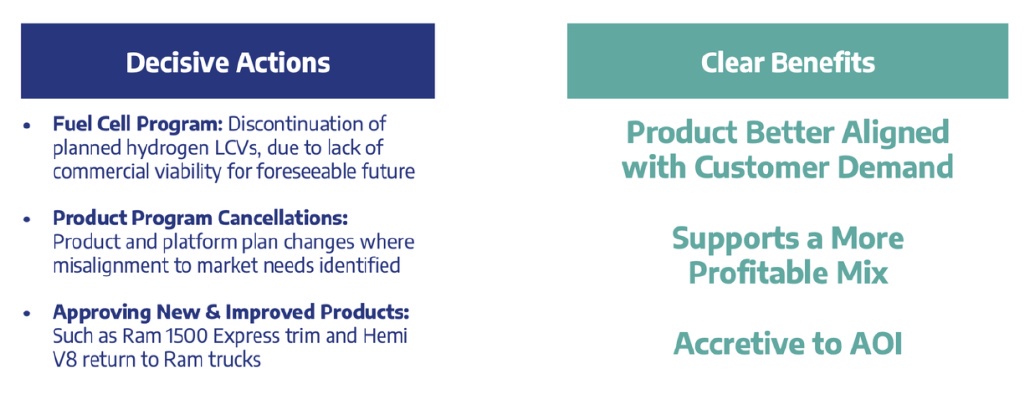
These one-time expenses totaled over 3.2 billion euros. Although non-recurring, they amplified net losses in the short term.
The depreciation of the Brazilian real, Argentine peso, and Turkish lira led to exchange losses, contributing to a 2% decline in net revenue. With operating profits plummeting, free cash flow turned negative at 3.005 billion euros. Despite optimized capital expenditures and working capital management, the gap at the operational level was difficult to offset.
This further weakened the company's ability to self-recover, making the second-half recovery more dependent on sales recovery and cost control.
Second-Half Strategies and Recovery Timeline
Facing multiple challenges, Stellantis has set the following directions for the second half:
◎ Accelerate product launches: Including new models based on the STLA Medium platform, the return of Hemi V8 models, and the relaunch of classic models(such as the Jeep Cherokee hybrid). Initial feedback in North America is positive, with first-day orders for Hemi V8 models exceeding 10,000 units.
◎ Tariff response: Plans to increase localization rates in North America to reduce reliance on imported models, offsetting an estimated 1.5 billion euros in net tariff expenses for 2025.
◎ Cost and incentive adjustments: Gradually tighten promotional policies, optimize model configurations, and improve unit margins. Simultaneously, accelerate supply chain adjustments and increase factory utilization rates.
◎ Deepen electrification: Strengthen BEV deployment in Europe and increase hybrid penetration in mainstream segments.
Net revenue and free cash flow are expected to improve significantly in the second half of 2025, with profit margins likely to rebound to the "low single-digit" range, indicating internal confidence in the recovery timeline.
Summary
Stellantis was once touted as a story of a cow that doesn't eat grass but keeps producing, but after Boss Tang stepped down, a series of issues emerged. The automotive industry doesn't allow for good products without prior effort.
North America and Europe, the two core markets, have weakened under the impact of electrification transformation, tariff changes, and model misalignment, compressing profit margins. High incentives, warranty costs, and special expenses have amplified financial pressures, exposing shortcomings in cost structure and platform strategy.
The copyright of this article belongs to the original author/organization.
The views expressed herein are solely those of the author and do not reflect the stance of the platform. The content is intended for investment reference purposes only and shall not be considered as investment advice. Please contact us if you have any questions or suggestions regarding the content services provided by the platform.
