

Audi's H1 2025 Financial Report: Behind the Divergence of the Four Major German Luxury Brands


Produced by Zhineng Auto
In the first half of 2025, the four major German luxury car groups submitted a report card under collective pressure.
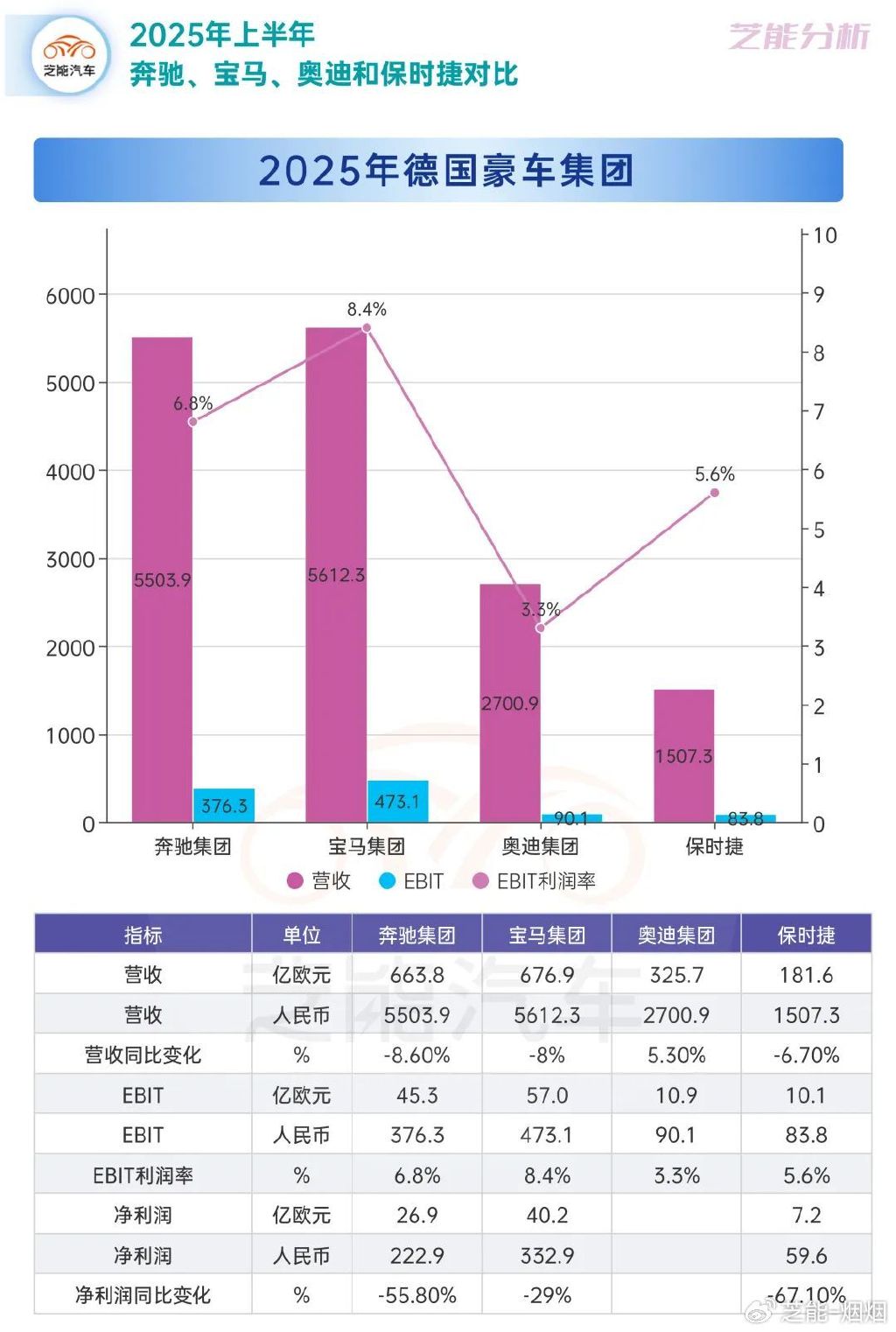
● Mercedes-Benz Grouprevenue was 66.38 billion euros, down 8.6% year-on-year;
● Porsche's decline was small at only 2.2%, but net profit plummeted 67.1% year-on-year, and the profit margin dropped to 5.6%.
● BMW's revenue fell by 8%, but it still achieved 5.7 billion euros in EBIT, maintaining a relatively high industry profit margin of 8.4%.
● Audi's revenue grew against the trend by 5.3% to 32.57 billion euros, but the profit margin dropped to only 3.3%.
Traditional German luxury car manufacturers are facing a structural challenge: revenue is capped by the expansion of electrification, while cost lines continue to rise due to raw material prices, platform transitions, and model adjustments, with overall growth in electric vehicle sales.
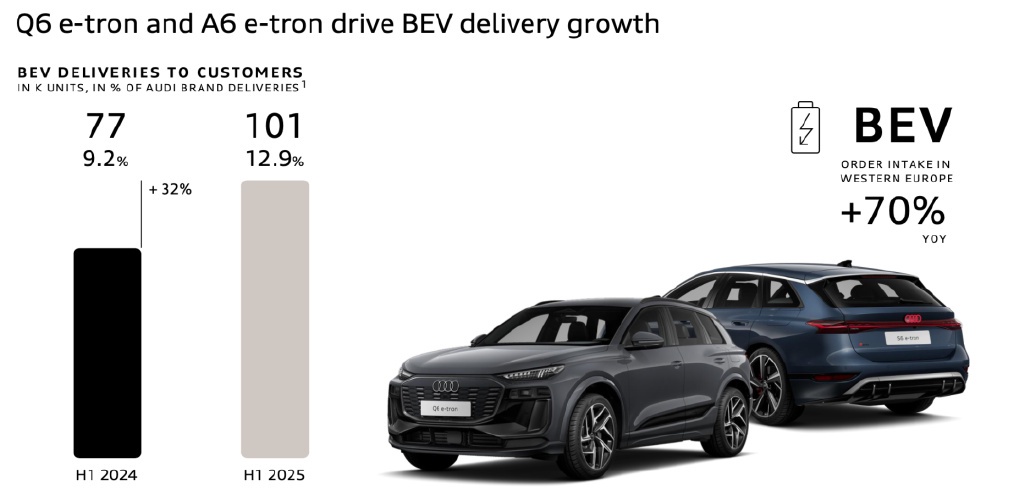
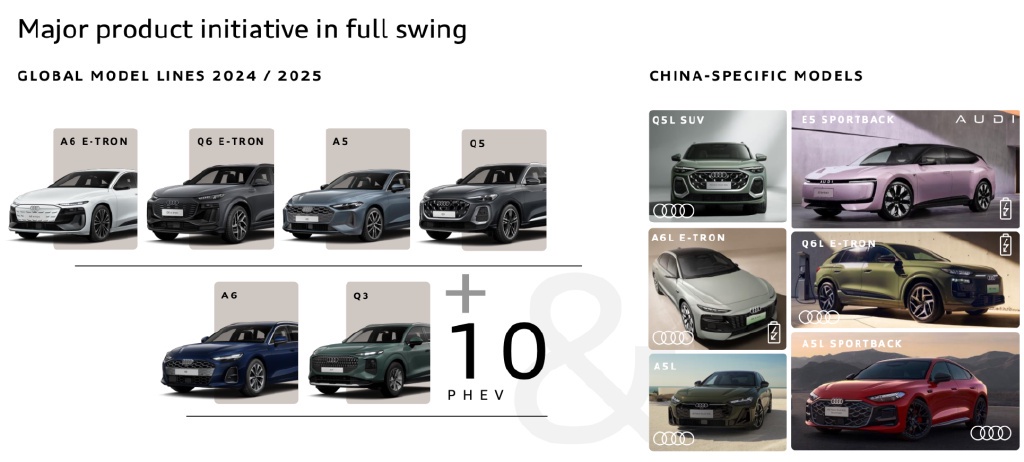
For example, Audi'sA6 e-tronand Q6 e-tron series contributed 101,000 pure electric deliveries, a year-on-year increase of 32%. However, high upfront investments and limited profit releases have left most automakers in a dilemma of "volume increase but profit decline." We will analyze Audi's situation next.

Part 1
German Luxury Car Groups
Revenue and Profit Structure Comparison, Audi's Growth Against the Trend
● Mercedes-Benz Group's revenue in the first half of the year was 66.38 billion euros, down 8.6% year-on-year, equivalent to approximately 550.4 billion yuan. EBIT was 4.53 billion euros, with a profit margin of 6.8%, and net profit fell by 55.8%.
● BMW Group's revenue fell slightly by 8% to 67.69 billion euros(about 561.2 billion yuan), with EBIT of 5.7 billion euros, a profit margin of 8.4%, and net profit down 29% year-on-year.
● Audi's revenue grew against the trend by 5.3% to 32.57 billion euros(about 270.1 billion yuan), but EBIT was only 1.09 billion euros, resulting in a profit margin drop to 3.3%.
● Porsche's revenue was 18.16 billion euros(about 150.7 billion yuan), with a profit margin of 5.6%, and net profit down 67.1% year-on-year.
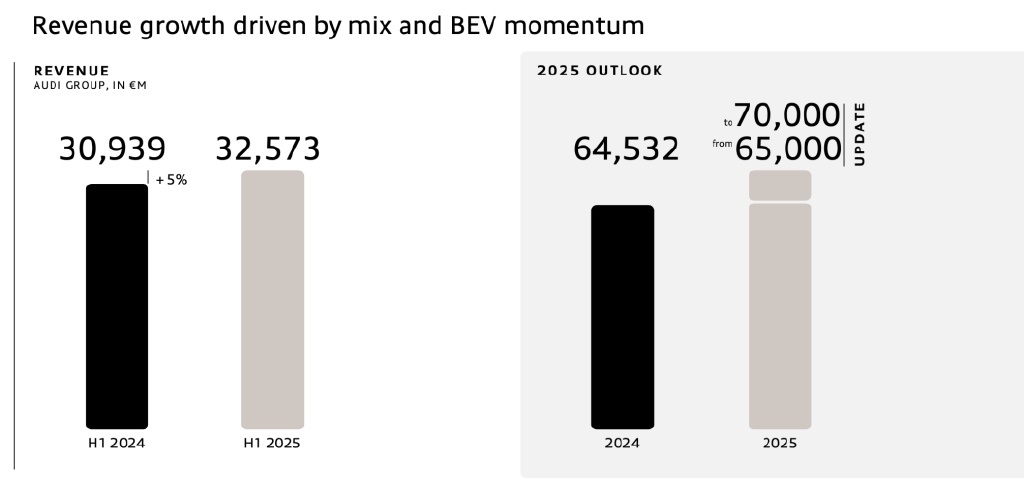
An analysis of the profit structure shows that BMW maintains relatively efficient profitability despite declining revenue, while Mercedes-Benz and Porsche face pressure from one-time restructuring costs, manufacturing, and market adjustments. Although its revenue grew, Audi's growth was mainly driven by the promotion of electric models, with insufficient profit contribution from traditional fuel and hybrid models.
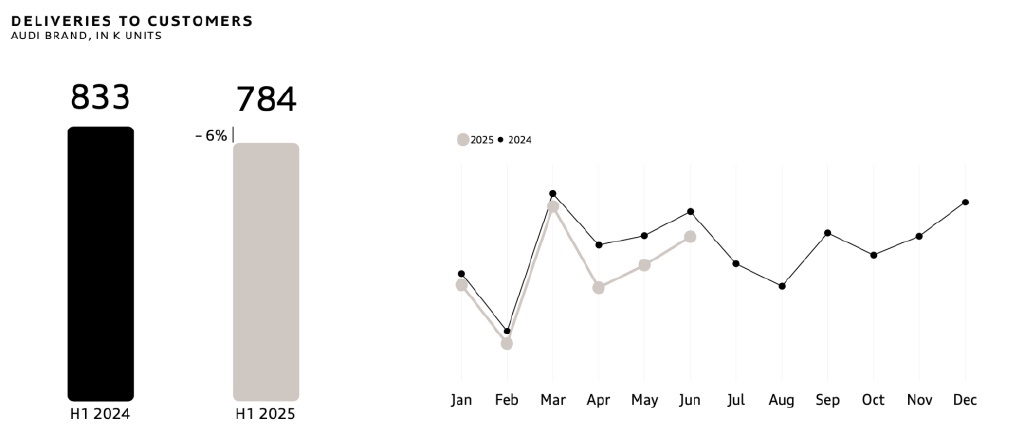
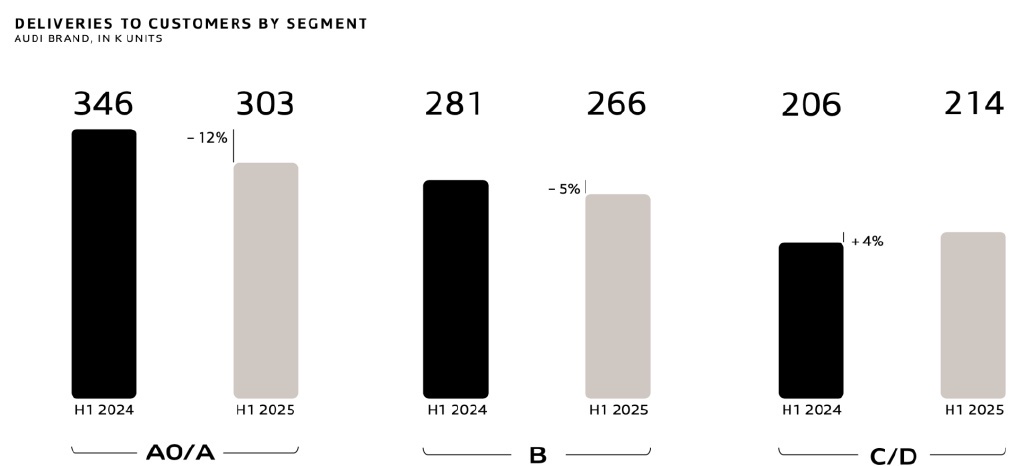
Audi's delivery data shows that total sales in the first half of the year were 784,000 units, down 6% year-on-year. Among them, sales of C/D-segment luxury sedans were about 303,000 units, B-segment compact models were 266,000 units, and the rebound in entry-level models contributed 206,000 units, a year-on-year increase.
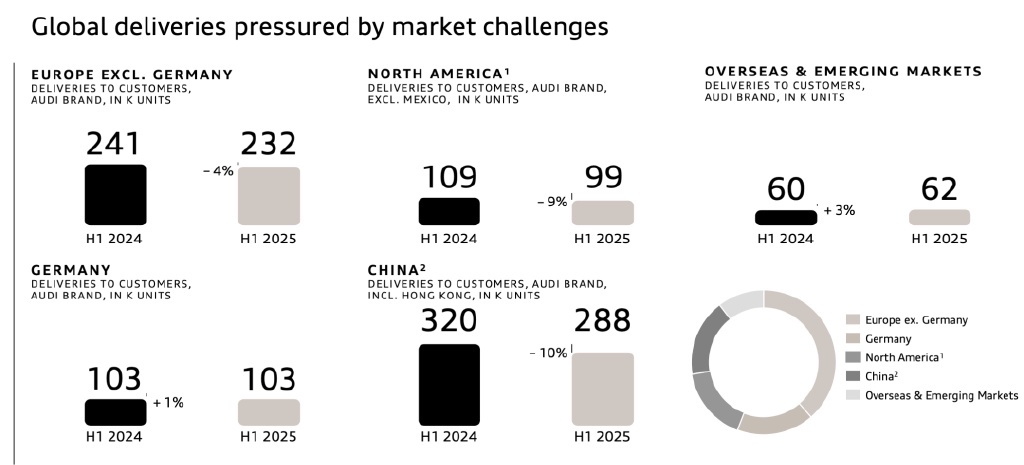
Regionally,
◎ Sales in the Chinese market were 288,000 units(-10%),
◎ North America was 99,000 units(-9%),
◎ Europe excluding Germany was 232,000 units(-4%), while the German domestic market remained stable.
In terms of electric models, Audi delivered 101,000 pure electric vehicles, accounting for 12.9% of total sales, a year-on-year increase of 32%, mainly driven by the A6 e-tron and Q6 e-tron families. Orders for pure electric vehicles in Western Europe grew by as much as 70%.
In terms of R&D and capital investment, all groups have reduced the proportion of R&D to revenue, with BMW and Audi maintaining around 6.5% to 8%, while capital expenditure remains at about 3.5%.
Overall cash flow has declined significantly, with marginal improvements expected in the second half of the year through cost control and product structure optimization.

Part 2
Audi's Development Path
From the performance of Volkswagen Group's brands, the differentiation between different positioning is intensifying, reflecting the "stratification" trend in the entire automotive market.
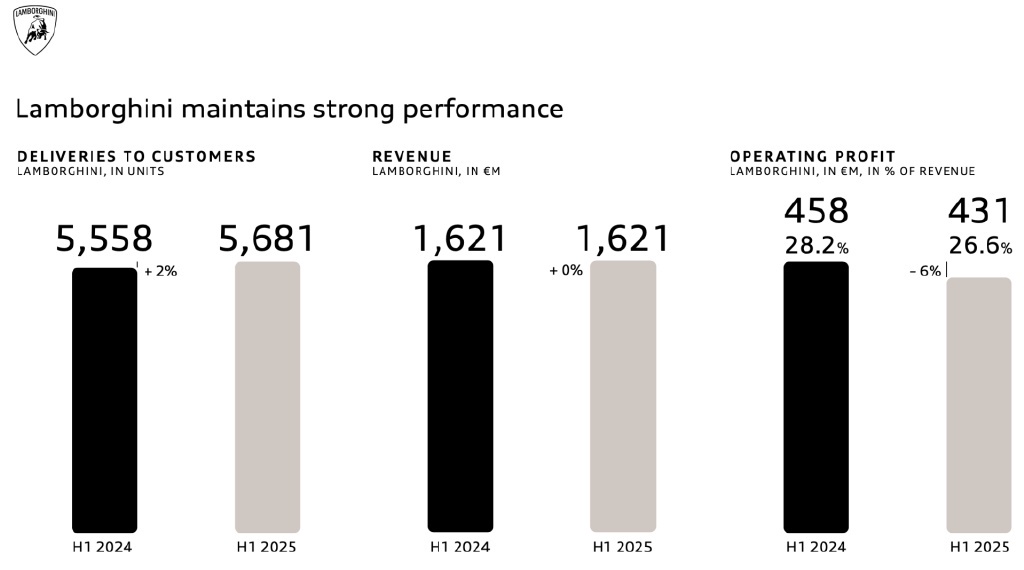
For example, the ultra-luxury brandLamborghininot only saw a 2% increase in sales against the trend but also maintained a profit margin of over 26%, demonstrating the strong risk resistance of the high-end market—wealthy people will still buy.
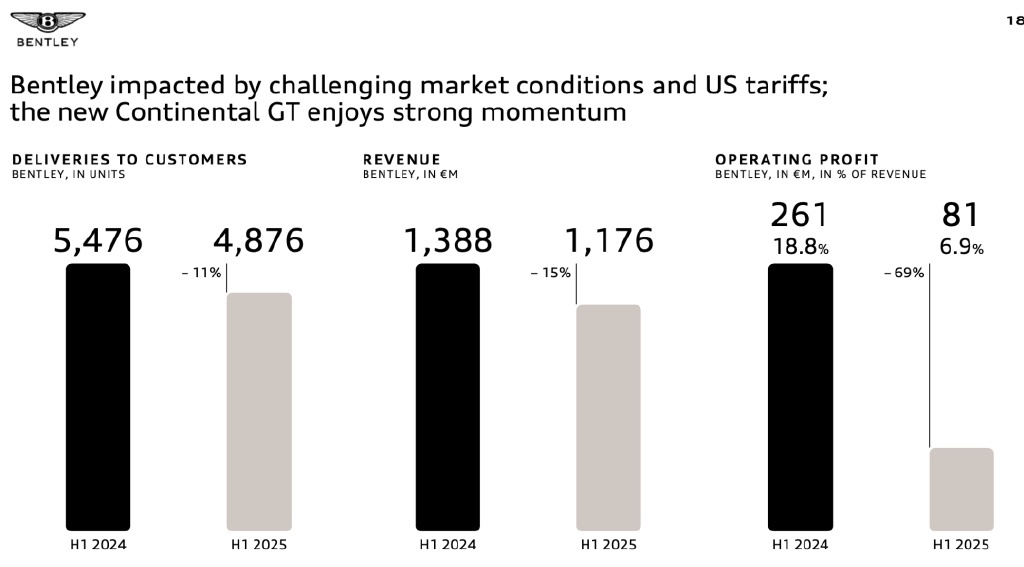
On the other hand,Bentley, also part of the ultra-luxury camp, was not so lucky.
Due to U.S. tariff increases, profits directly plummeted by 69%. This rise and fall precisely illustrate that brands in different price bands have completely different sensitivities to policy changes.
This is also forcing Volkswagen Group to rethink how to allocate resources: brands like Lamborghini are responsible for "stabilizing the profit base," while main brands like Audi must shoulder the banner of "electrification transformation."
The financial report mentions a key phrase: "weak sentiment in the electric vehicle market." Europe and the U.S. are becoming increasingly hesitant about electric vehicles, and with the poor economy, consumers in these regions find high-priced electric vehicles "less appealing" in the absence of price advantages.
Audi's electric vehicle launch pace is generally acceptable. This is a game of "trading time for space."
Traditional fuel vehicles can still bring cash flow to the group, but the window is closing; before this wave recedes, the electric vehicle business must be nurtured to "self-sufficiency," forming its own cash flow loop.
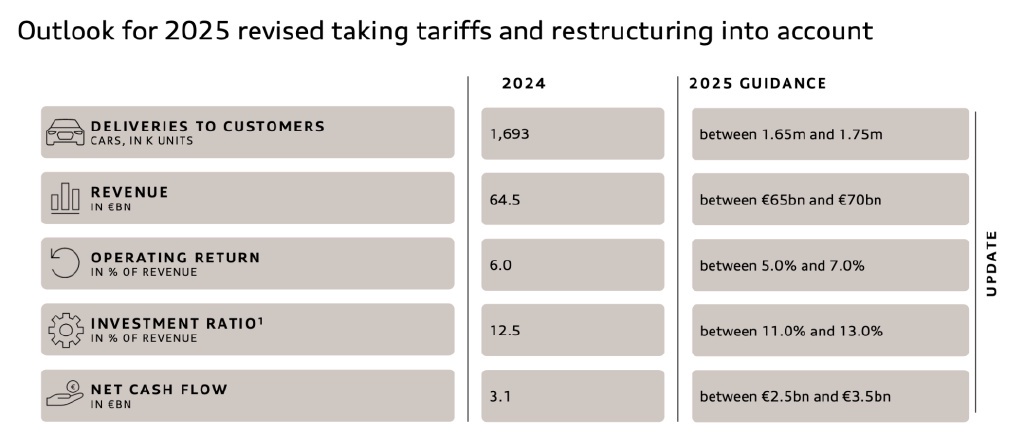
In the 2025 outlook, Audi provided an expected range of "1.65-1.75 million deliveries and 2.5-3.5 billion euros in cash flow," giving the market a "precautionary shot" and leaving room through more flexible profit strategies.
Summary
As of the first half of 2025, the German luxury car market shows divergent developments among groups in terms of revenue, profit structure, and technological paths. BMW maintains strong traditional profitability, Audi's revenue grows but profits are weak, and Mercedes-Benz and Porsche face cost and transformation pressures.
Audi's A6 e-tron and Q6 e-tron electric models drive pure electric sales growth with high-efficiency, high-performance technological positioning, while the Q3 hybrid solution demonstrates a smooth transition to electrification in the mid-size SUV segment.
The copyright of this article belongs to the original author/organization.
The views expressed herein are solely those of the author and do not reflect the stance of the platform. The content is intended for investment reference purposes only and shall not be considered as investment advice. Please contact us if you have any questions or suggestions regarding the content services provided by the platform.
