

Asian Auto Market | Thailand's Auto Market to Undergo Major Changes in the First Half of 2025! Chinese Brands Enter the Mainstream

In the first half of 2025, the automotive market in Thailand underwent a significant shift. The traditional Japanese Big Three still dominate the top spots, but Chinese car brands are moving from the periphery to the mainstream. The starting point of this transformation is not new.
Since 2022, brands like BYD, MG, XPeng, Neta, and Aion have entered the Thai market, initially seen as price-driven supplementary options. However, by the first half of 2025, Chinese companies have become the main drivers of the increase in new energy vehicle penetration.
According to data from the Passenger Car Association and the Thai Automotive Association, Chinese brands now account for over 80% of the pure electric vehicle market and have exceeded 15% of the overall passenger car market for the first time.
Sales figures are just the surface; the real change lies in the supply structure. Over the past six months, Chinese automakers have continuously introduced models better suited to Southeast Asian needs, while also promoting local assembly, expanding sales networks, and accelerating charging infrastructure development.
From policy adjustments to shifts in consumer perception, Chinese brands have not only improved the "usability" of electric vehicles but are gradually enhancing their "desirability."
01
Thailand's Automotive Market:
Traditional Fuel Vehicles Are Slowly Losing Dominance
In June 2025, Thailand's total new car sales reached 53,500 units, showing a month-on-month recovery. Cumulative sales for the first half of 2025 stood at 319,600 units, gradually stabilizing due to a low base and policy support.
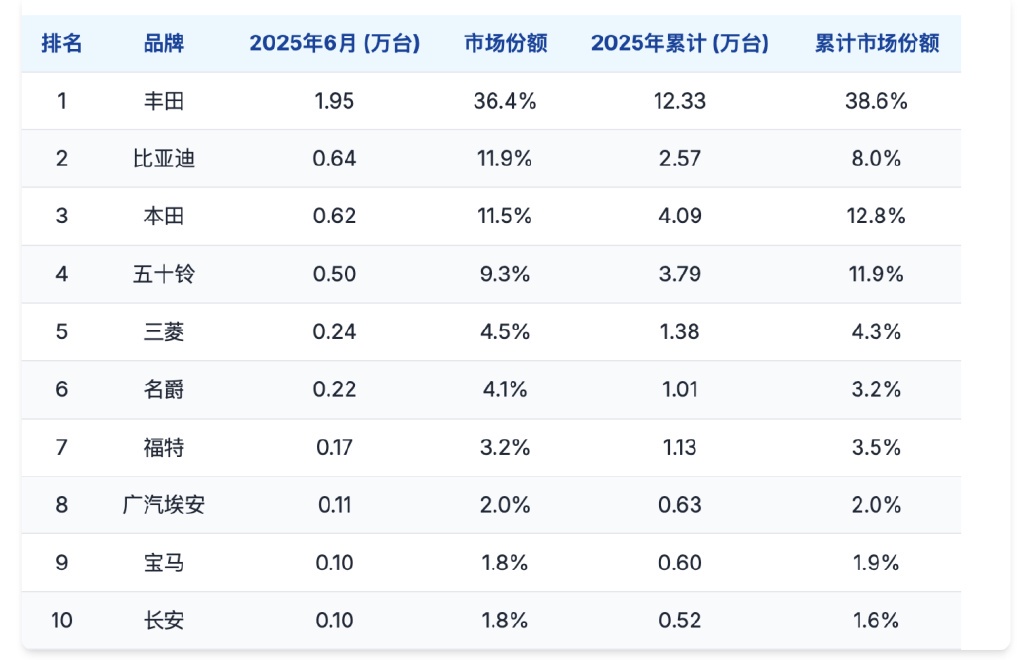
From a market share perspective,
◎ Toyota remained the leader with a 36.4% market share, though this was slightly down from 38.6% in the same period last year, as its share was eroded by rapidly rising new energy brands.
◎ BYD sold 6,380 units in June, capturing an 11.9% market share, surpassing Honda (6,183 units, 11.5%) for the first time to become the second-largest brand in Thailand.
◎ Isuzu ranked fourth with 4,998 units (9.3%),
◎ followed by Mitsubishi (4.5%), MG (4.1%), Ford (3.2%), and other Japanese and joint-venture brands.
◎ GAC Aion and Changan also entered the top ten for the first time, showcasing the collective momentum of Chinese brands in the Thai market.
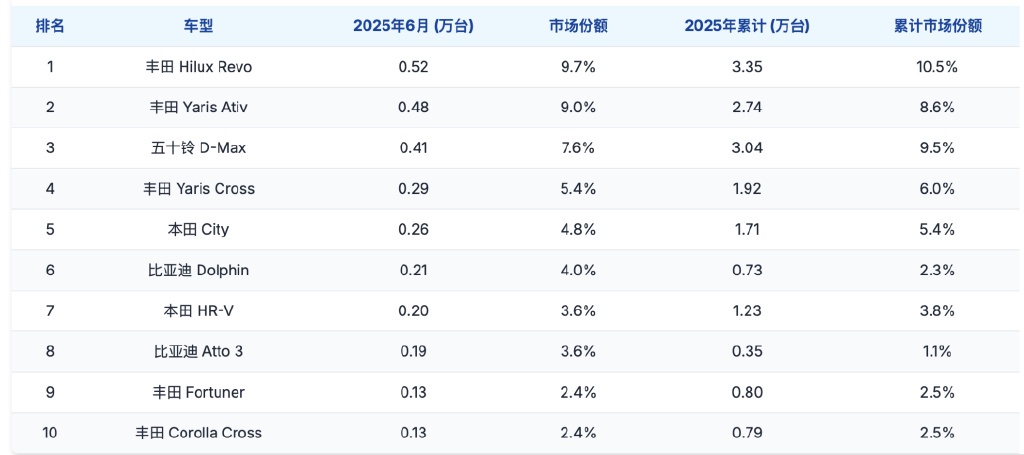
From a model perspective, pickup trucks and compact cars remain the mainstream choices for Thai consumers.
◎ The sales champion was still the Toyota Hilux Revo (5,170 units),
◎ followed by the Yaris Ativ (4,814 units) and the Isuzu D-Max (4,073 units).
◎ Among new energy models, the BYD Dolphin ranked sixth with 2,141 units, while the Atto 3 and Seal 7 also made it into the top ten and top fifteen, respectively, indicating a growing consumer base for electric vehicles in Thailand.
From a powertrain perspective, while hybrid and traditional fuel vehicles still dominate the market, the penetration rate of pure electric vehicles is rising rapidly.
Among the top 20 best-selling models in June 2025, several electric vehicles made the list, including the BYD Dolphin, Atto 3, MG4, Seal 7, Tesla Model Y, and Ora Good Cat, indicating a significant improvement in Thai consumers' acceptance of electric vehicles.
Thailand's automotive market is at a turning point where fuel and electric vehicles coexist, and competition between traditional brands and new players is intensifying. The penetration of Chinese brands is the most impactful variable in this shift.
02
Chinese Brands' Collective Push:
BYD Leads as New Energy Accelerates Market Penetration
Chinese brands performed particularly well in Thailand's June 2025 market.BYD, GAC Aion, Changan, MG, Ora, XPeng, Geely, Denza, Leapmotor, Neta, ZEEKR, and Great Wall all achieved varying degrees of sales growth, with their collective market share approaching 30%.
◎ Among them, BYD is the undisputed leader. In June, BYD sold 6,380 units in Thailand, capturing an 11.9% market share, with both month-on-month and year-on-year growth.
Its best-selling model, the Dolphin, sold 2,141 units, rising to sixth place; the Atto 3 sold 1,941 units, ranking eighth with significant month-on-month growth; the Seal 7 and Seal 6 also made the top twenty with 1,124 and 743 units, respectively.
BYD is establishing a three-pronged product structure in Thailand—compact cars, compact SUVs, and midsize SUVs—further broadening its target audience coverage.
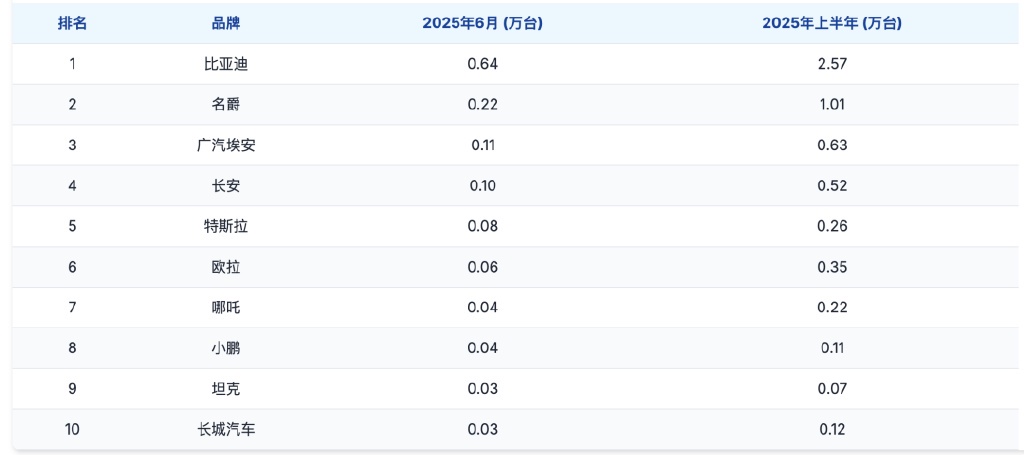
◎ The MG4 ranked eleventh with 1,211 units;
◎ The Ora Good Cat ranked 25th with 517 units, remaining visible on the list;
◎ GAC Aion's Y Plus, V, and Hyper HT models collectively sold 1,063 units;
◎ Changan achieved 866 units with its S07 and L07 models;
◎ The Denza D9 ranked 42nd with 246 units, becoming one of the few new energy MPVs in the mid-to-high-end segment to make the list;
◎ The XPeng X9 and G6 sold 198 and 165 units, respectively, quickly building local consumer awareness.
Beyond pure electric vehicles, hybrid products are also expanding.For example, the BYD Seal 6 DM-i hybrid sold 743 units in June, becoming the preferred choice for multi-scenario users in the new energy market, reflecting the local adaptability of its "electric + hybrid" dual-strategy approach.
From a competitive structure perspective,Chinese brands have established a certain scale effect in Thailand's market, thanks to their comprehensive new energy product lineup, strong price-performance ratio, and continuous local channel development.
BYD, in particular, has rapidly transitioned from a "backup brand" to a "mainstream option" through SKD assembly, channel expansion, and localized marketing. Other brands like GAC Aion, Changan, Ora, and XPeng are targeting different market segments with diverse models and differentiated designs, forming a tiered support system for the overall Chinese brand image.
Summary
The rise of Chinese brands in Thailand is not solely driven by low prices or subsidies. What truly determined the outcome in the first half was product strength and responsiveness. Chinese automakers have faster product cycles and updates, better aligning with consumers' actual needs.
The first half of 2025 was a critical period for Chinese automakers to achieve a "quantitative to qualitative" transformation in Thailand. Japanese brands still have a strong user base and channel system, especially in the pickup truck and B-segment markets, where Chinese brands have yet to make significant inroads.
The copyright of this article belongs to the original author/organization.
The views expressed herein are solely those of the author and do not reflect the stance of the platform. The content is intended for investment reference purposes only and shall not be considered as investment advice. Please contact us if you have any questions or suggestions regarding the content services provided by the platform.
