

Don't be fooled by the '193.1% surge in half-year profits.' Tasly is still dealing with the 'blockbuster product crisis.'

During this round of intensive earnings disclosures, Darentang released its report card earlier than its "big brother" Tongrentang.
The financial report shows that in the first half of this year, Darentang achieved operating revenue of 2.65 billion yuan, a year-on-year decrease of 33.1%; net profit attributable to the parent company reached 1.93 billion yuan, a significant year-on-year increase of 193.1%.
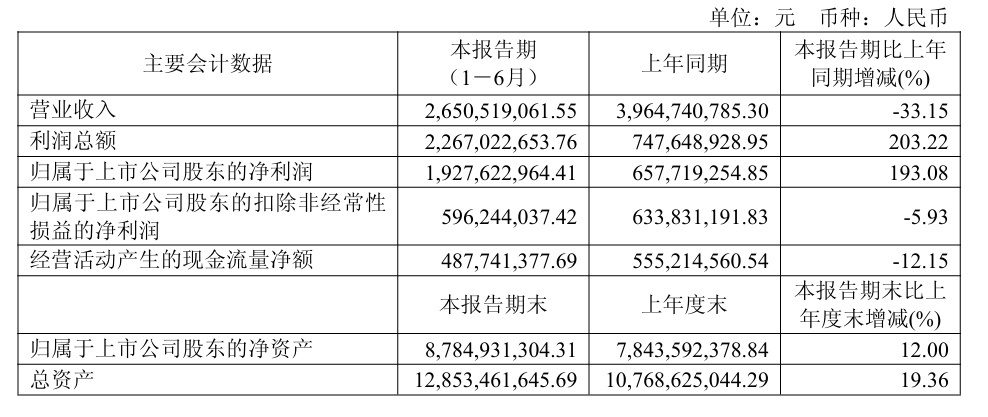
According to Darentang's explanation, product factors do not seem to have a decisive impact on the above performance trends. The sharp decline in revenue is mainly related to strategic equity adjustments, while the surge in net profit is largely influenced by the disposal of non-recurring assets.
If we set aside these factors, we can still see Darentang's true and not-so-optimistic operational foundation. Among them, the flagship product Suxiao Jiuxin Pill remains the central pillar, providing us with an observation point.
The Operational Foundation Under the "Single Product Crisis"
First, let's discuss the direct reasons for the ups and downs in Darentang's performance.
According to the financial report, the sharp decline in Darentang's revenue in the first half of this year was mainly due to the company's decision at the end of 2024 to transfer all equity of its wholly-owned subsidiary Tianjin Zhongxin Pharmaceutical Co., Ltd. to Tianjin Pharmaceutical Taiping Pharmaceutical Co., Ltd. in the form of capital increase. The pharmaceutical commercial sector was removed from the company's consolidated scope, and its revenue was no longer recognized this year, leading to a year-on-year decline in mid-year revenue.
After excluding this factor, Darentang's pharmaceutical industrial sector achieved operating revenue of 2.645 billion yuan, a slight year-on-year increase of 0.87%.
The surge in net profit attributable to the parent company was mainly due to Darentang's transfer of 12% equity in Sino-American Tianjin SmithKline Pharmaceutical Co., Ltd., resulting in a net after-tax gain of 1.308 billion yuan. Excluding this factor, Darentang's net profit attributable to the parent company, excluding non-recurring gains and losses, was 596 million yuan, a year-on-year decrease of 5.93%.
It is not hard to see that Darentang's actual business performance is struggling.
Specifically, the biggest contributor to growth in this reporting period remains Darentang's flagship product—Suxiao Jiuxin Pill. The financial report shows that in the first half of this year, the sales of Suxiao Jiuxin Pill (including tax) reached 1.128 billion yuan, a year-on-year increase of 5.45%, which still appears to be in an upward trend, but its explosive growth is no longer what it used to be.
It is reported that the sales of Suxiao Jiuxin Pill first exceeded 1 billion yuan in 2018 and reached 2 billion yuan in 2023, doubling in five years, which was quite impressive. However, in 2024, the sales of this product (including tax) were 1.98 billion yuan, showing almost no growth compared to 2023, and the single-digit growth in the first half of this year was not particularly surprising.
Darentang's "single product crisis" has indeed emerged.
First, competition is inevitable. Although Suxiao Jiuxin Pill is a state-classified secret product with significant exclusive advantages for Darentang, it cannot withstand the continuous emergence of similar drugs. It is reported that for the prevention and treatment of cardiovascular diseases, patients can choose not only Suxiao Jiuxin Pill but also products like Shexiang Baoxin Pill and Compound Danshen Dripping Pill, as well as Western alternatives such as nitroglycerin and beta-blockers, which are even faster-acting and cheaper.
Under these circumstances, it is already difficult for Suxiao Jiuxin Pill to expand its market share. According to Zhongkang data, from January to August 2024, Suxiao Jiuxin Pill's brand sales in retail pharmacies reached 560 million yuan, accounting for 11.8% of the national market share, with only a 0.9% year-on-year increase.
In addition, the normalization and institutionalization of centralized procurement and fluctuations in the prices of traditional Chinese medicine raw materials will also have a certain impact on the sales volume of core products.
Darentang mentioned in its financial report, "The Kangmei·China Traditional Chinese Medicine Price Index rose from 1,246 points in January 2020 to 2,250 points in June 2024. Since then, the index has adjusted to 1,761 points by mid-year. Although the index has declined significantly over the past 12 months, it is still significantly higher than the levels before 2021. In the coming years, the overall trend of traditional Chinese medicine raw materials may continue to fluctuate at high levels, and ensuring stable supply and controllable prices of raw materials has become a operational challenge for the industry in recent years."
As the "single product crisis" gradually becomes apparent, Darentang has long been aware of the need to break the deadlock and has launched the "Three Cores and Nine Wings" product strategy, but this is more of a long-term battle.
Darentang Equipped with "Three Cores and Nine Wings"
What is the "Three Cores and Nine Wings"? Darentang also provided a detailed explanation in this semi-annual report.
First, the "Three Cores." The first core is the "Chinese Heart" series of cardiovascular and cerebrovascular health products represented by Suxiao Jiuxin Pill, which includes 8 exclusive products and 42 drug approvals in the cardiovascular and cerebrovascular field. The second core is the "Chinese Skin" series of products represented by Jingwanhong Ointment, with 8 external skin product approvals. The third core refers to the "Chinese Brain" plan series of products represented by Niuhuang Qingxin Pill and Qinggong Shoutao Pill, which have unique effects in anti-aging, memory improvement, and Alzheimer's disease treatment.
Next are the "Nine Wings," which focus on nine categories such as respiratory, digestive, rheumatic and bone pain, women and children, and tumors.
It can be seen that Darentang has ambitious plans, attempting to open up vast growth space through a broad product matrix covering multiple dimensions and health management throughout the entire life cycle, including prevention, health care, treatment, rehabilitation, and longevity.
In the first half of this year, the company has also actively implemented the "Three Cores and Nine Wings" strategy with frequent actions.
For example: In brand building, Darentang has registered a total of 1,319 trademarks, and its brands have continued to increase exposure in various media, with growing influence; in marketing innovation, the company has transitioned from "1.0 sales upon production" to "2.0 push-pull combination," strengthening 3S (Sell In, Sell Through, Sell Out) management and enhancing Sell Out operational capabilities; in technical R&D, the company has completed pilot studies for two hospital preparation-to-new drug projects, promoted feasibility assessments for traditional Chinese medicine patch projects, and established the correlation between the active ingredients of "Jingwanhong Ointment" and skincare raw materials.
This has refreshed the public's perception of its product structure, and there is certainly "quantitative change." The most obvious example is the 52.28% year-on-year increase in sales (including tax) of Qingyan Dripping Pill, but it is still only 289 million yuan, which is not as prominent as the contribution of Suxiao Jiuxin Pill and still requires a cultivation period.
In addition, how to allocate resources reasonably during business expansion is also a core issue.
For a long time, Darentang has shown a clear tendency to prioritize marketing over R&D. The financial report shows that from 2022 to 2024, Darentang's R&D expenses were 153 million yuan, 185 million yuan, and 162 million yuan, respectively, while sales expenses were 1.969 billion yuan, 2.126 billion yuan, and 2 billion yuan, respectively. In the first half of 2025, the company's R&D expenses increased by 31.94% year-on-year to 61.55 million yuan, but there is still significant room for improvement compared to sales expenses exceeding 1 billion yuan.
Overall, it is clearly not easy for Darentang to "make an elephant dance."
Source: Pharmaceutical Research Society
The copyright of this article belongs to the original author/organization.
The views expressed herein are solely those of the author and do not reflect the stance of the platform. The content is intended for investment reference purposes only and shall not be considered as investment advice. Please contact us if you have any questions or suggestions regarding the content services provided by the platform.
