

 SNXX
SNXX TQQQ Return Rate
"AI OS", the super platform for the next two decades.

$Alphabet(GOOGL.US) $Microsoft(MSFT.US)
Introduction
Every shift in human-computer interaction paradigms reshapes the tech landscape.
From Windows in the PC era to iOS/Android in the mobile internet era, operating systems are not just software platforms but dominant forces in ecosystems.
- PC Era: Operating systems (Windows/macOS) became moats.
- Smartphone Era: iOS/Android defined ecosystems, with Apple gaining an edge through a closed experience.
- AI Era: The paradigm of human-computer interaction evolves (voice, conversational assistants, multimodal), and the moat of operating systems is being breached by large models.
Now, we are entering the era of AI operating systems (AI OS). And this time, Google is leading the charge.
1. From "Assistant" to "Kernel": The Systemic Evolution of AI
In the past, Google Assistant was just an app and tool on Android.
In Android 16, Gemini has been integrated into the underlying interaction logic of the OS, becoming the new system kernel.
This means:
- Voice, visual, and multimodal interactions are no longer add-ons but native to the system.
- The way users interact with phones is redefined: from "open an app → input commands" to "natural conversation → automatic completion."
In other words, Android is transitioning from a "mobile OS" to an "AI-native OS."
2. Pixel: The Validator of AI OS
Google isn’t just betting on software; it’s using the Pixel lineup to unleash the power of AI OS:
- Tensor G5 chip + Gemini Nano ensures on-device model operation.
- Magic Cue: Automatically pulls up Gmail, Calendar, and Messages in conversations for contextual assistance.
- Camera Coach: Provides real-time guidance on framing and shooting.
- Gemini Live: "Sees" what the user sees through the camera and offers real-time guidance.
Pixel’s role is as an incubator for new features and the best testing ground for integrating Gemini with hardware.
3. OEM Flywheel: Taking Gemini Global
Google’s strategy isn’t limited to Pixel.
With Circle to Search, Google has already pushed the feature onto hundreds of millions of devices from Samsung, Xiaomi, and other OEMs.
In the future, Gemini will become a standard for Android manufacturers, even a "must-have for differentiation."
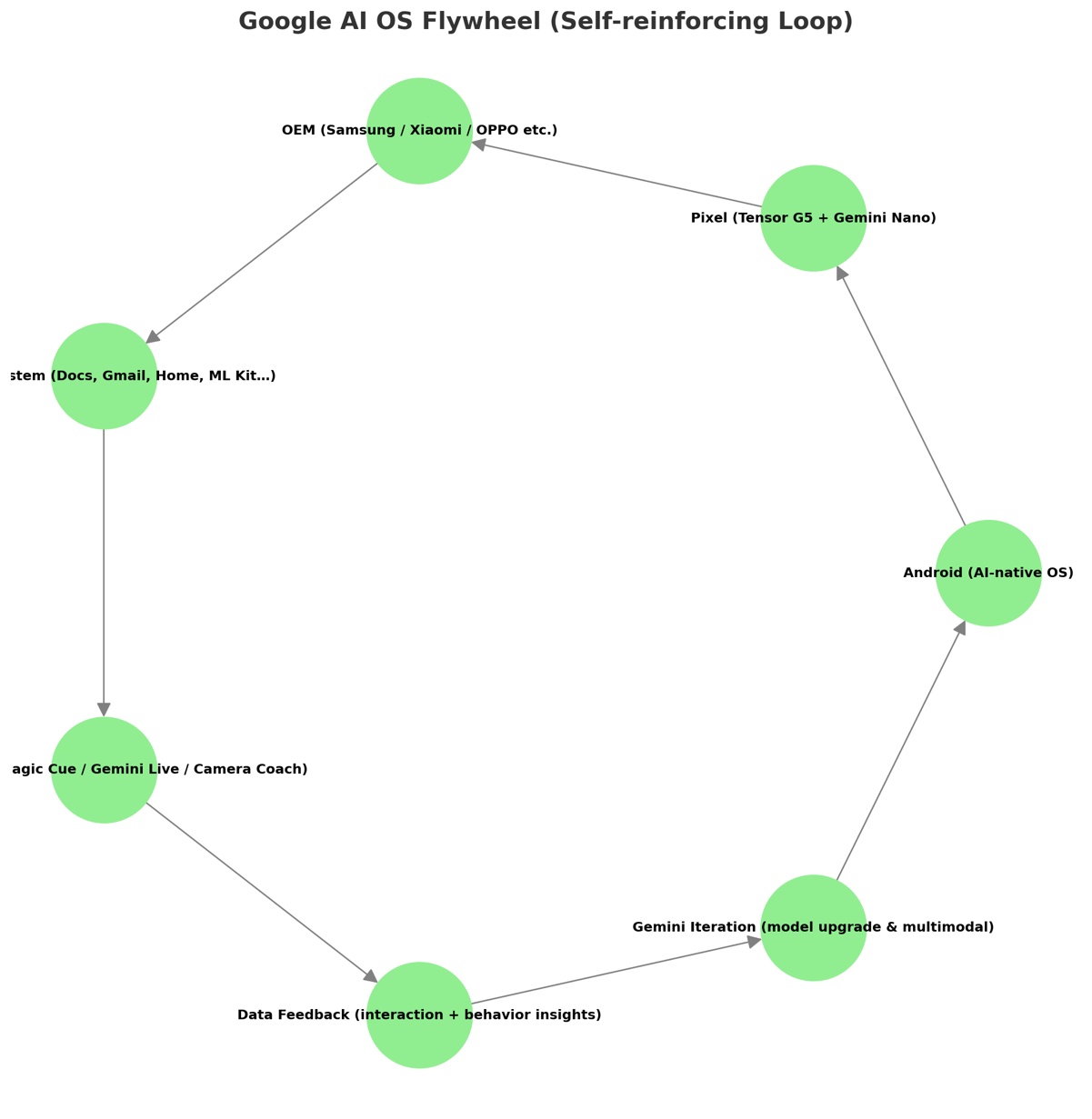
This creates a classic flywheel effect:
- Pixel validation → OEM adoption → device proliferation → user habit shifts → data feedback → Gemini iteration.
Once OEMs fully adopt it, Android will no longer be a "mobile OS" but a global AI OS.
4. App Ecosystem: Gemini Pervades Everything
Google is integrating Gemini into the entire app and developer ecosystem:
- Productivity: Docs, Gmail, and Sheets already support AI-assisted writing and image generation.
- Home: Gemini for Home lets users control lights, temperature, and security with natural language.
- Health: Fitbit Premium integrates with Gemini Health Coach for personalized health assistance.
- Developer Platform: ML Kit opens APIs like Summarization and Image Description for on-device Gemini Nano calls by third-party apps.
Gemini isn’t just an "assistant" but a common capability layer for the app ecosystem.
5. User Habits and Data Feedback
When Magic Cue automatically pulls up your schedule,
When Gemini Live helps you navigate with the camera,
When Camera Coach teaches you to take better photos—
Users will gradually adopt an AI-first interaction habit.
These interactions, under privacy compliance, will feed back as data, driving Gemini’s continuous iteration.
The result is a self-reinforcing cycle:
System → hardware → OEM → apps → users → data → model → system.
Google has built an AI OS flywheel.
6. Gemini Iteration: Infinite Evolution
Google’s model roadmap (Gemini 1.5 → 2.0 → 2.5 Pro → Deep Research) shows:
Gemini isn’t just an assistant but an infinitely evolvable intelligent operational layer.
Each iteration will quickly reach users through Pixel and Android, accelerating the flywheel.
Conclusion: The Super Platform of the Next Two Decades
The essence of an operating system has never been "desktop icons" or "phone interfaces" but the gateway to human-computer interaction.
Today, through Android + Pixel + Gemini, Google is pushing AI from the app layer to the system layer, creating an unprecedented AI OS.
In the next two decades, the competition for super platforms won’t be hardware vs. hardware,
but who controls the gateway to AI-native operating systems.
Google is seizing this opportunity.
The copyright of this article belongs to the original author/organization.
The views expressed herein are solely those of the author and do not reflect the stance of the platform. The content is intended for investment reference purposes only and shall not be considered as investment advice. Please contact us if you have any questions or suggestions regarding the content services provided by the platform.
