

Kuaishou strengthens AI narrative

Kuaishou delivered a quite impressive quarterly report, but what's more attention than the performance data is that Kuaishou has reshaped its valuation logic with AI narratives.
Let's talk about the performance itself first.
Revenue reached 35.05 billion yuan, exceeding market expectations of 34.45 billion yuan, with a year-on-year growth rate of 13.1%, the highest in the past five quarters. However, to be fair, part of the accelerated growth was influenced by the base effect, as revenue began to slow down in Q2 last year and continued until Q4.
Non-GAAP net profit was 5.62 billion yuan, surpassing the market consensus of 5.06 billion yuan. Not only did net profit hit a quarterly record high, but the profit margin also reached a historic high of 16%.
Considering Kuaishou's strong investment in AI and the robust growth momentum and prospects of Kling AI, this means Kuaishou is winning in the present while focusing on the future.
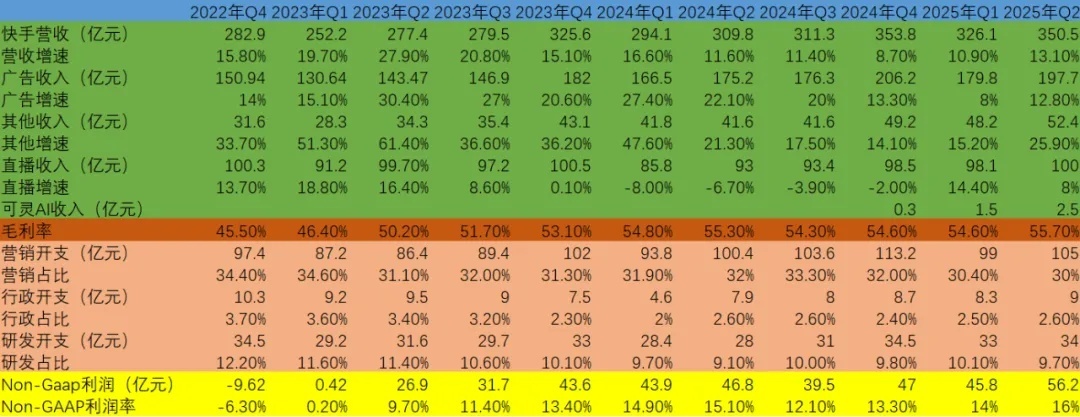
Breaking down by business segments, core advertising revenue was 19.77 billion yuan, up 12.8% year-on-year, significantly higher than in Q1. However, as we mentioned in the Q1 analysis, the low growth in Q1 was due to the high base in Q1 2024, so the growth performance this quarter is excellent but expected.
Live streaming revenue was 10 billion yuan, showing steady growth both quarter-on-quarter and year-on-year.
Other business revenue reached 5.24 billion yuan, a record high, with a year-on-year growth rate of 25.9%, significantly faster than the past four quarters, mainly driven by better-than-expected e-commerce GMV and accelerated revenue from Kling AI.
This quarter, Kling AI recorded revenue of 250 million yuan. Over the past three quarters, this figure was 30 million (a rough estimate, as public data only shows historical revenue of 100 million yuan up to February), 150 million, and 250 million yuan, respectively.
Kling AI's revenue in the first half of the year was 400 million yuan. Barring any surprises, it is highly likely that annual revenue will exceed 1 billion yuan.
Kuaishou's gross margin this quarter reached a record high of 55.7%, benefiting from both the increased proportion of high-margin businesses like advertising and AI-driven cost and profit margin optimization.
Looking ahead, this trend of gross margin improvement can continue, or at least be maintained at this high level. In the short term, with the resurgence of local life competition in Q3 and increased marketing efforts by major players, advertising revenue for traffic platforms should be secure.
Major operating expenses include marketing, administrative, and R&D. This quarter, these three items remained stable. Marketing expenses increased slightly by 4.6% year-on-year, with the revenue share further declining to 30% due to operating leverage, also the lowest in history. Administrative expenses were 900 million yuan, with a stable revenue share. R&D expenses were 3.4 billion yuan, up slightly year-on-year, also benefiting from operating leverage to reduce the revenue share.
With accelerating revenue growth, improving gross margins, and reasonable operating expenses with their share declining, it's hard not to see good profits.
At the same time, while overseas business grows steadily, it can also turn from a loss-making segment into a profit driver. Kuaishou is gradually taking on the appearance of a stable player.
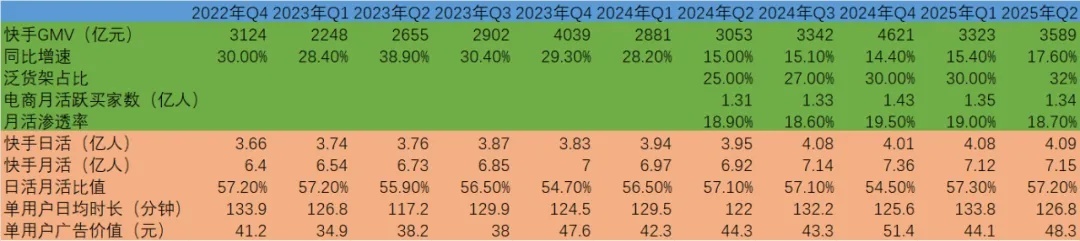
From an operational data perspective, Kuaishou's GMV this quarter reached 358.9 billion yuan, up 17.6% year-on-year, which is somewhat surprising.
On one hand, Kuaishou's GMV had dropped sharply to around 15% over the past four quarters, and the market was once worried it would continue to decline to single digits. This quarter's rebound may also be partly due to the "low base in Q2 last year," but it also shows that at least Kuaishou's e-commerce ecosystem is relatively stable.
On the other hand, since the second half of 2024, live-streaming e-commerce has faced some headwinds at the policy level, especially for the core influencer-driven live-streaming e-commerce model. Kuaishou's e-commerce performance this quarter has somewhat alleviated market concerns.
But based on the information I've gathered, the trend in live-streaming e-commerce remains slightly cautious. We don't need to be overly pessimistic, but we shouldn't be blindly optimistic either. A neutral judgment is appropriate.
From the perspective of the share of general shelf GMV, this quarter hit a new high of 32%, which may be an important reason for Kuaishou's e-commerce resilience.
Of course, the company has introduced many policies to support both new and existing merchants and influencers, and the operating environment for live-streaming e-commerce continues to improve. These subjective efforts cannot be ignored.
Key operational metrics like monthly active buyers, daily active users (DAU), and monthly active users (MAU) all showed steady performance, with DAU hitting a new record.
As mentioned at the beginning of this article, what's more noteworthy than the performance itself is that Kuaishou is significantly strengthening its AI narrative and has already achieved very clear results.
Today's Kuaishou can increasingly be viewed through an AI lens rather than just as an e-commerce/content platform.
If you pay attention, you'll notice that starting from Q1 2025, Kuaishou has positioned AI as a separate "business unit" in its business review section, placing it in the first paragraph and dedicating significant space to it.
Additionally, the company has used AI to rebuild its two core ecosystems: content and commercialization.
We've previously mentioned that Kuaishou has two ecosystems—content and commercialization—and within commercialization, there are two sub-ecosystems: internal and external loops.
From the content ecosystem perspective, AI has penetrated core underlying systems like algorithm recommendations, effectively improving user engagement time and experience, not to mention the assistance and enhancement of content creation emphasized over the past few quarters.
In commercialization, AI's impact is even more significant. It helps merchants with everything from ad creation and placement to private messaging interactions, personalized replies, and 24/7 live streaming. It also enables the platform to target more accurately, with end-to-end new technologies further improving ad efficiency, thereby encouraging clients to increase their investments.
Now, short-video dramas, small and medium-sized merchants, and other clients are heavily using AI to automate marketing and services, reducing the operational costs of content, ads, and services.
Finally, and perhaps what the market is most interested in, is that Kuaishou's Kling AI is indeed impressive.
Revenue is the most straightforward aspect, and everyone has seen that.
I'd like to mention something less observable.
I occasionally use video generative AI myself. As everyone knows, due to computing power and technical bottlenecks, video generative AI is far less widely used than general large models. In terms of accessibility, usability, and cost, Kling AI is one of the top global players.
In my limited experience, Kling AI is the closest domestic AI video model to ChatGPT (GPT might be leveraging Sora's video model). However, Kling feels slower in generating images and videos, sometimes to the point of being unbearable.
For AI to work, the most critical factors are computing power and data.
Coincidentally, Kuaishou is well-prepared in both. It was one of the first major Chinese companies to venture into general video models, and its video data is among the top three in China.
Moreover, Kuaishou is pragmatic. From what I understand, it almost exclusively uses Nvidia chips, which is one reason Kling AI can maintain such intensive system updates.
Looking back, one of the earliest applications of AI was in advertising.
The success stories of Meta and APPLovin have already proven this, and this quarter Tencent also reinforced this consensus through its earnings report. Kuaishou happens to be on this track as well.
Finally, let's look at Kuaishou's valuation. Currently around 310 billion HKD, with this quarter's net profit of 5.62 billion yuan, annualized profit is estimated at about 20 billion yuan, or roughly 22 billion HKD, implying a PE of around 14x?
The current 30% marketing expense ratio still has room to decline—I mean, as the business matures—while advertising and other revenue shares continue to rise. This means Kuaishou can benefit from both gross margins and operating expenses in the long run.
If international expansion is not aggressive, overseas business still has room for profit improvement.
Even without considering potential optimistic factors like continued advertising expansion, stable e-commerce growth, AI-driven acceleration, gross margin improvement, and declining operating expense ratios, a cash flow valuation based on a mature business model suggests:
Assuming Kuaishou achieves 22 billion HKD in profit in 2025 and maintains a 4% compound growth rate thereafter, with a 10% discount rate, the DCF model values it at 380 billion HKD.
It's worth noting that internationally, mature companies typically use a 6%-9% discount rate, growth companies use 9%-12%, and small companies use 12%-20%. Here, we use 10%—to be conservative and considering our environment.
Thus, 380 billion HKD is already a very conservative valuation.
Of course, given the fierce competition in the short-video industry, Kuaishou also faces challenges to its market position. Additionally, geopolitical factors have led to significant discounts for Chinese stocks in general.
But weighing both positive and negative factors, I still believe Kuaishou is undervalued, with 400 billion HKD as a reasonable target, implying a target price of around 92.7 HKD.$KUAISHOU-W(01024.HK)
The copyright of this article belongs to the original author/organization.
The views expressed herein are solely those of the author and do not reflect the stance of the platform. The content is intended for investment reference purposes only and shall not be considered as investment advice. Please contact us if you have any questions or suggestions regarding the content services provided by the platform.
