

Decoding the Core Competitiveness of LiDAR Companies — Technology Layout and Market Performance

Recently, $Hesai(HSAI.US) and $ROBOSENSE(02498.HK) released their Q2 financial reports. The LiDAR industry has been in an upward trend, and both companies are expected to experience significant growth by 2025, not only in terms of rapid penetration in the automotive sector but also in large-scale deliveries in the robotics field. In the highly competitive LiDAR industry, which involves technology, capital, and delivery, neither bullish nor bearish views should be made hastily—details matter. As a seasoned investor, we don’t just look at revenue but also the 'quality' of revenue and the underlying 'structure.' A comparison across several dimensions reveals the clear winner.
R&D Investment: Not an 'Expense' but 'Capital'—Hesai’s Higher R&D Investment and Conversion Efficiency
In the valuation model for growth stocks, 'R&D expenses' should not be simply viewed as costs but as capitalized investments, with the core focus being conversion efficiency.
Based on publicly available information, a table was created showing that Hesai’s R&D investment has consistently been higher than RoboSense’s, with early-stage investment even doubling that of RoboSense. This indicates that Hesai started its in-house chip development earlier and invested more heavily, which later translated into significant market returns. Hesai’s AT128 generation already achieved in-house development of transceiver components, and the fourth-generation chip platform is set for mass production this year.
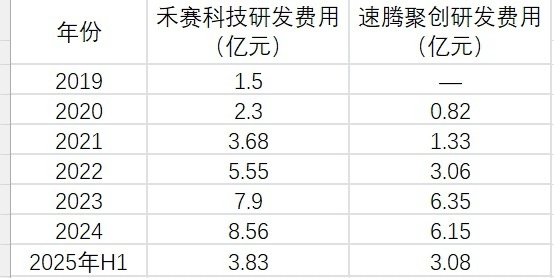
In contrast, RoboSense’s R&D expenses only increased after 2023, but it appears more focused on integrating and applying existing technologies, resembling a 'hardware assembly plant,' which explains its relatively higher gross margin pressure.
In-House Chip Development and Patent Portfolio Determine the Ceiling
Chips are the 'heart' of LiDAR, and the extent of in-house development greatly impacts LiDAR performance and cost. Hesai was the first LiDAR company in the industry to begin in-house chip development and establish its own production line. Starting from 2017, it achieved mass production by 2021 and completed the strategic acquisition of Swiss chip design company Fastree 3D, making it the LiDAR company with the earliest and deepest digital LiDAR patent portfolio globally. The FT120, released in 2023, is the world’s first automotive-grade digital LiDAR application, featured in the first mass-produced digital LiDAR vehicle model, the JiShi.
I’ve previously stated that Hesai could become the next CATL, but its approach to chips follows an 'Apple-style' vertical integration, ensuring full control over chip development. This means: rapid iteration (product definition is self-determined); steep cost reduction curves (cost control is in their hands); and high-performance limits. While RoboSense also develops chips in-house, its efforts are not as extensive or deep as Hesai’s, and it is widely known to rely heavily on Sony’s chips. Sony, after all, is not a LiDAR company, making this a suboptimal solution.
Some online sources claim RoboSense develops its own chips, but a look at the line count reveals that the 520-line LiDAR customized for ZEEKR uses Sony’s SPAD.

Market Performance: Delivery Volume Is the Litmus Test
Ultimately, the secondary market hinges on performance, and Q2 data is critical: Hesai delivered over 300,000 units in the ADAS sector, proving that the ATX has gained widespread market recognition following the success of the AT128. In contrast, RoboSense’s official report did not disclose ADAS performance, likely less than half of Hesai’s, indicating a lag. Its highly touted 520-line LiDAR has yet to enter mass production. Gaishi also announced Hesai as the top LiDAR supplier in China for the first half of the year. Behind RoboSense’s declining sales is the loss of key clients like BYD and ZEEKR to Hesai, and XPeng’s shift to pure vision, prompting RoboSense to pivot toward robotics.
After this analysis, anyone still claiming Hesai lacks technical prowess should take a closer look at the industry.
In summary, investing in tech stocks requires distinguishing between 'execution' and 'storytelling.' Hesai’s high R&D investment has translated into in-house chip development and patent barriers, leveraging technological advantages to capture market share, with scale reinforcing profitability and further R&D. This is a self-sustaining 'virtuous cycle' with clear logic.
RoboSense’s pivot to robotics, however, seems like a compensatory narrative after losing its early-mover advantage in chip development and facing setbacks in the critical ADAS battlefield, leading to client attrition.
When a company leads in technology, cost control, and market share, any claims of 'technical inferiority' are more likely the backlash of market underperformers. For investors, Hesai’s financial reports and delivery data outline a clear growth trajectory, warranting continued attention.
The copyright of this article belongs to the original author/organization.
The views expressed herein are solely those of the author and do not reflect the stance of the platform. The content is intended for investment reference purposes only and shall not be considered as investment advice. Please contact us if you have any questions or suggestions regarding the content services provided by the platform.
