


Jingyin Pharma in the IPO Battle of Hong Kong Stocks: siRNA Therapy as the Trump Card, but Commercialization Remains a Distant Star

Hong Kong IPO continues to be lively.
According to PharmaGo statistics, from September 22 to September 29, one pharmaceutical company has passed the hearing in the Hong Kong market, and four innovative pharmaceutical and medical device companies have submitted listing applications. Among them, a young pharmaceutical company founded in 2021 and dedicated to the development of siRNA (small interfering RNA) therapies has attracted considerable attention.
This company is Jingyin Pharmaceuticals, which has now submitted a listing application to the Hong Kong Stock Exchange, with Goldman Sachs, Haitong International, and HSBC serving as joint sponsors. It is reported that in the approximately four years since its establishment, the company has "frantically raised funds": completing a $60 million Series B financing in October 2023 and a $50 million Series B+ financing in May 2025, with cumulative financing nearing $150 million. Investors include Boyuan Capital, OrbiMed, Hongyuan Capital, Hankang Capital, and others.
Additionally, in May of this year, Jingyin Pharmaceuticals entered into a strategic partnership with CRISPR Therapeutics (hereinafter referred to as "CRISPR"). The two parties plan to share costs and global profits on a 50:50 basis to advance the development and commercialization of Jingyin Pharmaceuticals' next-generation long-acting siRNA therapy, SRSD107, including R&D funding support based on joint research plans.
Under the cooperation agreement, Jingyin Pharmaceuticals will receive $95 million in cash and cash equivalents as an upfront payment from CRISPR and is eligible for over $800 million in additional upfront and milestone payments, with potential total payments exceeding $895 million (approximately RMB 6.4585 billion).
At present, Jingyin Pharmaceuticals has become a "hot cake" in the capital market. How did it achieve this? Is an IPO a sure thing just because it's popular in the primary market?
Behind the Nearly $900 Million BD Deal
For the industry, the nearly $900 million BD deal achieved by Jingyin Pharmaceuticals in May is significant: it is the third BD outbound transaction in China's small nucleic acid field and a rare "high transaction value, joint development, and joint commercialization" model in the industry.
Moreover, CRISPR is no small player. Co-founded by a Nobel Prize winner in Chemistry, it went public on NASDAQ in 2016. It is a biopharmaceutical company focused on developing transformative nucleic acid drugs for severe diseases, currently boasting a diverse pipeline of candidate products covering a wide range of disease areas, including hemoglobinopathies, oncology, regenerative medicine, cardiovascular diseases, autoimmune diseases, and rare diseases.
In 2018, CRISPR advanced the first CRISPR/Cas9 gene-editing therapy into clinical trials for sickle cell disease and transfusion-dependent β-thalassemia, successfully developing the approved product CASGEVY®.
Overall, CRISPR is a gene drug R&D giant with a global market focus and extensive development experience. Under a long-term and deep collaboration model, it should provide significant support to Jingyin Pharmaceuticals. But how did CRISPR notice this startup pharmaceutical company?
In fact, Jingyin Pharmaceuticals has a high starting point. According to public information, the company was jointly founded by the globally renowned healthcare investment firm OrbiMed Entities and Creacion Ventures. It has established a dual-headquarters structure in the U.S. (San Diego, responsible for innovation) and China (Shanghai, focused on translational medicine and clinical development), targeting the global market.
Executive Director and CEO Dr. Qun-Sheng Ji has over 25 years of experience in drug R&D, translational medicine, and business management, having served as a director and head of biosciences at AstraZeneca and vice president and head of oncology and immunology at WuXi AppTec.
However, such a founding background is not the decisive factor in attracting capital and partners. For an innovative pharmaceutical company, what matters more is having technology, products, and market potential.
Jingyin Pharmaceuticals' "Fundraising" Code
Many industry insiders consider Jingyin Pharmaceuticals a dark horse in the siRNA field, and for good reason.
First, at the technical level. The prospectus shows that, compared to traditional small-molecule or antibody drugs, siRNA therapy has the fundamental advantages of "upstream intervention, long-lasting suppression, and broad targeting." It can selectively silence multiple disease-related genes, significantly reducing the expression of related proteins in various diseases (such as genetic disorders, viral infections, tumors, and metabolic diseases).
To fully leverage the advantages of siRNA therapy, Jingyin Pharmaceuticals independently developed the PEPR platform, which features chemical modifications, target and sequence selection, siRNA sequence design and optimization, and advanced delivery technologies.
Among these, chemical modifications can minimize off-target effects and improve safety, thereby broadening the potential therapeutic window, which is crucial for treating chronic diseases. The extrahepatic delivery system can expand the scope of siRNA's action from the liver to tissues such as fat, skeletal muscle, heart, kidneys, and the central nervous system.
The advantages of this technological platform also form the foundation for Jingyin Pharmaceuticals to enrich its product pipeline and develop first-in-class and best-in-class drugs.
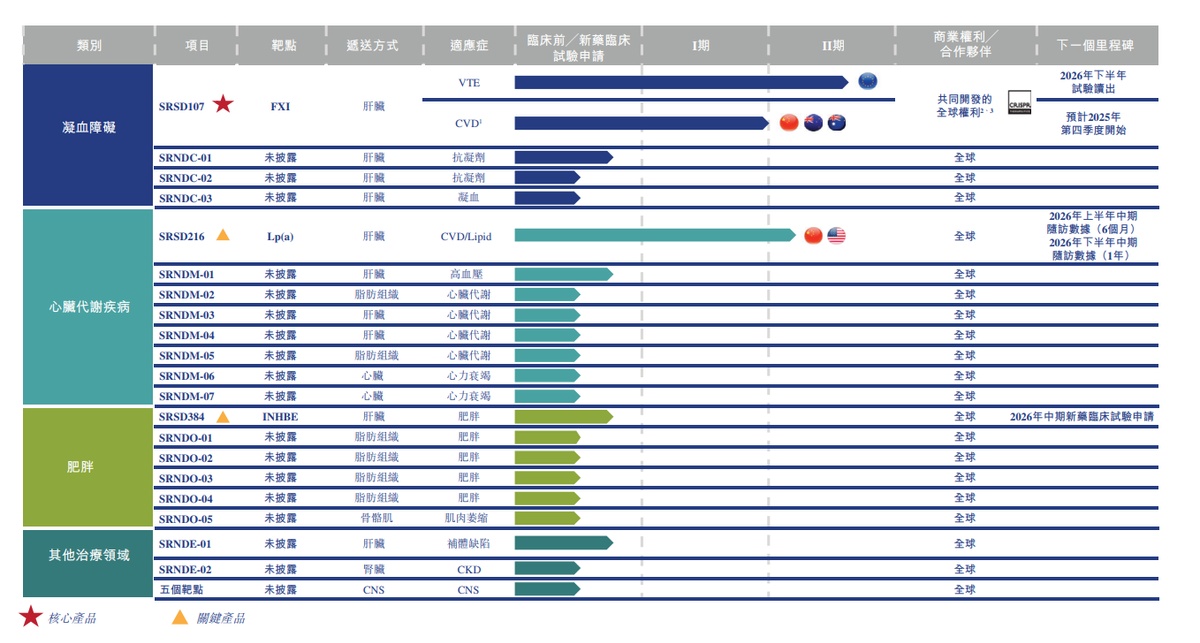
At the product level, according to the prospectus, Jingyin Pharmaceuticals' main product assets include SRSD107, SRSD216, SRSD384, and others.
Among them, the core product SRSD107 aims to selectively inhibit coagulation factor XI (FXI) and is the centerpiece of Jingyin Pharmaceuticals' collaboration with CRISPR. It is currently undergoing a Phase II multicenter venous thromboembolism (VTE) clinical trial in Europe, with Phase II cardiovascular disease trials expected to launch in China, Australia, and New Zealand. SRSD216 is a potential best-in-class siRNA targeting Lp(a) for cardiometabolic diseases, currently in Phase IIa trials in China and the U.S. SRSD384 is a candidate drug targeting INHBE for obesity, advancing to the new drug clinical trial application stage.
This also offers a glimpse into Jingyin Pharmaceuticals' market prospects.
The prospectus notes that in 2024, the fields of coagulation disorders, cardiometabolic diseases, and obesity treatment each have at least one blockbuster drug with global annual sales exceeding $10 billion, along with other drugs with annual sales in the billions. Once siRNA technology matures, the market size of related products could far exceed existing treatment paradigms. Some research institutions have made optimistic predictions. According to a Frost & Sullivan report, the global siRNA therapy market size reached $2.4 billion in 2024 and is expected to grow to $50.3 billion by 2040, with a compound annual growth rate of 20.9%.
Capital's vision is often sharp. Many investors favor Jingyin Pharmaceuticals, perhaps because they see the company's long-term value in technology, products, and the market. However, a pharmaceutical company with a short history, no matter how high its starting point or precise its positioning, cannot avoid growth challenges.
Startup Pharmaceutical Company Faces Growth Challenges
Currently, Jingyin Pharmaceuticals' operational difficulties remain quite prominent.
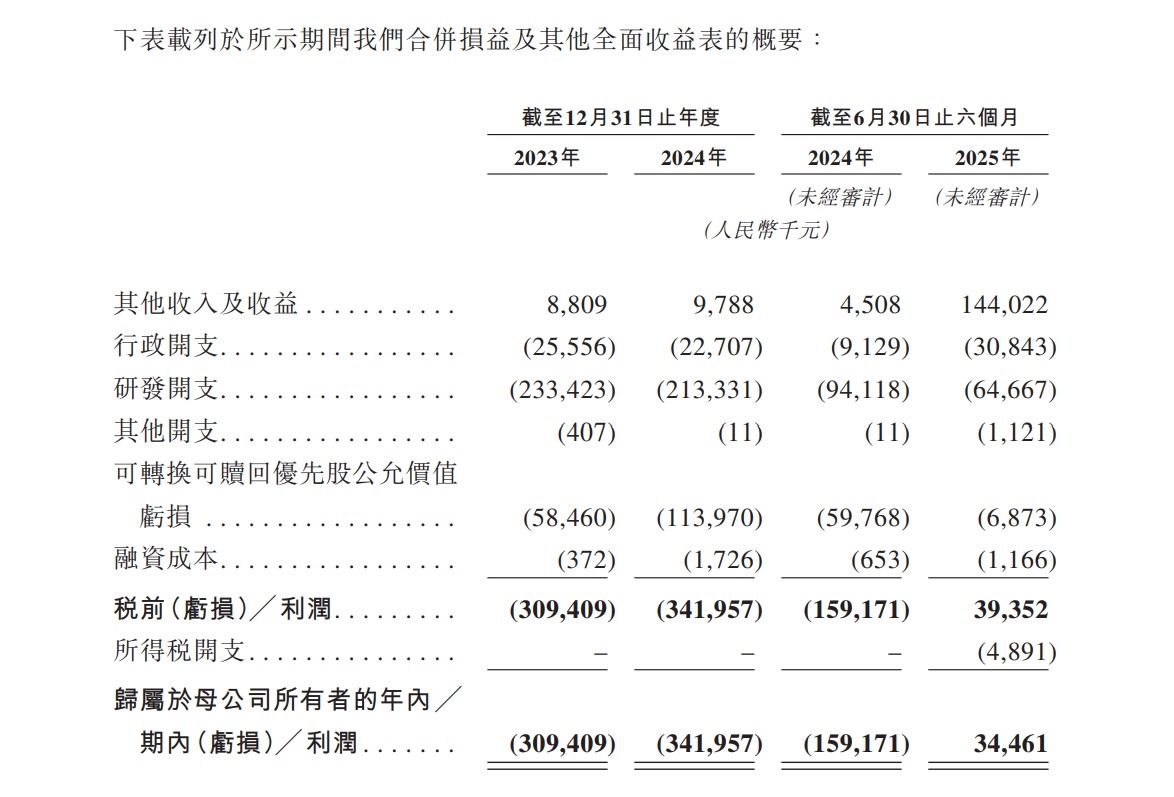
The prospectus shows that, as it has not yet entered the commercialization stage, Jingyin Pharmaceuticals' total revenue from 2023 to the first half of 2025 remained at 0, with profits of -RMB 309 million, -RMB 342 million, and RMB 34.461 million, respectively. The profit in the first half of this year was mainly due to the fair value change of CRISPR shares received as an upfront payment from the collaboration with CRISPR.
It is worth noting that R&D expenses in the first half of the year fell 31.3% year-on-year to RMB 64.667 million. Jingyin Pharmaceuticals explained that this is related to the company's pipeline development arrangements, under which it incurred significant expenses in 2024 for Phase I trials of SRSD107 and preclinical studies of SRSD216.
Some investors believe that this temporary decline may be to optimize financial statements for the IPO. As clinical research on the pipeline continues to advance, R&D expenses will only increase, highlighting the urgency of the IPO and strategic partnerships. "For a startup like ours, independently developing such a product is not realistic. We need to find partners with a shared vision to move forward together," Dr. Qun-Sheng Ji has also stated.
However, a more pressing issue is that market competition continues to intensify.
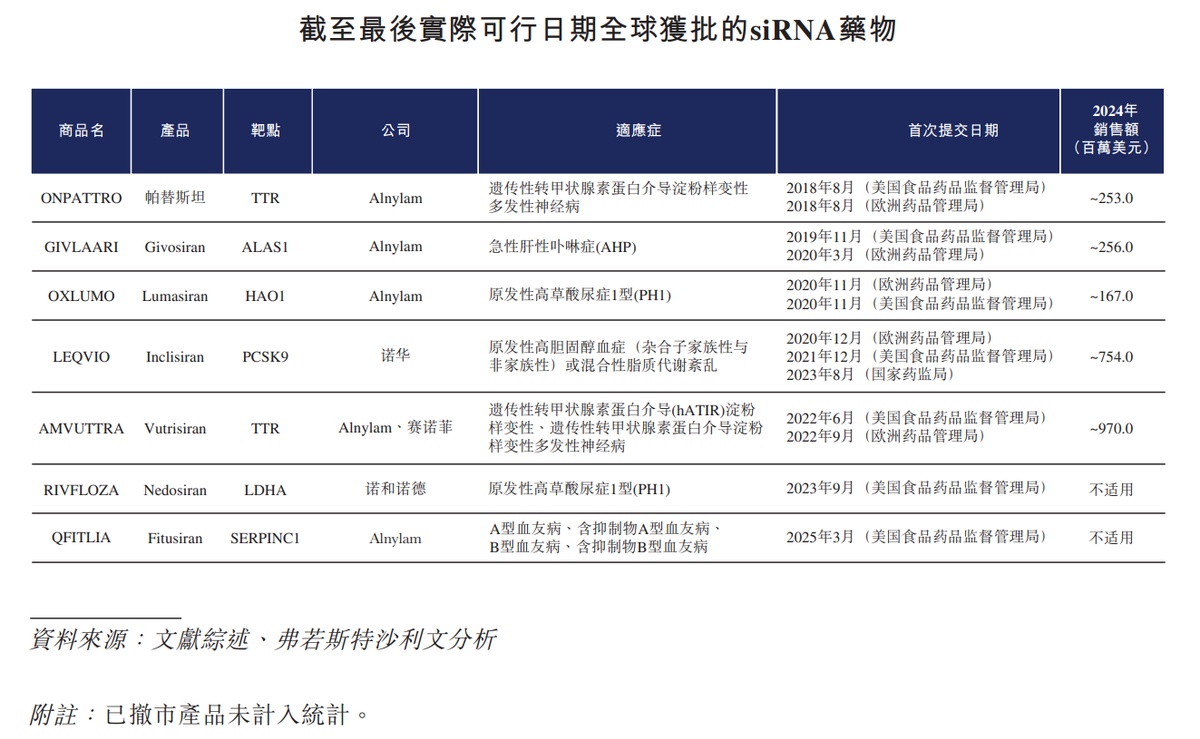
It should be noted that siRNA is not a niche field. The prospectus mentions that since the approval of the first siRNA drug, Onpattro® (patisiran), in 2018, siRNA therapy has achieved significant clinical and commercial validation. As of the latest practicable date, seven siRNA products have been approved for marketing in major global markets, backed by major players such as Novartis, Sanofi, and Alnylam.
Zooming in on the FXI inhibitor-targeted siRNA therapy track where the core product SRSD107 operates, Jingyin Pharmaceuticals is also racing against companies like Ribo, Sirnaomics, and ADARx.
From this perspective, whether Jingyin Pharmaceuticals can maintain a long-term advantage in technology and products, the extent of its collaboration benefits with partners like CRISPR, and when its core products will achieve a commercial breakthrough remain uncertain.
Source: Pharmaceutical Research Society
The copyright of this article belongs to the original author/organization.
The views expressed herein are solely those of the author and do not reflect the stance of the platform. The content is intended for investment reference purposes only and shall not be considered as investment advice. Please contact us if you have any questions or suggestions regarding the content services provided by the platform.
