

 Feed Explorer
 Rising Creator
Detailed Explanation of Option Core Indicators and Practical Selection Strategies

zogzogn
I. Two Fundamental Indicators for Option Pricing
1. Implied Volatility (IV)
Definition:
- The market's expectation of future volatility, calculated by reverse-engineering the option's market price using the Black-Scholes model
- Representsthe collective expectation of market participants regarding the price fluctuations of the underlying asset
- Expressed as a percentage, e.g., IV=30% indicates an expected annualized volatility of 30%
Key Characteristics:
- Forward-looking indicator - Reflects future expectations, not historical data
- Driven by supply and demand - Rises with strong buyer demand, falls with increased seller supply
- Mean-reverting property - Extreme high/low IV tends to revert to average levels
Practical Implications:
High IV → Expensive options → Favorable for selling strategies (selling calls/puts)
Low IV → Cheap options → Favorable for buying strategies (buying calls/puts)
2. Historical Volatility (HV)
Definition:
- Actual statistical measure of past price fluctuations of the underlying asset
- Calculation: Annualized standard deviation of logarithmic returns
- Commonly calculated for 20-day, 30-day, 60-day periods, etc.
Key Characteristics:
- Lagging indicator - Reflects realized volatility
- Objective data - Based on actual prices, unaffected by subjectivity
- Period-sensitive - HV can vary significantly across different time windows
Practical Implications:
IV > HV → Options may be overpriced → Consider selling strategies
IV < HV → Options may be underpriced → Consider buying strategies
IV/HV ratio → Core metric for assessing relative option value

II. Option Price Composition
Option Premium
Complete Formula:
Option Price = Intrinsic Value + Time Value
(1) Intrinsic Value
- Call option intrinsic value = Max(Underlying price - Strike price, 0)
- Put option intrinsic value = Max(Strike price - Underlying price, 0)
Example:
Stock price = $150 Call strike = $140 Intrinsic value = $150 - $140 = $10 If option price = $15 Then time value = $15 - $10 = $5
(2) Time Value
- The portion of option price exceeding intrinsic value
- Decays exponentially as expiration approaches (non-linear decline)
- Influenced by volatility, interest rates, time remaining, etc.
III. Detailed Explanation of Option Greeks
1. Delta (Δ) - Directional Risk
Definition: Expected change in option price when the underlying asset moves $1
Value Range:
- Call options: 0 to +1
- Put options: -1 to 0
Practical Interpretation:
Delta = 0.50 → Underlying rises $1, option gains $0.50
Delta = 0.80 → Deep in-the-money option, behaves similarly to underlying
Delta = 0.20 → Out-of-the-money option, requires significant move to profit
Applications:
- Hedge ratio calculation: 100 shares require 200 options with Delta=0.5 for hedging
- Directional exposure: Larger absolute Delta means greater directional risk
- Portfolio construction: Delta-neutral strategies (market makers' favorite)
2. Gamma (Γ) - Second-Order Risk
Definition: Rate of change in Delta when the underlying moves $1
Key Characteristics:
- Highest for at-the-money options - Most sensitive near strike price
- Smaller for long-dated options - Smoother Gamma further from expiration
- Spikes near expiration - Gamma explodes in final days
Practical Interpretation:
Gamma = 0.05, Delta = 0.50 Underlying rises $1: New Delta = 0.50 + 0.05 = 0.55 New option price change ≈ $0.55 (vs. original $0.50)
Risk Management:
- Positive Gamma (long options) - Accelerates profits during large moves
- Negative Gamma (short options) - Accelerates losses during large moves
- Gamma risk before expiration - Sellers must watch for gamma explosion in final week
3. Vega (ν) - Volatility Risk
Definition: Change in option price for 1% change in implied volatility (IV)
Key Characteristics:
- Highest for at-the-money options
- Larger for long-term options - More time means greater volatility impact
- Long options gain from Vega, short options lose
Practical Interpretation:
Option price = $5.00 Vega = 0.15 IV increases from 25% to 26% (+1%) New option price ≈ $5.00 + $0.15 = $5.15
Strategy Selection:
| IV Level | Vega Position | Recommended Strategy |
|---|---|---|
| IV < Historical Average | Long Vega | Buy straddles/strangles |
| IV > Historical Average | Short Vega | Sell options/iron condors |
| Anticipating Major Events | Position Early | Buy pre-event, close post-event |
4. Theta (Θ) - Time Decay
Definition: Amount option price decreases due to time value erosion over 1 day
Key Characteristics:
- Always negative (for option buyers)
- Non-linear decay - Accelerates in last 30 days
- Highest for at-the-money options - Where time value is richest
Practical Interpretation:
Option price = $3.00 Theta = -0.05 Next day's price ≈ $2.95 (all else equal)
Time Decay Curve:
60 days to expiration: ~1-2% daily time value loss 30 days: ~2-4% daily 7 days: ~5-10% daily Final 2 days: Time value collapses
Strategy Applications:
- Seller strategies - Profit from Theta (time is your friend)
- Buyer strategies - Need quick directional moves to overcome Theta (time is enemy)
5. Rho (ρ) - Interest Rate Risk
Definition: Change in option price for 1% change in risk-free rate
Practical Significance:
- Least important Greek - Usually negligible (except for long-term options or extreme rate environments)
- Positive for calls - Rising rates increase call values
- Negative for puts - Rising rates decrease put values
When to Monitor Rho:
- Central bank preparing rate changes
- Trading LEAP options (1+ year expiration)
- Interest rate derivatives
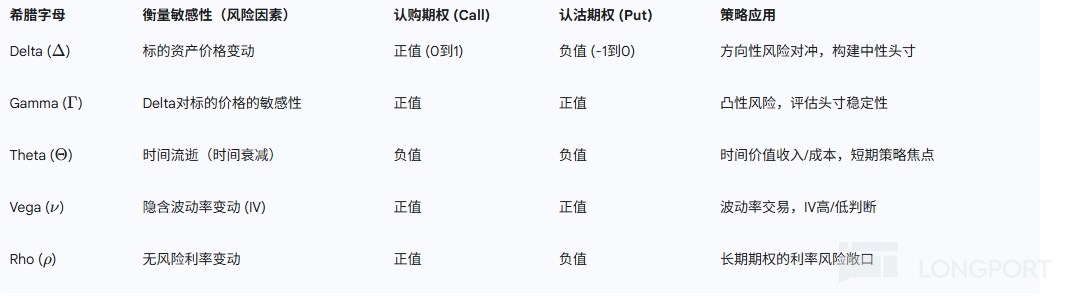
Summary:
| Indicator | Meaning | Unit/Range Example | Impact by Option Type |
|---|---|---|---|
| Implied Volatility (IV) | Market's forward-looking expectation of underlying asset volatility, reflecting pricing of uncertainty. | Percentage (e.g., 20%-50%), higher means more expensive options. | All options; high IV favors sellers. |
| Historical Volatility (HV) | Actual past volatility of underlying, used to assess IV rationality. | Percentage (e.g., 15%-30%), based on standard deviation. | All options; HV>IV suggests overpricing. |
| Effective Premium | Option premium net of fees/slippage, or time value pricing efficiency. | Currency (e.g., $2/contract), considers transaction costs. | Buyers seek low premium, sellers target high. |
| Delta (Δ) | Sensitivity of option price to underlying price changes, measures directional exposure. | -1 to 1 (e.g., 0.5 means $0.5 gain per $1 rise). | Near 1 for deep ITM, near 0 for deep OTM. |
| Gamma (Γ) | Rate of Delta change relative to underlying moves, measures acceleration effects. | Positive (e.g., 0.05), high Gamma amplifies P&L. | Peaks at ATM, ideal for volatility plays. |
| Vega (ν) | Sensitivity to IV changes, measures volatility exposure. | Positive (e.g., 0.2 = $0.2 gain per 1% IV rise). | Larger for long-dated options, key for vol trades. |
| Theta (Θ) | Daily time value decay. | Negative (e.g., -0.05 = $0.05 daily loss). | Largest for short-term options, sellers benefit. |
| Rho (ρ) | Sensitivity to interest rate changes. | Positive/negative (e.g., 0.1 for calls), minimal impact. | Matters for long-dated calls in rate-sensitive markets. |
IV. Practical Case Studies
Case 1: Buying Strategy in Low IV Environment
Market Context:
- Underlying: Tesla (TSLA)
- Current price: $250
- Current IV: 22% (historical avg 35%)
- HV: 28%
Analysis:
✓ IV < HV → Options relatively cheap ✓ IV well below historical → Mean reversion expected ✓ Earnings upcoming → IV likely to spike
Strategy: Long Straddle
- Buy 1 $250 call, 30 DTE, Premium $8
- Buy 1 $250 put, 30 DTE, Premium $7
- Total cost: $15
Greeks Analysis:
Delta: ~0 (offset) Gamma: +0.08 (benefits from big moves) Vega: +0.30 (profits from IV rise) Theta: -0.50 ($0.50 daily time decay)
Breakeven:
- Upside: $250 + $15 = $265
- Downside: $250 - $15 = $235
- Requires >6% move to profit
Outcome (Hypothetical): Post-earnings price surges to $275, IV jumps to 45%
- Call value: ~$28 ($25 intrinsic + $3 time value)
- Put value: ~$2 (pure time value)
- Total value: $30, net profit: $15 (100% return)
Case 2: Selling Strategy in High IV Environment
Market Context:
- Underlying: Nvidia (NVDA)
- Current price: $450
- Current IV: 65% (historical avg 40%)
- Just after major event, IV spiked
Analysis:
✓ IV >> HV → Options severely overpriced ✓ Extreme IV → Likely to mean-revert ✓ Event passed → IV crush expected
Strategy: Iron Condor
- Sell $470 call, credit $6
- Buy $480 call, debit $3
- Sell $430 put, credit $5
- Buy $420 put, debit $2
- Net credit: $6 (max profit)
Greeks Analysis:
Delta: ~0 (neutral) Gamma: -0.03 (helps with small moves) Vega: -0.45 (profits from IV drop) Theta: +0.30 ($0.30 daily gain)
Profit Zone: $436 - $464
- Profits if price stays within range
- Max risk: $4 (if price breaks range)
Outcome (Hypothetical): After 10 days, price flat at $455, IV drops to 40%
- IV crush decimates option values
- Position worth ~$0, realizing ~$6 profit
- Annualized return: ~365% ($6 profit/$4 margin×10 days)
Case 3: Gamma Scalping (Market Maker Strategy)
Market Context:
- Underlying: SPY
- Price: $420
- Buy ATM call: Delta=0.50, Gamma=0.05
Strategy Logic:
Establish Delta-Neutral Position
- Buy 1 option (Delta=+0.50)
- Short 50 SPY shares (Delta=-0.50)
- Net Delta=0
Dynamic Hedging with Gamma
Scenario A: Price rises to $422
New Delta = 0.50 + (0.05 × 2) = 0.60 Option gain ≈ $0.50 × 2 = $1.00 Stock loss = $2.00 (short 50 shares) Net loss = -$1.00 Buy 10 SPY to rebalance Delta: - Buy at $422, sell when price drops to $420 - Scalping profit: $0.20/share × 10 = $2.00
Scenario B: Price falls to $418
New Delta = 0.50 - (0.05 × 2) = 0.40 Option loss ≈ $0.50 × 2 = $1.00 Stock gain = $2.00 Net profit = $1.00 Sell 10 SPY to rebalance Delta: - Sell at $418, cover at $420 - Scalping profit: $0.20/share × 10 = $2.00
Profit Source:
- Profits when realized vol > implied vol
- "Buy low, sell high" via Gamma effects
- Requires frequent trading, suits market makers
V. Practical Decision Tree
Step 1: Assess Volatility Environment
IV vs HV: IV < HV → Options cheap → Consider buying
IV > HV → Options expensive → Consider selling
IV ≈ HV → Neutral market → Directional or wait
IV Percentile:
IV < 20th → Extremely low → Strong buy signal
20-40th → Low → Moderate buy
40-60th → Neutral → Decide by other factors
60-80th → High → Moderate sell
IV > 80th → Extremely high → Strong sell signal
Step 2: Determine Directional Bias
| Bias | IV Level | Recommended Strategy | Key Greek |
|---|---|---|---|
| Strong Bullish | Low IV | Buy calls | High Delta, +Vega |
| Strong Bullish | High IV | Sell puts | +Theta |
| Strong Bearish | Low IV | Buy puts | -Delta, +Vega |
| Strong Bearish | High IV | Sell calls | +Theta |
| Big Move (Direction Unknown) | Low IV | Straddle/Strangle | High Gamma, +Vega |
| Range-bound | High IV | Iron Condor/Butterfly | +Theta, -Vega |
| Market View/Goal | Desired Greek Exposure | Option Contract Preference | Risk-Reward Profile |
|---|---|---|---|
| Expecting Sharp Move | High Gamma, +Vega | Short-term, ATM/slightly OTM longs | High upside, fast Theta burn |
| Expecting Calm/Range | High |Theta| | Short-term, ATM/slightly OTM shorts | Steady premium, high Gamma risk |
| Betting on Volatility Rise | High Vega | Medium-term, ATM longs | Vol hedge, lower Theta cost |
| Pure Directional Play | High Delta | Deep ITM (stock substitute) | Delta ~1, capital inefficient |
Step 3: Select Expiration
Time Considerations:
| DTE | Theta Behavior | Gamma Behavior | Use Case |
|---|---|---|---|
| <7 days | Extreme decay | Extreme sensitivity | Event plays (earnings, news) |
| 2-4 weeks | High decay | High sensitivity | Standard trading, balance cost/time |
| 1-3 months | Moderate decay | Moderate sensitivity | Trend plays, allow time to develop |
| 6+ months (LEAPs) | Slow decay | Low sensitivity | Long holds, stock substitutes |
For Buyers:
- Avoid last 2 weeks (brutal Theta)
- 30-60 DTE optimal (cost/time balance)
- 7-14 DTE for high-conviction plays (high risk/reward)
For Sellers:
- 30-45 DTE sweet spot (peak Theta harvest)
- Avoid <7 DTE (Gamma risk explosion)
- Roll strategy: Close 7-10 DTE, reopen 30-45 DTE
Step 4: Select Strike Price
Using Delta as Guide:
| Delta | Status | Characteristics | Investor Type |
|---|---|---|---|
| 0.80-1.00 | Deep ITM | High cost, high win rate, low leverage | Conservative, stock-like |
| 0.60-0.80 | ITM | Mod-high cost, balanced | Moderate, some leverage |
| 0.40-0.60 | ATM | Mod cost, max Gamma/Vega | Volatility traders |
| 0.20-0.40 | OTM | Low cost, high payoff, needs big move | Aggressive, lottery |
| 0.00-0.20 | Deep OTM | Very cheap, likely to expire worthless | Speculators, hedging |
Practical Tips:
Buying: Choose Delta 0.40-0.70 - Balance cost/profit potential - Avoid deep OTM (fast time decay) Selling: Choose Delta 0.20-0.40 - Higher chance keeping full premium - If assigned, acceptable stock cost basis
VI. Comprehensive Checklist
Pre-Trade Must-Checks:
✅ Volatility Analysis
- [ ] Current IV & percentile
- [ ] IV vs HV spread (IV/HV ratio)
- [ ] Upcoming events (earnings, FDA, elections)
- [ ] Post-event IV crush potential
✅ Greeks Review
- [ ] Delta: Directional exposure match?
- [ ] Gamma: P&L acceleration in big moves
- [ ] Vega: Impact of 1% IV change
- [ ] Theta: Daily time decay cost
- [ ] Portfolio Greeks (multi-leg strategies)
✅ P&L Analysis
- [ ] Breakeven calculation
- [ ] Max profit/max loss
- [ ] Win rate estimate (based on HV)
- [ ] Risk-reward ratio (target ≥2:1)
✅ Liquidity Check
- [ ] Bid-ask spread <5%
- [ ] Daily volume > 100 contracts
- [ ] Open interest > 1,000
- [ ] Avoid illiquid traps (can't exit)
✅ Risk Management
- [ ] Single trade risk < 2% account
- [ ] Total premium exposure < 20% account
- [ ] Margin reserved (for selling)
- [ ] Clear stop-loss plan
VII. Common Mistakes & Avoidance
❌ Mistake 1: Buying Deep OTM Options (Lottery Tickets)
Example:
Buy Delta=0.10 call for $0.50 Needs 15% move to break even 90% chance of expiring worthless
Solution:
- Choose Delta 0.40-0.60 ATM/slightly ITM
- Higher cost but much better odds
❌ Mistake 2: Ignoring Theta Decay
Example:
Buy 30 DTE, hold 25 days no profit Final 5 days Theta crushes, turns -30%
Solution:
- Buyers: Close/roll 7-10 DTE
- Time-based stop-loss, don't hold to expiry
- Consider 60-90 DTE for time buffer
❌ Mistake 3: Buying in High IV
Example:
Pre-earnings IV spikes to 80%, buy straddle Post-earnings price up but IV crush kills options
Solution:
- Pre-event: Enter at low IV
- Post-event: Wait for IV to normalize
- High IV: Sell, don't buy
❌ Mistake 4: Selling Without Stops
Example:
Sell call for $2 credit Price surges, loss hits $20 no stop Final loss $50 (25x credit)
Solution:
- All shorts must have stops
- Close at 2-3x credit received
- Use spreads (e.g., bull spreads) to cap risk
VIII. Golden Rules of Option Selection
Rule 1: Volatility is the Anchor
Buy low IV, sell high IV IV/HV ratio is king
Rule 2: Time is Double-Edged
Buyers: Time is enemy, act fast Sellers: Time is friend, wait
Rule 3: Direction + Volatility Dual Drivers
Right direction + wrong vol → May lose Wrong direction + right vol → May win
Rule 4: Greeks Portfolio Management
Single-leg: Watch Delta Multi-leg: Monitor portfolio Greeks Dynamic hedge: Mind Gamma
Rule 5: Liquidity Above All
Great strategy + no liquidity = trap Skip opportunities with poor liquidity
IX. Advanced Resources
Books:
- 《Option Volatility & Pricing》- Sheldon Natenberg (Bible)
- 《Options as a Strategic Investment》- McMillan
- 《Trading Option Volatility》- Euan Sinclair
Tools:
- OptionStrat - Visual strategy P&L
- ThinkorSwim - Advanced Greeks analysis
- VIX - Market fear gauge
Tracking:
- IV Rank/Percentile (broker platforms)
- Skew (call vs put IV difference)
- Term Structure (IV by expiration)
The copyright of this article belongs to the original author/organization.
The views expressed herein are solely those of the author and do not reflect the stance of the platform. The content is intended for investment reference purposes only and shall not be considered as investment advice. Please contact us if you have any questions or suggestions regarding the content services provided by the platform.
