

Trump's tariff threats are back, your portfolio needs this options protection guide!

Black Friday!
Trump is stirring up trouble again, threatening on Twitter to impose a 100% tariff on Chinese goods and restrict software exports. China immediately retaliated, announcing special fees on U.S. vessels and export controls on rare earths, lithium batteries, and more.
The U.S.-China trade situation suddenly escalated, and the market instantly became nervous. Just 3 minutes after Trump's remarks, the three major U.S. stock indices plummeted, catching everyone off guard. That day, the VIX index surged 31%, and everyone was in "panic mode."
It felt like the tariff crisis from April was repeating itself. The market was like a startled bird, selling off collectively at the slightest sign of trouble. $Tesla(TSLA.US) fell over 5%, $Amazon(AMZN.US) dropped nearly 5%, and even $NVIDIA(NVDA.US) fell almost 5%. Is your portfolio trembling too?
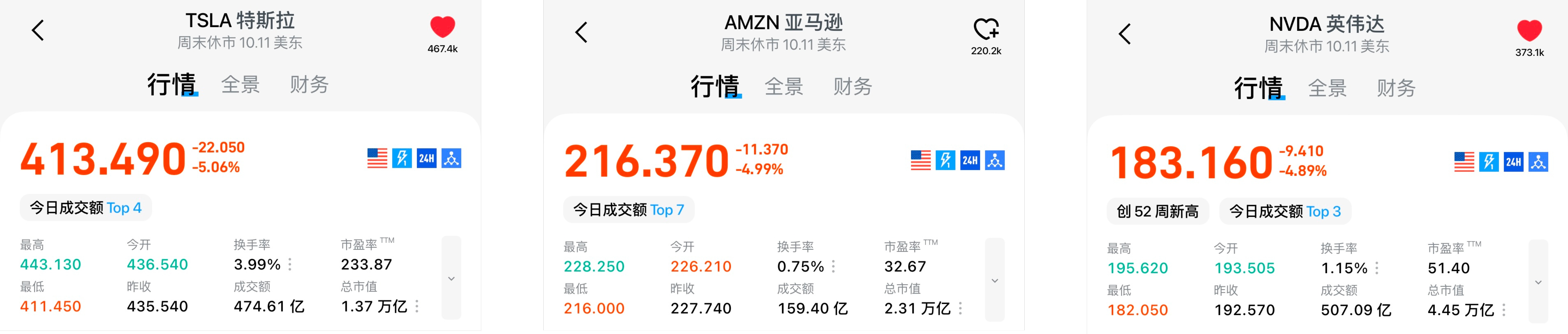
When the market is crashing, stay calm—you still have options as a tool. Today, let’s share a few practical options strategies to help you "insure" your portfolio and give you some peace of mind in volatile markets.
1. Protective Put: Insuring Your Stocks
This is a classic "insurance" strategy. Simply put, while holding stocks, you buy a put option with a strike price slightly below the current stock price—like spending a little money for peace of mind.
The number of options contracts should match your stock holdings one-to-one. For example, if you own 100 shares, buy 1 put option. If you own 500 shares, buy 5 put options.
This way, if the stock price falls, the put's gains can offset some losses; if the stock price rises, you still enjoy the upside, only losing the small premium paid for the put.
How to Execute:
Go to the stock details page, click "Options," and select "Single-Leg Strategy." Although this is a combination strategy, since you already hold the stock, choose "Single-Leg Strategy" when building it.
Then, based on your forecast and budget, pick a suitable strike price and expiration date. Generally, the strike price should be slightly below the current stock price—for puts, the higher the strike, the more expensive the premium. The expiration date should balance cost and protection duration—the further out, the more expensive the premium.
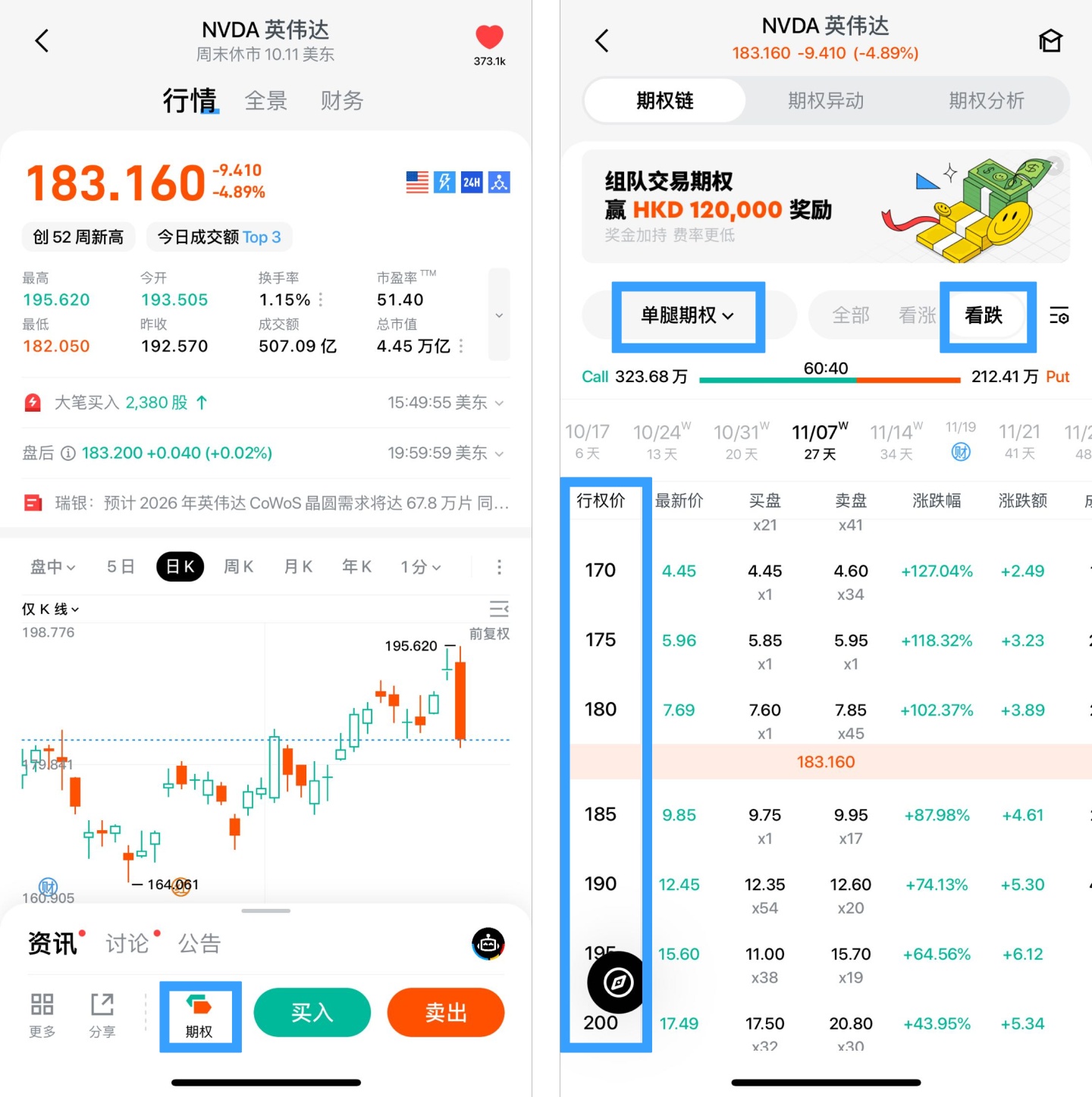
Scenario:
Assume you hold 100 shares of NVIDIA at $183. You see the headlines and worry: What if Trump tweets something crazy at midnight and my portfolio tanks?
So you decide to buy 1 put option with a $160 strike expiring in one month, costing $2.50 per share. Your total cost = $2.50 × 100 = $250.
This $250 is the "insurance premium" you pay to protect your 100 shares.
P&L Analysis:
Now, let’s see how this strategy protects your investment at different stock prices:
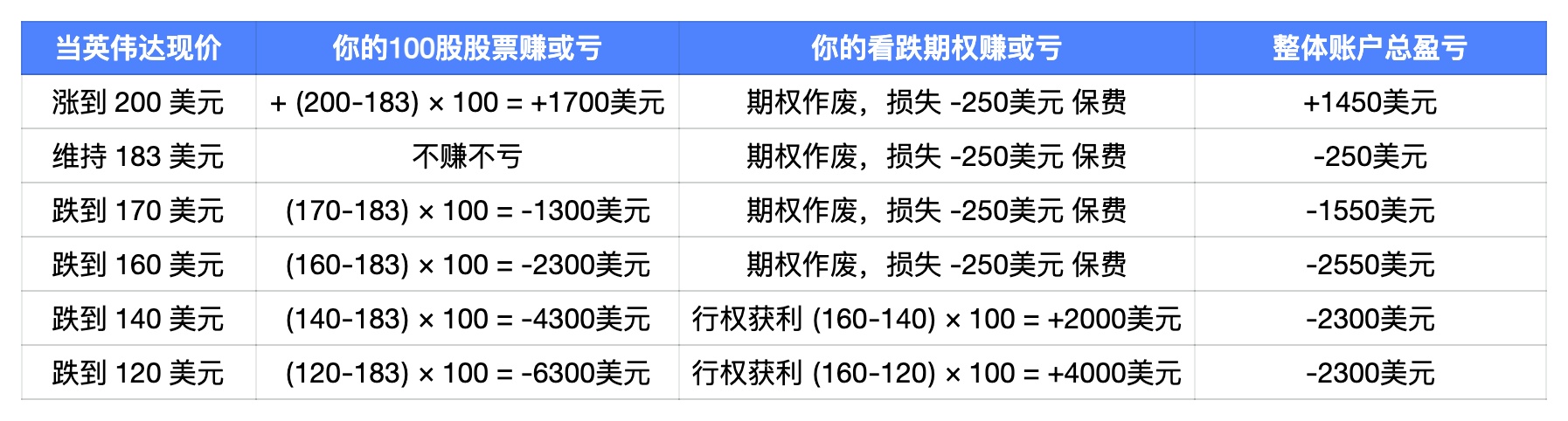
As the table shows, the protection effect is clear:
1) If the stock rises: You just "wasted" the $250 premium but still enjoy most of the upside.
2) If the stock dips slightly (above $160): Your stock loses money, the put doesn’t help, and you lose the premium—this is the cost of protection before it kicks in.
3) If the stock crashes (below $160): The put’s gains start strongly offsetting stock losses!
At $140, without protection, you’d lose $4,300; with protection, you only lose $2,300.
At $120, without protection, you’d lose $6,300; with protection, your loss is still capped at $2,300.
Key Takeaway:
In short, spend a small, manageable amount for peace of mind and a "lifeline" during downturns. No matter how far the stock falls, your loss has a floor—at most, you lose $2,300. The sky won’t fall.
No matter how much Trump tweets, no matter how badly NVIDIA’s stock drops, this money is your "front-row ticket" to watch the market turmoil while staying mentally secure.
Key Reminder:
For clarity, the P&L above assumes holding to expiration and exercising. But in real trading, most investors rarely exercise—they prefer closing early to lock in profits.
Why? Because closing is usually more flexible and cost-effective!
Example: At $120, your put’s intrinsic value is $40. But the option’s market price could be higher. Here, selling the put to capture the spread may yield higher profits than exercising, and it’s easier.
So when should you exercise? Three main cases:
1) Can’t sell: Deep in-the-money options have low liquidity. If no one buys, exercising is the last resort.
2) Closing is worse: If the market drifts or stagnates, IV drops and time decay may make closing less profitable than exercising.
3) Exiting entirely: After a crash, if volatility has subsided and you want to exit (selling stocks and unwinding protection), exercising and selling the stock is clean.
2. Long Collar: Lower-Cost "Insurance"
When buying a put for protection, you might think: Why is this insurance so expensive?
Because during crashes, panic drives up option IV, making puts pricier.
So when using options, ask: Is this premium worth it? After all, insurance costs money—it must match your portfolio’s value.
If you want protection but find puts too costly, try an upgraded method: the Long Collar.
It slashes protection costs, even achieving "zero-cost" coverage.
How? While holding stocks, buy a lower-strike put and sell a higher-strike call, using the call’s premium to offset the put’s cost.
How to Execute:
Case 1: If you already hold stocks, go to the stock details page, click "Options," and still choose "Single-Leg Strategy." Buy a put and sell a call separately.
Case 2: If you don’t hold stocks, click "Collar Strategy," and the system will auto-build: buy stock + buy put + sell call.
Under "Default Spread," you can customize. Adjust the strike gap between put and call to control the strategy’s cost.
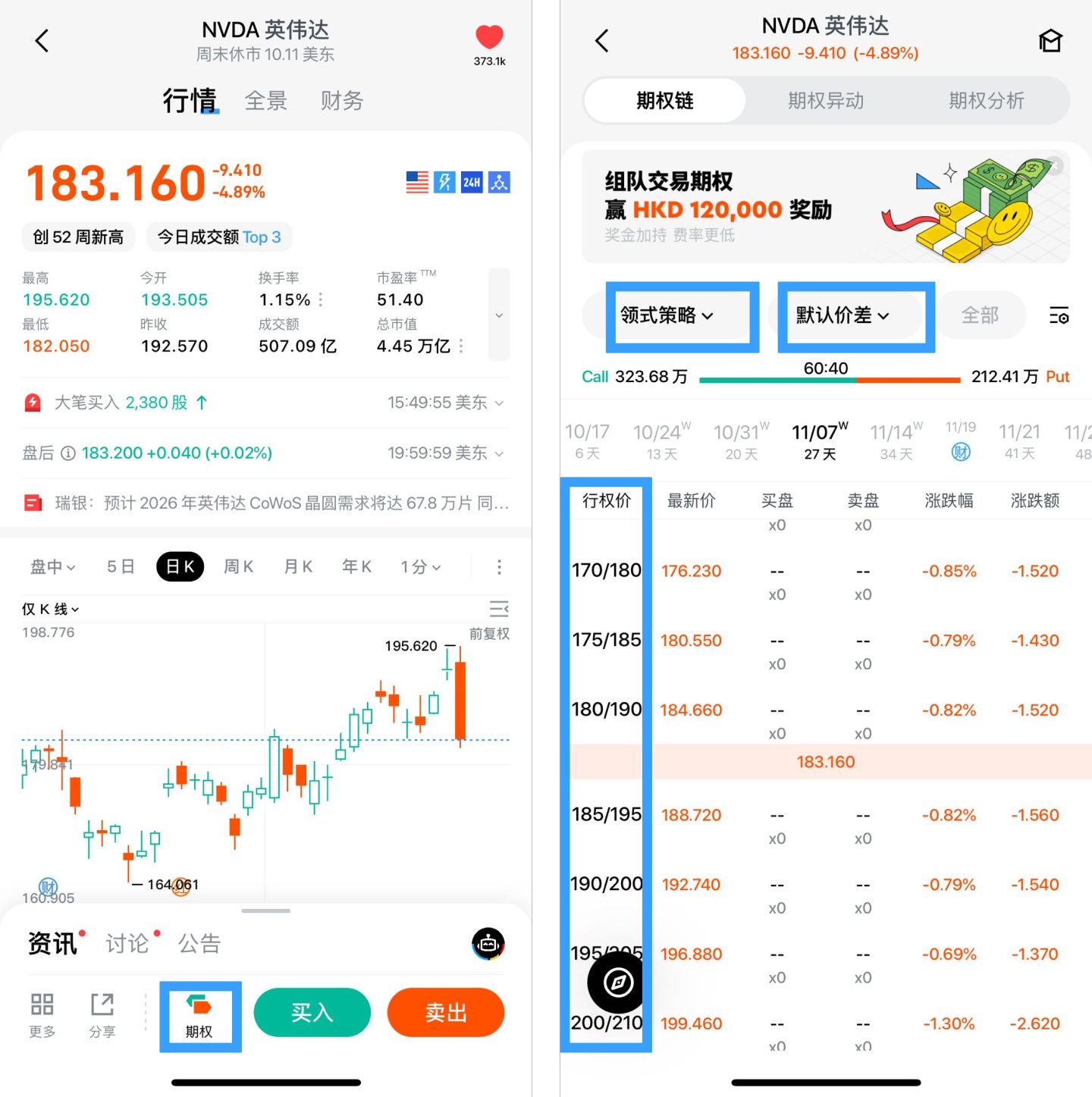
Scenario:
Assume you hold 100 NVIDIA shares at $183. You spent $250 on a $160-strike put but think: "This premium is steep!"
Now, sell a higher-strike call to "recoup." The call’s premium directly offsets the put’s cost.
Call strike selection matters—it depends on your market outlook and cost goals. Three outcomes:
Positive cost: Call income < put cost. You still pay a small net premium.
Negative cost: Call income > put cost. You net cash.
Zero cost: Call income = put cost. "Free" insurance.
Many prefer zero-cost collars—they add a "safety rail" without extra spending.
Key Reminder:
This strategy isn’t perfect. Pros and cons:
Pros (downside): Like buying puts, you’re protected from crashes at lower cost.
Cons (upside): Your gains are capped. If NVIDIA surges past your call’s strike, you miss further upside.
That’s all for today’s two strategies.
Facing market swings, we can’t predict direction but can plan ahead with strategies.
Hope these two strategies inspire you.
Share your thoughts in the comments!
The copyright of this article belongs to the original author/organization.
The views expressed herein are solely those of the author and do not reflect the stance of the platform. The content is intended for investment reference purposes only and shall not be considered as investment advice. Please contact us if you have any questions or suggestions regarding the content services provided by the platform.
