

Off-hospital pharmaceutical retail has supported a business with nearly 3 billion yuan in annual revenue. Why is Rongtai Pharmaceutical still in a hurry to list in Hong Kong?

As a bridge between upstream pharmaceutical companies and downstream sales terminals, out-of-hospital pharmaceutical service providers have become increasingly needed in recent years. They undertake distribution functions and are more adept at providing digital marketing and supply chain solutions.
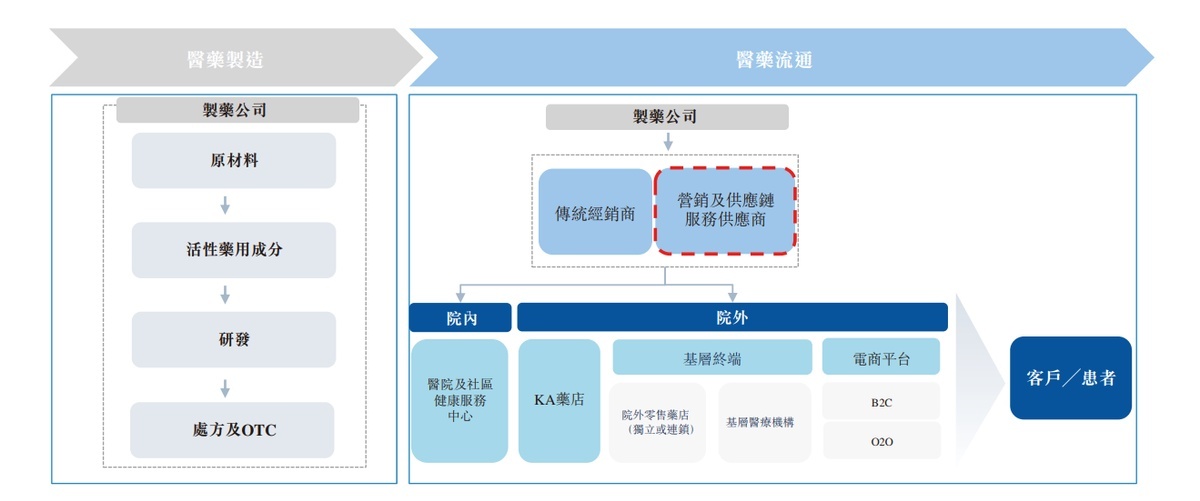
In the recent wave of Hong Kong stock IPOs, we have also seen a case of a company "taking off" with the tailwind of out-of-hospital pharmaceutical retail—Guangdong Rongtai Pharmaceutical Co., Ltd. (hereinafter referred to as "Rongtai Pharma").
It is reported that Rongtai Pharma has recently submitted a listing application to the main board of the Hong Kong Stock Exchange, with CITIC Securities as the sole sponsor. In addition, according to Frost & Sullivan, by 2024 revenue, the company is the fourth-largest marketing and supply chain solutions provider in China's out-of-hospital pharmaceutical market and the largest marketing and supply chain solutions provider for individual customers in China's out-of-hospital pharmaceutical market, occupying a relatively leading position in its niche.
However, judging from the fluctuations in Rongtai Pharma's performance, the business of out-of-hospital pharmaceutical service providers still hides many ups and downs.
The Out-of-Hospital Pharmaceutical Track: A Long and Promising Path Under the Trend of Prescription Outflow
Where does the optimism come from?
The most notable aspect is the track's prospects. Frost & Sullivan's report predicts that the next few years will be a critical development stage for China's out-of-hospital pharmaceutical distribution market. In 2024, the out-of-hospital pharmaceutical retail market accounted for 40.2% of the overall market, and this is expected to reach about 47.9% by 2030.
Several factors are driving this trend, such as the continuous outflow of prescription drugs, increased consumer health awareness, and strong demand for drugs in retail channels.
Among these, the outflow of hospital prescriptions may be the most core driver. Rongtai Pharma's prospectus mentions that since 2017, policies allowing prescription outflow have been introduced, permitting patients to obtain medications from qualified retail pharmacies, gradually shifting pharmaceutical sales from hospital dominance to diversified out-of-hospital channels. Although challenges such as limited medical insurance coverage and uneven professional capabilities of retail pharmacies remain, with the support of favorable policies, prescription outflow is widely regarded as an irreversible long-term trend.
It is against this backdrop that the connection between upstream and downstream players in out-of-hospital pharmaceutical distribution has become tighter, and out-of-hospital marketing and supply chain service providers like Rongtai Pharma are in a favorable position for development.
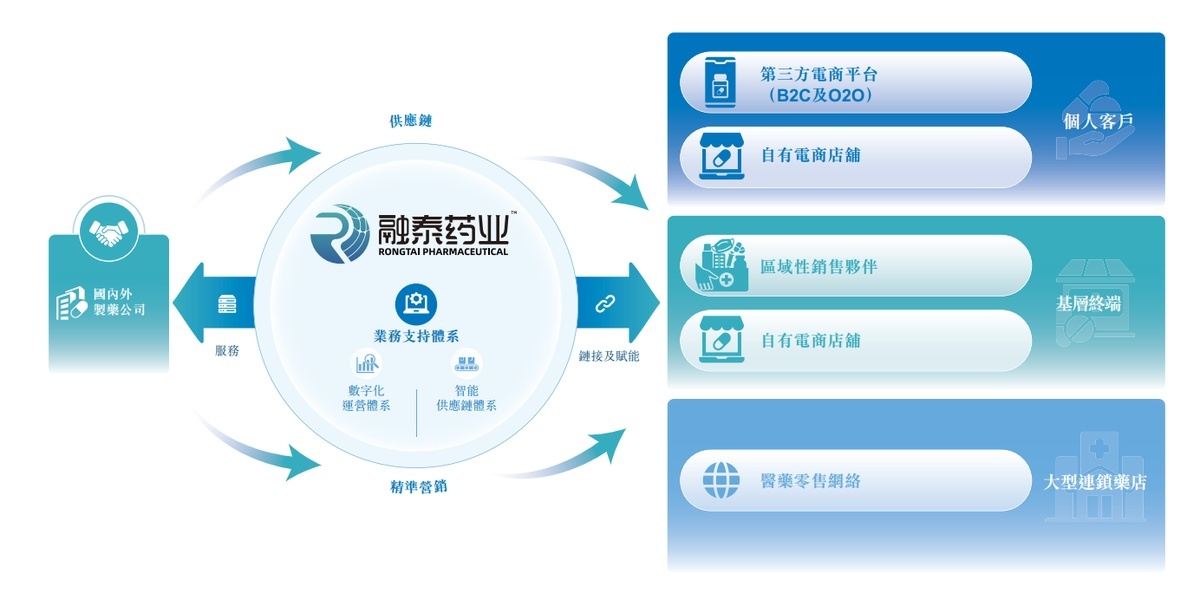
Unlike traditional distributors, out-of-hospital marketing and supply chain service providers not only handle distribution but also focus more on integrating digital business, data platforms, and smart logistics infrastructure to provide pharmaceutical companies with end-to-end, omnichannel pharmaceutical sales solutions, enabling precise and effective reach and service to end customers.
This service model has, to some extent, addressed the pain points of fragmentation in out-of-hospital pharmaceutical retail and has gradually become mainstream in the sector.
Frost & Sullivan data shows that from 2019 to 2024, the size of China's out-of-hospital marketing and supply chain service market grew from RMB 159.7 billion to RMB 242 billion and is expected to reach RMB 430 billion by 2030.
Among these, Rongtai Pharma has established a scalable digital-enabled pharmaceutical distribution system that integrates advanced data analytics, intelligent supply chain management, and omnichannel marketing solutions. On this basis, the company primarily generates revenue by selling pharmaceutical products to individual customers, grassroots terminals, and large chain pharmacies through third-party e-commerce platforms, e-commerce stores, and regional sales partners. This business ecosystem has also accelerated the company's scaled development.
The prospectus shows that from 2022 to 2024 and the first half of 2025, Rongtai Pharma collaborated with 1,505, 1,471, 1,470, and 1,291 pharmaceutical companies, respectively, and sold 5,958, 5,568, 5,937, and 5,161 SKUs. The pharmaceutical companies it serves include 15 of the top 20 global pharmaceutical companies by revenue in 2024, such as Viatris, Haleon, Johnson & Johnson, and Pfizer, as well as 81 domestic pharmaceutical companies selected for the 2024 China Pharmaceutical Industry Top 100 list, such as Baiyunshan, Qilu, and Lingrui.
However, the actual performance still reveals some challenges.
Unstable Performance: Revealing a Relatively Weak Industry Position?
On the long and promising track of out-of-hospital pharmaceutical distribution, Rongtai Pharma's journey has not been entirely steady.
Currently, the company's performance fluctuations are quite noticeable. The prospectus shows that from 2022 to 2024 and the first half of 2025, Rongtai Pharma achieved revenues of approximately RMB 2.427 billion, RMB 2.916 billion, RMB 2.875 billion, and RMB 1.540 billion, respectively. Profits for the same periods were RMB 14.78 million, RMB 45.717 million, RMB 3.741 million, and RMB 17.092 million.
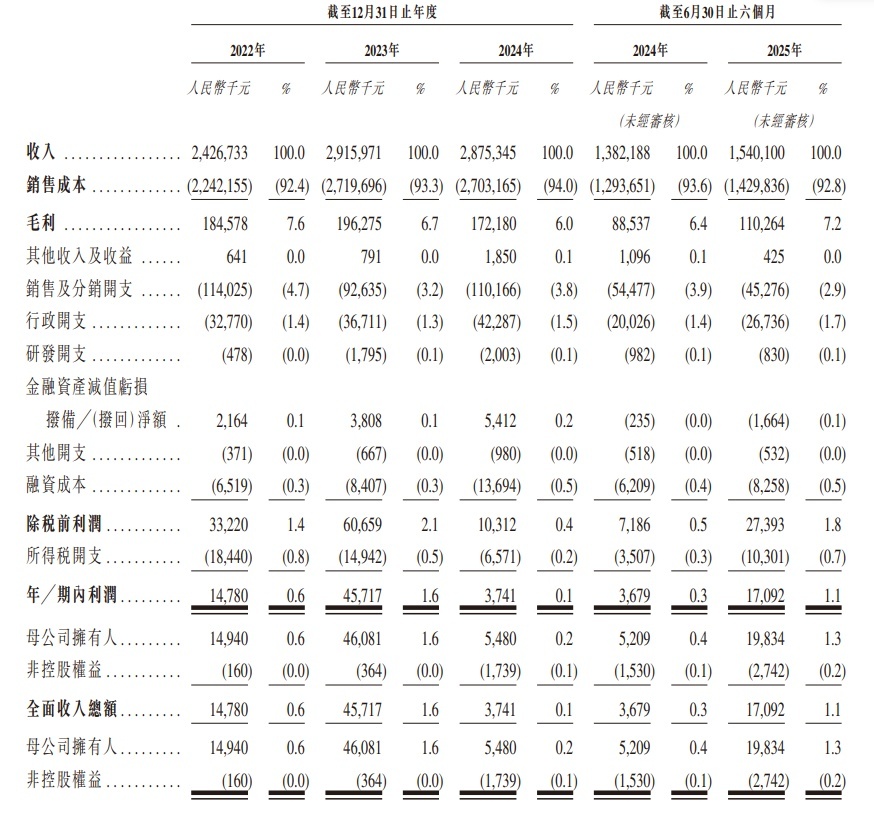
This operational performance has also raised some market doubts: Are Rongtai Pharma's high market ranking and large customer base inflated?
In reality, among the competitors in China's out-of-hospital marketing and supply chain service market, Rongtai Pharma ranks fourth but holds only a 1.2% market share. The industry leader is a comprehensive pharmaceutical service company whose main businesses include digital drug distribution and supply chain services, exclusive drug agency and brand promotion, OEM (original equipment manufacturing) services, retail business, consumer healthcare and value-added services, and digital drug logistics services and supply chain solutions. By 2024 revenue, its market share reached 11.4%.
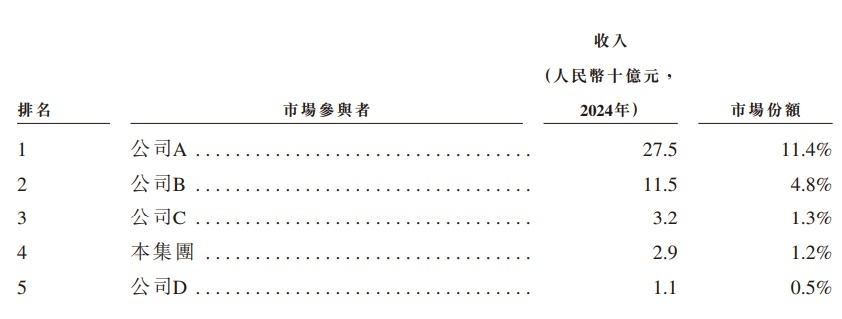
With its limited market share, Rongtai Pharma also inevitably has binding relationships with some clients (mainly e-commerce clients, regional sales partners, grassroots terminals, large chain pharmacies, and individual end consumers) and suppliers (mainly pharmaceutical companies, followed by certain designated distributors of pharmaceutical companies).
The prospectus shows that from 2022 to 2024 and the first half of 2025, the revenue from Rongtai Pharma's top five clients accounted for 61.2%, 57.1%, 56.8%, and 48.9% of total revenue, respectively. Revenue from the largest client accounted for 22.8%, 17.9%, 20.8%, and 22.5% of total revenue during the same periods. Meanwhile, purchases from the top five suppliers accounted for 73.8%, 70.0%, 62.0%, and 54.8% of total purchases, with purchases from the largest supplier accounting for 27.0%, 26.3%, 16.1%, and 15.6% of total purchases.
Although the downward trend in the data suggests that Rongtai Pharma has, intentionally or unintentionally, reduced its industry dependence, potential risks remain prominent.
The company states bluntly in its prospectus: "If we are unable to continue to procure sufficient quantities of high-quality pharmaceutical products from existing suppliers, if suppliers fail to supply sufficient quantities of pharmaceutical products on time, or if the supplied products do not meet relevant quality standards, or if suppliers fail to comply with the terms of agreements regarding product returns or payments for warehousing, logistics, or other fees (as applicable), our business, operational performance, financial condition, and prospects may be materially and adversely affected."
Additionally, it is worth noting that while out-of-hospital marketing and supply chain service providers may appear glamorous, they are actually caught between upstream and downstream players, making it difficult to gain significant bargaining power. Currently, Rongtai Pharma's high accounts receivable more or less reflect this issue.
According to the prospectus, from the end of 2022 to the end of June 2025, Rongtai Pharma's trade receivables and notes increased from RMB 455 million to RMB 629 million. Furthermore, as of June 2025, the company's accounts receivable turnover days had increased to 63 days, up by 14 days compared to 2022.
Overall, as a key hub in pharmaceutical distribution, the development prospects of out-of-hospital marketing and supply chain service providers are undoubtedly broad, but they still occupy a relatively weak position in the broader industry. The reasons for this may be related to a lack of moats, such as not yet fully breaking away from traditional labor-intensive operations and insufficient technological driving force, which affects scale and efficiency improvements.
Therefore, one of Rongtai Pharma's major development goals is now focused on "committing to becoming an AI-driven digital enterprise-level service provider in the pharmaceutical industry, building an 'AI + digital' precision marketing system to lead the upgrade of the pharmaceutical distribution value chain." Perhaps, in the near future, we will get a glimpse of the true value of out-of-hospital marketing and supply chain services through its development.
Source: Pharmaceutical Research Society
The copyright of this article belongs to the original author/organization.
The views expressed herein are solely those of the author and do not reflect the stance of the platform. The content is intended for investment reference purposes only and shall not be considered as investment advice. Please contact us if you have any questions or suggestions regarding the content services provided by the platform.
