


 Rate Of Return
Talk about the thoughts on US stocks and some opportunity ideas after this "Trump TACO".

First, let's talk about "TACO," a new term that's been trending on Wall Street recently. Trump Always Chickens Out is a mocking phrase used to describe how Trump initially threatens to impose heavy tariffs and tough policies, causing market panic, but then backs down or softens his stance when the market falls and pressure mounts.
Actually, this time, creating policy expectation shocks in the early hours of Saturday, during the Asia-Pacific time zone night, is a common political tactic: giving the market a "first-move shock" to force China to react in negotiations while also leaving enough buffer space for oneself. Then, over the weekend, Vance spoke up to soften the tone. This typical short-term political game is nothing new, but this time it triggered an unusually large shock in U.S. stocks and crypto, which was unexpected. So today, our company held a meeting to review and established an ironclad rule: we will adopt a short position strategy on weekends, retreating and holding U.S. dollars (U) after work on Friday to prevent such uncertain events from happening again.
To summarize, Trump's approach has several intentions:
• Applying pressure and seizing the initiative in the agenda: first making strong statements to force the other side to react and take a stance;
• Creating bargaining chips: making the market and the other side feel that there will be serious consequences if they don't concede;
• Testing red lines: seeing how much China can tolerate in terms of rare earths and export controls and whether it can make concessions for negotiations;
• Guiding market psychology: when the market falls due to tariff concerns, he may choose to "back down" to stimulate a rebound (TACO-style operation).
Therefore, for this kind of Trump's habitual game tactic, we not only need to analyze and deconstruct it but also flexibly improve our investment strategies and thinking. Since it's impossible to guard against everything, the best approach is to exit the market at critical times and avoid participation altogether.
📝 The impact of this "TACO" on U.S. stocks + market confidence
In terms of market confidence, in my view, this time's impact is likely to be a typical "short-term panic + medium-term recovery":
1️⃣ Short-term: Market sentiment is suppressed, leading to a "risk preference pullback"
Because this involves highly sensitive areas for China and the U.S., such as rare earths, technology, and supply chains, any combination of "export restrictions + tariff hikes" will put pressure on sectors like technology, semiconductors, and electronics. Just like the sharp declines seen in the S&P and Nasdaq in recent days. Short-term panic among investors may increase, leading to a rise in safe-haven buying (such as U.S. bonds and gold).
2️⃣ Medium-term: Policy softening and the possibility of negotiation easing may drive a recovery rebound
If Trump ultimately doesn't implement the tariffs or China makes concessions on rare earth exports, this "sell-off followed by release" path will lead to a wave of "buying after the drop"—isn't this the TACO trading opportunity of "buying when the market is most panicked"? Moreover, many strategic funds and hedge funds may repeatedly bottom-fish and clear positions during this wave of policy volatility, engaging in cyclical trading.
3️⃣ Long-term: Fundamentals remain key
Whether the market can stabilize depends on the "degree of concession" and transparency between China and the U.S. on rare earths, technology exports, and supply chains. If it's just tough talk without policy implementation or eventual concessions, market confidence may experience short-term volatility but won't collapse. On the other hand, if it escalates to actual restrictions and retaliation, it could evolve into a larger systemic risk.
Overall, I wouldn't consider this operation a signal of "U.S. stock market confidence collapse," but it is indeed a catalyst for increased volatility and shaken short-term confidence. As a U.S. stock investor, I will remain vigilant, strictly control positions, and keep some liquidity to wait for opportunities.
At the same time, we need to watch a few key points:
• How the U.S. stock market reacts at the open: if it's under pressure again at the open, it may indicate that market fears about policy implementation are still strong;
• China's official response + whether rare earth export policies will tighten further or make concessions;
• Whether negotiation news in the coming days or weeks will bring "softening steps," especially at the APEC meeting at the end of the month.
🎯 Rare earth and critical mineral concept U.S. stocks may present opportunities
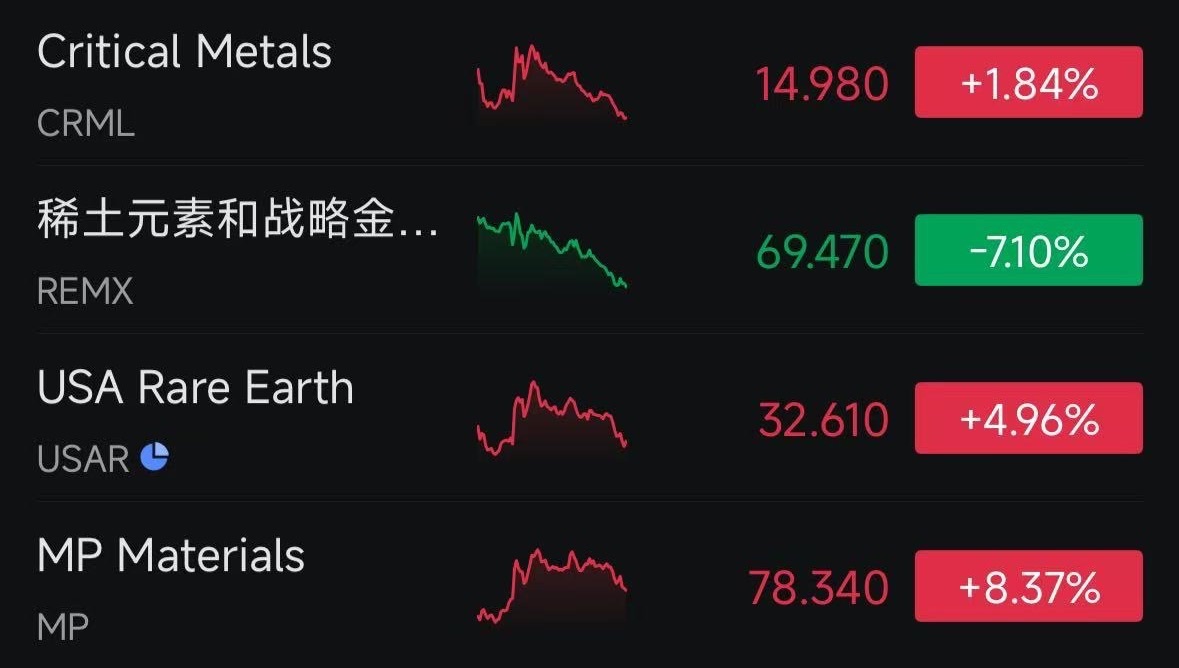
Because rare earths and critical minerals (including rare earths, lanthanum, neodymium, praseodymium, heavy rare earths, magnetic materials, and permanent magnets) inherently have "strategic + industrial + policy-oriented" attributes, they may have potential positive factors in the recent game. Below are a few representative companies that I personally think are worth keeping an eye on.
1️⃣ MP Materials (NYSE: #MP)
MP Materials is the largest rare earth mining company in the U.S. and the only rare earth asset operator in the U.S. with both mining and processing capabilities. It owns the Mountain Pass mine resources in California and is advancing the integration of downstream processing, magnets, and permanent magnets into a full supply chain. Recently, it secured a major collaboration with the U.S. Department of Defense (DoD): the DoD invested $400M to become its largest shareholder and established a price floor guarantee mechanism for NdPr (neodymium-praseodymium oxide) at $110/kg. This price floor can reduce the impact of Chinese subsidies suppressing market prices on #MP. It also has a collaboration with #Apple (supplying rare earth magnets) to ensure the stability of its downstream orders.
Investment logic:
• National security + non-Chinese supply chain
Against the backdrop of the U.S.-China tech war and supply chain localization, #MP's vertical integration + U.S. domestic rare earth resources make it a policy-favored target.
• Guarantee mechanism + government commitment
The price floor commitment + government investment + contract order guarantees can, to some extent, mitigate the damage to the company's operations from large fluctuations in commodity prices.
• Long-term upward demand for rare earths / magnetic materials
From electric vehicles and wind power to robotics, defense, and aerospace components, rare earths are indispensable, providing solid long-term demand support.
• "First-mover advantage + technical and scale barriers"
Although many companies talk about entering the rare earth industry, the technical barriers, capital investment, environmental approvals, and policy permits are all challenging. But #MP is already on the path. If China tightens rare earth export controls or imposes new restrictions in the future, companies like MP may see an "supply substitution" investment trend.
2️⃣ USA Rare Earth (#USAR)
USA Rare Earth is another well-known rare earth and permanent magnet supply chain company in the U.S., attempting to lay out a full industrial chain plan for "mining + magnet manufacturing." The company has proposed building mining and magnet facilities in Texas, aiming to complete a more complete chain domestically in the U.S. Recently, company executives stated that they are in close communication with the Trump administration and may seek policy and funding support.
If the government is truly willing to support "U.S. domestic rare earths + magnet manufacturing," #USAR could be one of the "potential dark horse beneficiaries."
3️⃣ Other noteworthy targets, some small companies and ETFs
• Critical Metals ( #CRML): Recent media reports suggest the U.S. government may invest in the company (a rare earth project in Greenland) to ensure control over strategic minerals.
• Rare earth and strategic metals ETFs, such as VanEck Rare Earth (#REMX), can also be considered as a way to diversify risk.
Overall, the recent TACO is still just talk and hasn't escalated into actual conflict, so we still need to observe. In terms of operations, it's not advisable to take on too large a position; instead, run lightly, keep some backup, and maintain liquidity. Stay alert to policy and news developments. Watch for key points: how China's rare earth export policies will change next; whether the U.S. government or the DoD will actually implement subsidy contracts and procurement; whether high-level officials from both sides will engage in easing negotiations at international events (e.g., APEC). For now, caution is the best policy—better safe than sorry!
The copyright of this article belongs to the original author/organization.
The views expressed herein are solely those of the author and do not reflect the stance of the platform. The content is intended for investment reference purposes only and shall not be considered as investment advice. Please contact us if you have any questions or suggestions regarding the content services provided by the platform.
