

Two consecutive days of stock price limit up! Behind the 900 million yuan change of ownership and 700 million yuan private placement, the survival story of Asia Pacific Pharmaceutical.

Asia Pacific Pharmaceuticals, a veteran pharmaceutical company established in 1989, is undergoing a major transformation.
Recently, Asia Pacific Pharmaceuticals announced that its controlling shareholder, Ningbo Fubang Holding Group Co., Ltd. (hereinafter referred to as "Fubang Group") and its acting-in-concert party, Shanghai Hangui Investment Management Co., Ltd. (hereinafter referred to as "Hangui Investment"), signed a "Share Transfer Agreement" with Zhejiang Xinghao Holding Partnership (Limited Partnership) (hereinafter referred to as "Xinghao Holding") and Zhejiang Xingchen Equity Investment Partnership (Limited Partnership) (hereinafter referred to as "Xingchen Investment") on October 13, 2025.
According to the agreement, Fubang Group and Hangui Investment plan to transfer 14.61% of Asia Pacific Pharmaceuticals' shares, totaling 108,945,566 shares, at a transfer price of RMB 8.26 per share (a 45.68% premium over the closing price of RMB 5.67 per share before the trading halt), with a total transaction amount of RMB 900 million. After the transaction is completed, the controlling shareholder of Asia Pacific Pharmaceuticals will change to Xinghao Holding, and the actual controller will change to Qiu Zhongxun.
In addition, Asia Pacific Pharmaceuticals also disclosed a plan to issue shares to specific investors. The company plans to issue no more than 136,986,301 shares (inclusive) to Xinghao Holding at a price of RMB 5.11 per share, raising no more than RMB 700 million, which will be fully used for new drug R&D projects after deducting issuance expenses. After the issuance, Xinghao Holding's shareholding in the listed company will increase to 22.38%.
The investment market responded quite positively to the above news. On October 14, Asia Pacific Pharmaceuticals resumed trading and hit a "limit-up" at RMB 6.24 per share. On October 15, the stock rose by the daily limit again to RMB 6.86 per share, a 9.94% increase.
The investment market clearly sees a turnaround for Asia Pacific Pharmaceuticals. In recent years, the company has been mired in losses, and "share transfer + private placement" has become a key opportunity to reverse its situation.
Survival Pressure Highlights the Urgency of Transformation
Times are changing, and so is the survival environment for veteran pharmaceutical companies. Traditional pharmaceutical companies like Asia Pacific Pharmaceuticals, which rose to prominence with chemical generics, have indeed reached a critical moment for transformation and upgrading.
Cold operational data sound the alarm. According to financial reports, from 2022 to 2024, Asia Pacific Pharmaceuticals' revenue was RMB 373 million, RMB 421 million, and RMB 405 million, respectively; net profit attributable to the parent company was -RMB 133 million, -RMB 11.877 million, and RMB 34.239 million, respectively; and non-GAAP net profit was -RMB 117 million, -RMB 68.9445 million, and -RMB 28.1319 million, respectively.
In addition, in the first half of 2025, Asia Pacific Pharmaceuticals achieved operating revenue of approximately RMB 152 million, a year-on-year decrease of 31.48%; net profit attributable to the parent company was approximately RMB 105 million, a year-on-year increase of 1,820.97%; and non-GAAP net profit was -RMB 48.8622 million, a year-on-year plunge of 524.31%.
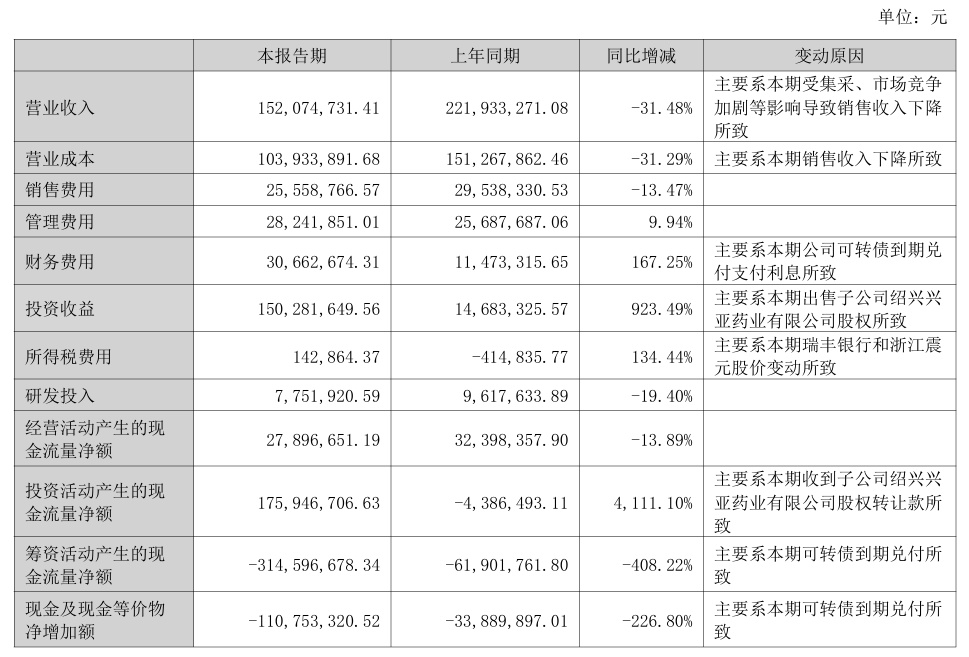
The surge in net profit attributable to the parent company was mainly due to the company's sale of 100% equity in its wholly-owned subsidiary, Shaoxing Xingya Pharmaceutical Co., Ltd., which increased the company's total profit for the first half of 2025 by approximately RMB 149 million. Excluding the impact of the above non-recurring gains and losses, Asia Pacific Pharmaceuticals' underlying losses remain unchanged.
From a product perspective, Asia Pacific Pharmaceuticals is still dragged down by generics.
According to financial reports, as of now, Asia Pacific Pharmaceuticals' chemical drug business is mainly divided into two categories: antibiotics and non-antibiotics, with a total of 114 approved drug formulations.
Among them, antibiotics account for about 60% of the company's revenue, mainly including 59 approved drug formulations such as amoxicillin and clavulanate potassium dispersible tablets, azithromycin dispersible tablets, azithromycin for injection, roxithromycin capsules, cefotaxime sodium for injection, and cefmetazole sodium for injection. Non-antibiotics mainly include 55 approved drug formulations such as digestive system drugs (e.g., pantoprazole sodium for injection, omeprazole sodium for injection, omeprazole enteric-coated capsules, lansoprazole enteric-coated capsules, etc.), antiviral drugs (e.g., ribavirin for injection, acyclovir for injection, ganciclovir for injection, etc.), cardiovascular drugs, and antipyretic analgesics.
There are many products, but most are crowded in hot, highly competitive, and relatively low-barrier segments. Asia Pacific Pharmaceuticals lacks a solid moat. In addition, policies such as volume-based procurement, medical insurance catalog negotiations, and consistency evaluations have accelerated in recent years, intensifying competition among generic drug companies in R&D, production, supply, and sales.
Asia Pacific Pharmaceuticals' semi-annual report mentioned that in July 2025, to ensure drug quality for patients, the state optimized the scale of the 11th round of centralized procurement, proposing the principles of "stabilizing clinical use, ensuring quality, preventing bid-rigging, and countering involution." The centralized procurement system avoids competition based solely on low prices, taking into account factors such as drug production quality and corporate supply capabilities. Consistency evaluation of generic drugs is a hard requirement for entering centralized procurement.
According to MoShang Pharmaceutical Database statistics, as of May 16 this year, 41 pharmaceutical companies have passed or are deemed to have passed consistency evaluations for 10 or more anti-infective drugs. Among them, Qilu Pharmaceutical, Kelun Pharmaceutical, and CSPC Pharmaceutical Group ranked in the top three with 59, 58, and 55 varieties, respectively.
Asia Pacific Pharmaceuticals started its generic drug consistency evaluation work relatively late. Currently, only 19 products have passed the evaluation (or are deemed to have passed). The company also expressed concerns in its latest financial report: "With increasingly strict national regulatory and registration laws, there is a risk that generic drug consistency evaluations may fail or the R&D cycle may be extended. If related products fail the evaluation, they may lose market access, adversely affecting the company's future operations."
All these challenges are accelerating Asia Pacific Pharmaceuticals' strategic transformation. Currently, "combining imitation with innovation and driving innovation" has become the company's core strategy. It believes that pharmaceutical companies with large-scale production capacity, strict quality control, strong innovation capabilities, and rich product pipelines will have an advantage in the complex competitive landscape of the pharmaceutical industry.
The change of ownership and fundraising are also based on these development needs.
What Can Asia Pacific Pharmaceuticals Gain from "Fundraising + Change of Ownership"?
The RMB 900 million transfer and RMB 700 million private placement are clearly not just about improving financial conditions. The key is to achieve continuous improvement in technology R&D and commercial operations.
Asia Pacific Pharmaceuticals also expressed its expectations for the future in the announcement: "Through the implementation of fundraising projects, the company will transition from traditional chemical generics to improved new drugs and Class 1 innovative drug R&D, enhancing its operational risk resistance under China's pharmaceutical policies, advancing potential new drug projects to critical clinical phases, expanding the depth and breadth of its product portfolio, and laying a solid foundation for strategic business transformation."
Specifically, the empowering role of the "new owner" Xinghao Holding is quite prominent.
First, in R&D. The announcement shows that the funds raised by Asia Pacific Pharmaceuticals will be fully used for new drug R&D projects, including an oncolytic virus drug R&D platform and a long-acting and complex formulation R&D platform, covering pipelines such as Type I and III FIC anti-tumor biologics, multiple myeloma drugs, risperidone microspheres, LRHR long-acting formulations, Parkinson's long-acting formulations, and dual-mechanism neuropathic pain drugs.
For such a layout, Xinghao Holding will not only provide financial support. According to the announcement, Xinghao Holding has signed a "R&D Cooperation Letter of Intent" with related CRO companies, aiming to integrate Asia Pacific Pharmaceuticals' industrialization capabilities and R&D resources to promote the transformation of innovative drug R&D achievements, helping the company expand its product portfolio and enhance market competitiveness. Additionally, Xinghao Holding has obtained exclusive intent authorization for the R&D of the above varieties.
It is worth noting that the innovative drug sector, which Asia Pacific Pharmaceuticals values, also has relatively broad prospects. For example, data disclosed in the announcement shows that the total market size for the indications targeted by Type I and III anti-tumor biologics in China and the U.S. is expected to reach RMB 160 billion in 2025. Among them, the existing market size for mid-to-late-stage patients suitable for these biologics is estimated at RMB 13-18 billion (China) and $14-30 billion (U.S.), highlighting the potential of these segments.
Second, in commercial operations. It is understood that Xinghao Holding's actual controller, Qiu Zhongxun, is also the helmsman of Yaodou Technology, the largest vertical digital pharmaceutical industry platform in China's private sector.
According to the announcement, Yaodou Technology's business model is already mature. It has established a nationwide integrated online and offline pharmaceutical sales network, with four major business segments: a national digital distribution platform—Yaodou Procurement, a pharmaceutical retail platform—Yaodou.com, a cross-border pharmaceutical platform—Yaodou International, and smart pharmaceutical AI and big data services. It represents over 1,000 advantageous drug varieties.
In addition, Yaodou Technology collaborates with over 4,000 upstream pharmaceutical suppliers and about 650,000 downstream commercial and terminal customers, with over 250,000 self-operated business users and cumulative platform transaction volume exceeding RMB 65 billion. This could fully empower Asia Pacific Pharmaceuticals in the commercialization of new drugs.
Overall, fundraising and change of ownership are necessary conditions for Asia Pacific Pharmaceuticals to enter the next cycle. The effectiveness of subsequent transformations will further anchor the company's investment value.
Conclusion
Currently, the contraction and Matthew effect in the generic drug sector are evident. According to Asia Pacific Pharmaceuticals' announcement, the market share of chemical generics has declined from 60% to 52% in the overall drug market and from 79% to 74% in the chemical drug market. There are about 20,000 participants in China's chemical generic drug market. Although there are many participants, nearly 60% of the market share is held by the top 100 leading companies (ranked by sales). Against this backdrop, more pharmaceutical companies selling themselves for acquisition" are expected, and industry consolidation is an inevitable trend.
Source: Pharmaceutical Research Society
The copyright of this article belongs to the original author/organization.
The views expressed herein are solely those of the author and do not reflect the stance of the platform. The content is intended for investment reference purposes only and shall not be considered as investment advice. Please contact us if you have any questions or suggestions regarding the content services provided by the platform.
