

Using AI to redefine human-machine relationships, OPPO Smart Services brings a more "understanding you" experience

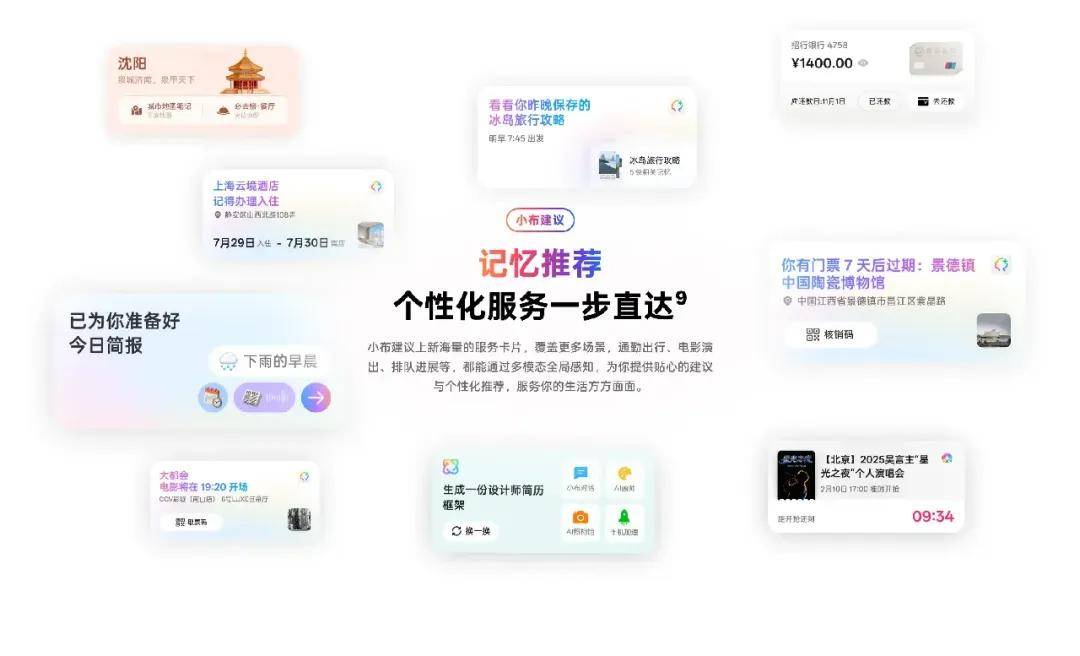
After mobile internet entered the era of stock competition, users and developers were pushed towards an invisible "narrow gate".
For users, it's "overload of choices".
With hundreds of apps installed on their phones, every immediate need—like ordering dinner on the way home from work—requires first finding a specific app and navigating through various menus to locate the corresponding service... The distance between people and services is widened by "complex operations".
For developers, it's "disconnected communication".
In an era of information overload and fragmented attention, traditional service distribution models are like "casting a net to catch fish", with user patience constantly diluted through layers of redirection. The result is that services remain in a "dormant state" for long periods, struggling to reach users precisely when their needs arise.
As large models become the main theme of innovation and every industry is being reshaped by AI, can the bottlenecks of service distribution be broken? How can smarter service experiences be delivered to users? At the recently concluded 2025 OPPO Developer Conference, we saw new possibilities at the Smart Service Ecosystem sub-forum.
01 OPPO's Solution: Reconstructing the Connection Path Between "People and Services"
Driven by the wave of large models, the industry has reached a consensus: human-machine relationships will shift from "command and execution" to "understanding and collaboration".
Over the past two decades, human-machine relationships have been "instructional"—we tell machines "what to do and how to do it", and machines execute according to specific rules. Whether it's entering commands, clicking buttons, or swiping interfaces, the essence has always been humans adapting to machine logic.
The revolutionary innovation of large models has fundamentally changed this dynamic. With capabilities like natural language understanding, multimodal perception, contextual reasoning, and autonomous execution, users only need to express their intent in natural language, and AI can actively match services and deliver results.
But between vision and reality, there are often chasms.
In the context of service distribution, traditional human-machine interaction is a passive "people finding services" response, while users in many scenarios may not even be aware of their latent needs. Vast services are trapped in isolated apps, forcing users to first think, "Which app should I use?"; the premise of precise distribution is accurate identification of user intent, yet relying solely on a user's single search or click behavior makes it hard to capture their true needs...
How does OPPO bridge these gaps? At the Smart Service Ecosystem sub-forum, we identified two key insights.
First, they built a three-dimensional, all-scenario entry matrix.
This includes the "minus one screen", home screen, lock screen, Fluid Cloud, Breeno Suggestions, global search, and more—effectively creating an omnipresent service delivery network. It deeply integrates the proactive path of "people finding services" with the passive path of "services finding people".
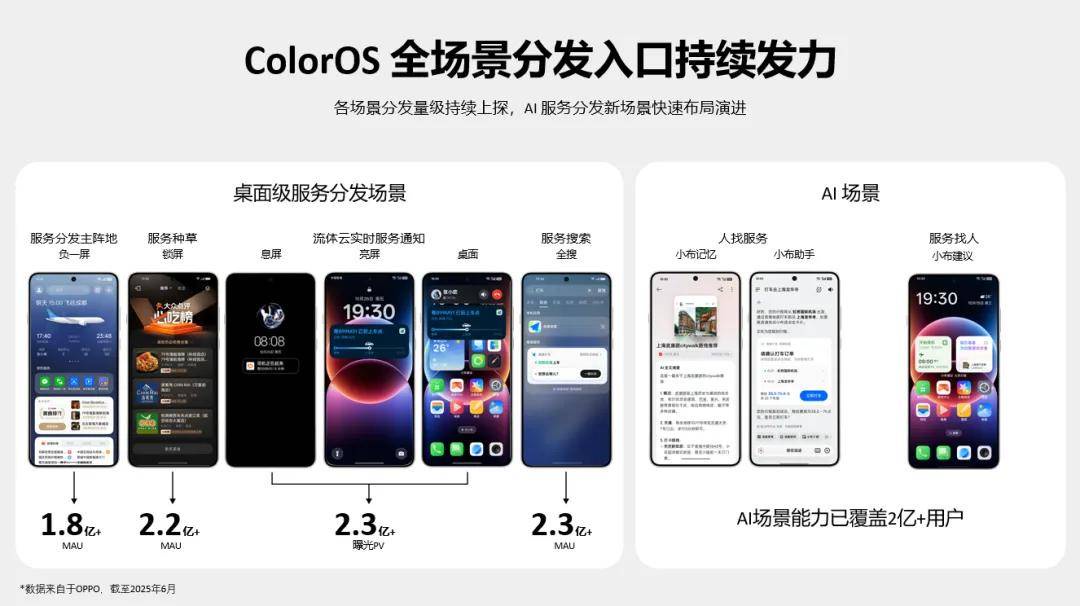
When user needs are clear, global search allows users to access specific app functions or service content with a single search, drastically shortening the operational chain. The "minus one screen" acts like a smart service hub, aggregating frequently used services and key information in card formats.
When user needs are nascent or vague, entry points like Fluid Cloud, Breeno Suggestions, and the lock screen proactively present services at the most opportune moments. For example, "Fluid Cloud" can display real-time updates like food order progress or ride-hailing ETAs in a lightweight, non-intrusive overlay on the system interface. The lock screen pushes high-priority notifications like boarding gate details or movie start reminders.
With this three-dimensional entry matrix, OPPO liberates services from isolated apps, embedding them into every corner of the system. Services can now be intelligently recommended when users need them, shifting from passive to proactive.
The other question to answer is: How to safely and accurately identify user intent and precisely match the right services?
The answer lies in system-level implementation of AI and intent-sensing capabilities.
Simply put, OPPO integrates multidimensional data like location, behavior patterns, and device status to build a more accurate user intent recognition model. While ensuring user privacy, the model analyzes intent based on context and scenarios, enabling precise service delivery.
A direct example is travel scenarios.
Users just need to give Breeno Assistant a "call a ride home" command. With authorization, it automatically links the current location, infers "home" from travel history, syncs the info to ride-hailing services to place an order, and provides voice updates on the ride's progress—all without needing to look at the screen.
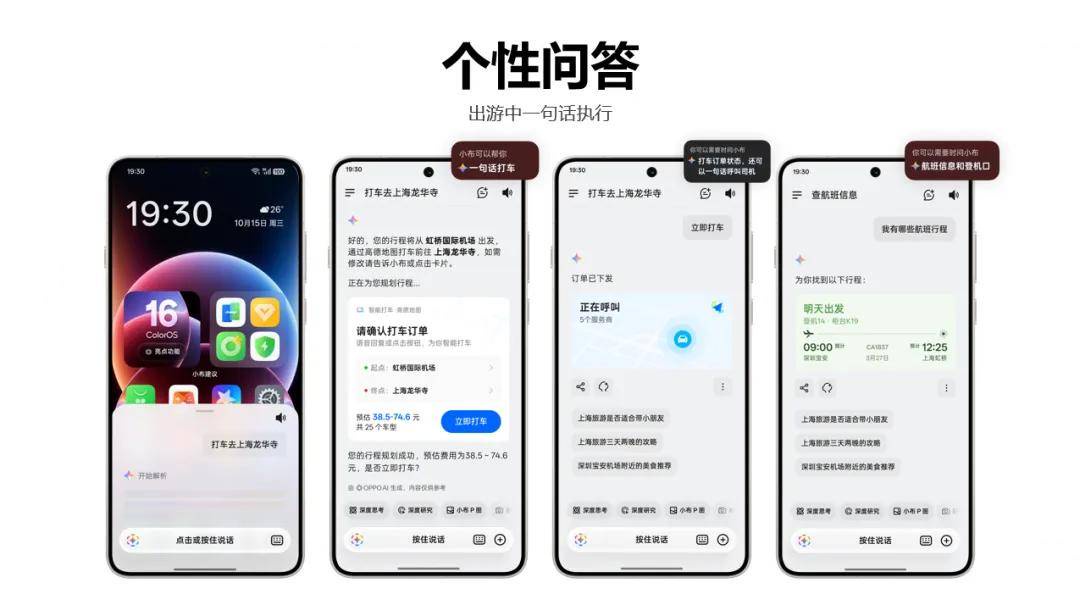
It's not just about simplifying "people finding services"; "services finding people" is also being redefined:
When leaving the office, Breeno Suggestions, using authorized location data, intelligently pushes a "call a ride home" card.
When near a saved tourist spot, the system pops up a card on the home screen reminding the user to check in, based on user-marked locations.
When a purchased restaurant deal is about to expire, it proactively reminds the user at the right time.
It can even act as a "personal guide", recommending trending eateries, using the camera to translate foreign signs or menus in real time, or enabling AR-assisted walking navigation—all while ensuring user awareness and consent for a safer, more thoughtful smart service experience.
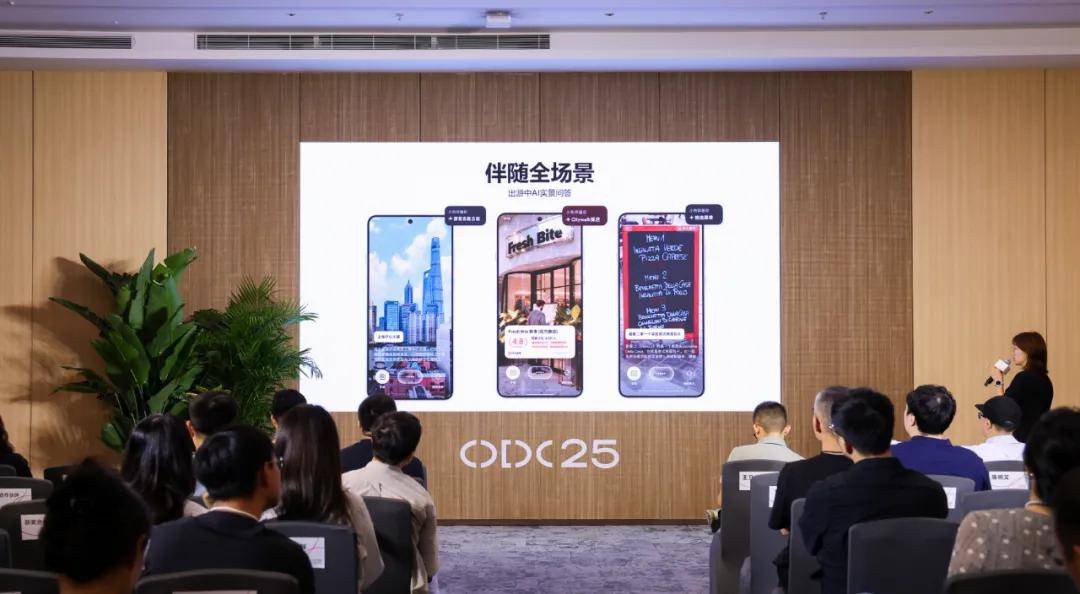
Clearly, Breeno Assistant and Breeno Suggestions, as OPPO's "main platforms" for smart services, have quietly transitioned from "tools" to "smart service partners". By reconstructing the connection path between "people and services", they’ve opened new possibilities for service distribution.
02 Ending Adaptation Woes: Building a Bridge for Developers and Users
From a developer’s perspective, as AI learns to understand users and anticipate scenarios, the relationship between people and services is being redefined.
Unlike the "app-centric" era of mobile internet, more companies and developers now realize: in the new narrative of "intelligent agents", services shouldn’t be confined to apps. Instead, they should exist in the system as perceivable, understandable, and callable entities, requiring collaboration across the industry to build an intent-driven smart service ecosystem.
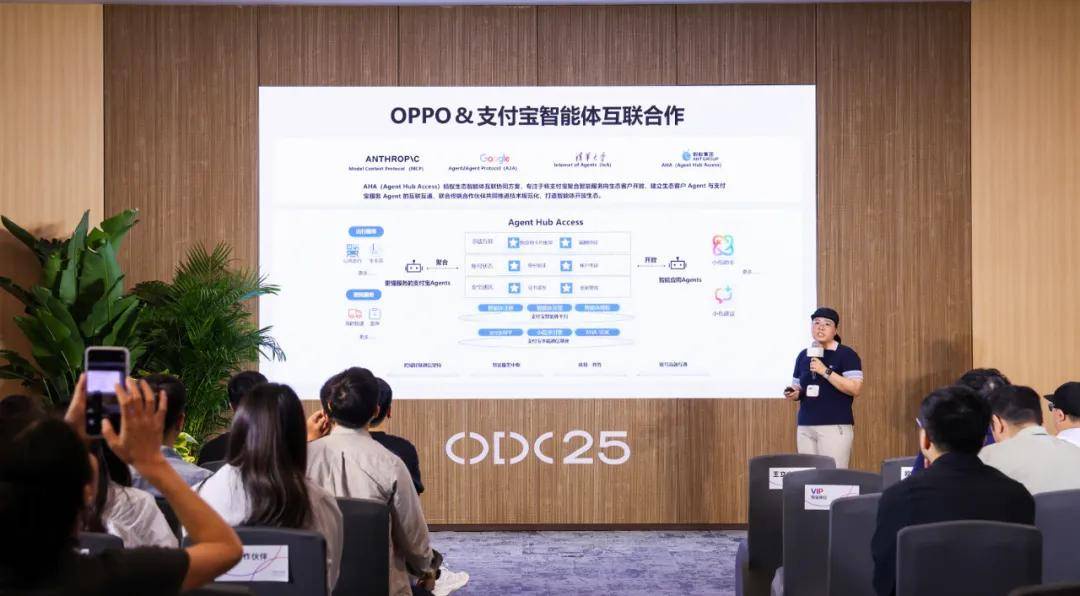
For example, OPPO and Alipay partnered to launch the industry’s first multi-agent interconnection solution, Agent Hub Access (AHA), based on the A2A protocol. Soon, Breeno AI will fully integrate Alipay’s AI travel, healthcare, and public services.
But for many developers, the smart service ecosystem remains an idealistic vision, while the reality is the widespread adaptation challenges in the industry.
Each entry point follows its own interaction logic and UI standards, with different technical frameworks, APIs, and data protocols. Adapting to each entry is like maintaining a new client, creating an invisible barrier that hinders deep integration of services with system-level scenarios and limits the ecosystem’s growth.
OPPO proposes three solutions.
First, a unified "intent standard".
Through open collaboration with leading players, OPPO has defined a relatively comprehensive intent standard, now covering 4 major domains and over 200 scenarios. To streamline developer integration, OPPO also introduced standardized intent framework interfaces and parameters, enabling unified access for quick apps, native apps, and cloud services.
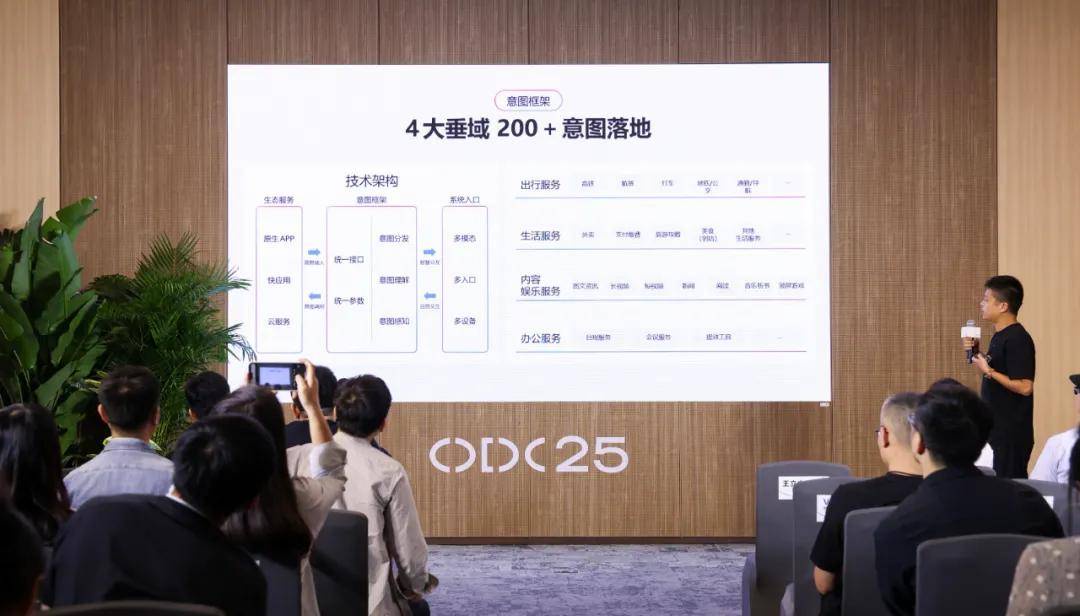
In short, developers only need to integrate once via the "intent standard", and their services can be distributed across all entry points like the minus one screen, home screen, and Breeno Assistant—drastically reducing adaptation complexity.
Second, a one-stop platform empowering the entire development lifecycle.
Compared to the limited functionality of mobile web or the high cost of native apps, OPPO and other smartphone makers are turning quick apps into efficient carriers for smart services. To boost quick app development and distribution efficiency, OPPO’s IDE offers rich templates and components, real-device debugging, and streamlined publishing and review processes—cutting time-to-market by 50%.
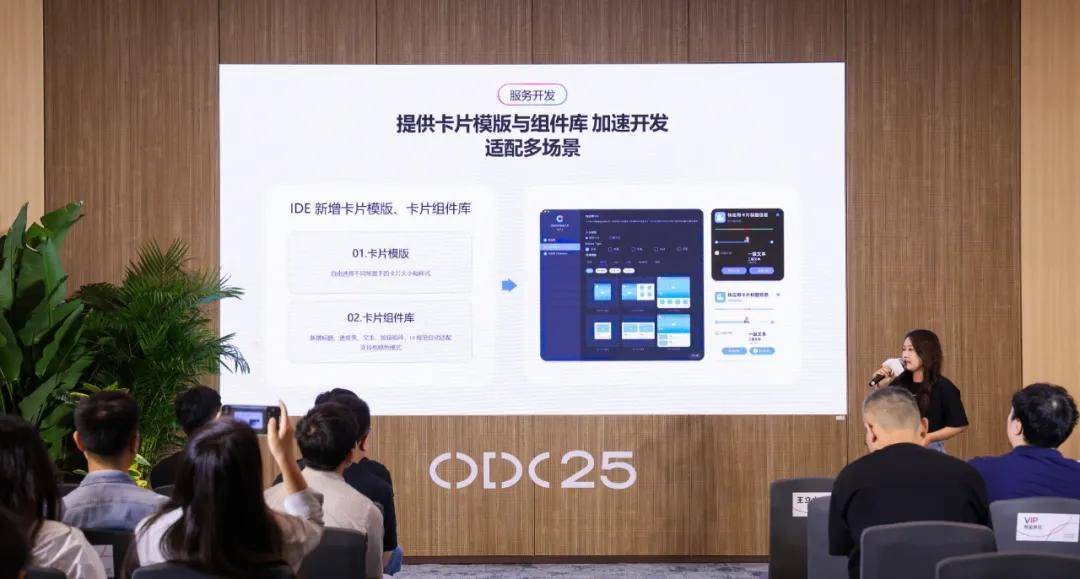
It also adds capabilities like geofence-triggered actions and data interoperability with apps, ensuring precise service activation and seamless user experience.
Third, adherence to three industry-standard security principles.
Addressing developer and user concerns about AI data privacy, OPPO’s "intent standard" follows strict security protocols:
For device-side, cloud-side, and quick app integration, sensitive data stays on-device and never uploads to the cloud; cloud-side desensitized data isn’t tracked, stored, or used for algorithm training; all data access requires user authorization, with options to enable/disable permissions or delete data—ensuring worry-free integration for developers and worry-free usage for users.
Metaphorically, OPPO acts as a "bridge builder", connecting developers and users for smart services: enabling developers to "understand every user’s intent" and letting them deliver the right service at the right time.
03 Closing Thoughts
OPPO’s innovations in service distribution validate the paradigm shift of the AI era—from "operation triggers" to "intent understanding".
As ZhenFund Managing Partner Dai Yusen noted in an interview: Internet-era competition was about capturing user time; in the AI era, companies must consider how to become essential nodes in the intelligent agent decision chain.
Traditional internet models relied on "attention-grabbing" logic, where users actively opened apps, searched, selected, and step-by-step completed goals. The lengthy, fragmented experience often delayed or buried real needs.
OPPO’s co-built smart service ecosystem demonstrates a new paradigm: services transcend apps, shifting from passive invocation to proactive awareness. Services no longer need to be "found"—they naturally "appear" in context.
Under this new paradigm, the once-troubling "narrow gate" for users and developers is widening:
For users, transitioning from "people finding services" to "services finding people", companion-like experiences—more understanding, proactive, efficient, and secure—will become AI-era infrastructure.
For developers, leveraging intent recognition, scenario triggers, and system synergy, they can rapidly build personalized, secure smart experiences, unlocking maximum value.
The copyright of this article belongs to the original author/organization.
The views expressed herein are solely those of the author and do not reflect the stance of the platform. The content is intended for investment reference purposes only and shall not be considered as investment advice. Please contact us if you have any questions or suggestions regarding the content services provided by the platform.
