

长期看好特斯拉,为什么我放弃两倍做多 ETF ?因为 LEAPS Call 才是长持的隐藏王者!

Earnings season is here again, and I believe many of you are most concerned about the earnings report of $Tesla(TSLA.US) this week.
Speaking of Tesla, many friends think the stock is too expensive and want to find some "accelerators." Generally, there are two options: one is options, and the other is leveraged ETFs.
You might think, "I'm bullish on Tesla in the long term, so I'll just buy a 2x leveraged ETF and hold it for a few years. Won't the return be twice that of the stock?"
No No No, that's not the case.
Let me cut to the chase: If you're into short-term trading, a 2x leveraged ETF is fine; but if you want to hold long-term, its performance might even be worse than LEAPS Call options.
Today, Options King will help you understand the differences between a 2x leveraged Tesla ETF and LEAPS Call options. How should we choose between them?
1. Why are leveraged ETFs unsuitable for long-term holding?
Leveraged ETFs are essentially ETFs with a built-in "magnifying glass." They use derivatives (like futures and options) to amplify the daily price movements by a fixed multiple. Note that their design is intended for daily amplification, not long-term amplification.
Common leveraged ETFs include (both long and short):
Tracking Tesla: $Direxion Daily TSLA Bull 2X Shares(TSLL.US), $GraniteShares 2x Short TSLA Daily ETF(TSDD.US)
Tracking NVIDIA: $GraniteShares 2x Long NVDA Daily ETF(NVDL.US), $Direxion Daily NVDA Bull 2X Shares(NVDU.US)
Tracking Nasdaq: $Proshares UltraPro QQQ(TQQQ.US), $Proshares UltraPro Short QQQ ETF(SQQQ.US)
Tracking Semiconductors: $Direxion Semicon Bull 3X(SOXL.US), $Direxion Semicon Bear 3X(SOXS.US)
For example:
If you buy TSLL and Tesla rises 1% in a day, TSLL should theoretically rise ~2%; but if Tesla falls 1%, TSLL will also drop ~2%.
If you buy TSDD and Tesla rises 1% in a day, TSDD should theoretically fall ~2%; but if Tesla drops 1%, TSDD will rise ~2%.
How does this amplification work?
Take TSLL as an example. The key is that it doesn’t directly buy Tesla stock but invests in derivatives like futures and options. This ensures the fund’s daily return precisely matches twice Tesla’s daily price movement.
To achieve this "2x" target, TSLL must adjust its holdings daily—adding positions when the stock rises and reducing them when it falls. This introduces a core issue: daily reset effects.
In other words, TSLL recalibrates its leverage to 2x at the end of each trading day. This daily "reset" operation causes significant erosion in volatile markets, leading to TSLL’s long-term performance ≠ Tesla’s long-term return × 2.
Case study:
Theory alone might be abstract, so let’s look at a concrete example to see how terrifying "volatility decay" can be:
Assume $Tesla(TSLA.US) is at $450, and $Direxion Daily TSLA Bull 2X Shares(TSLL.US) is at $20.
Day | Tesla Price | Daily Change | TSLL Price | Daily Change |
Day 1 | 450 → 472.5 | +5% | 20 → 22 | +10% |
Day 2 | 472.5 → 425.25 | -10% | 22 → 17.6 | -20% |
Day 3 | 425.25 → 412.49 | -3% | 17.6 → 16.54 | -6% |
Day 4 | 412.49 → 433.11 | +5% | 16.54 → 18.19 | +10% |
Tesla’s price fell from $450 to $433.11, a cumulative drop of ~-3.75%; TSLL fell from $20 to $18.19, a cumulative drop of ~-9.05%. This is nowhere near 2x!
The conclusion is clear: While TSLL’s daily moves are roughly 2x Tesla’s, after four days, the total loss is greater, and returns are worse.
Chasing mechanism: When Tesla rises 5%, TSLL must rise 10%. To achieve this, the fund manager must buy more call options or futures contracts—essentially chasing the rally.
Killing mechanism: When Tesla falls 10%, TSLL must fall 20%. To maintain accurate leverage, the manager must reduce call options or buy puts—effectively selling into weakness.
This forced "chase rallies, sell into weakness" behavior continuously erodes capital in choppy markets. For example, after a rally, the investment base grows; when the stock falls, losses are calculated on a larger base, creating a vicious cycle of "small base for gains, large base for losses."
Moreover, leverage magnifies this decay. Even if the stock rebounds later, TSLL’s price often struggles to return to previous highs, especially after a decline.
Key takeaway:
Leveraged ETFs’ decay mechanism makes them unsuitable for long-term holding. In volatile markets, this decay continuously erodes your capital, leading to far worse returns than expected.
Thus, leveraged ETFs are best for short-term trading, ideal for playing events like earnings or capturing technical swings.
Unless you’re highly confident the market will trend strongly in one direction (either up or down), avoid using them as long-term investments.
If your perspective is long-term, LEAPS Call options are usually the better choice.
2. Why are LEAPS Calls suitable for long-term holding?
LEAPS options, short for Long-Term Equity Anticipation Securities, are, as the name suggests, options with exceptionally long lifespans. LEAPS Calls are long-dated call options.
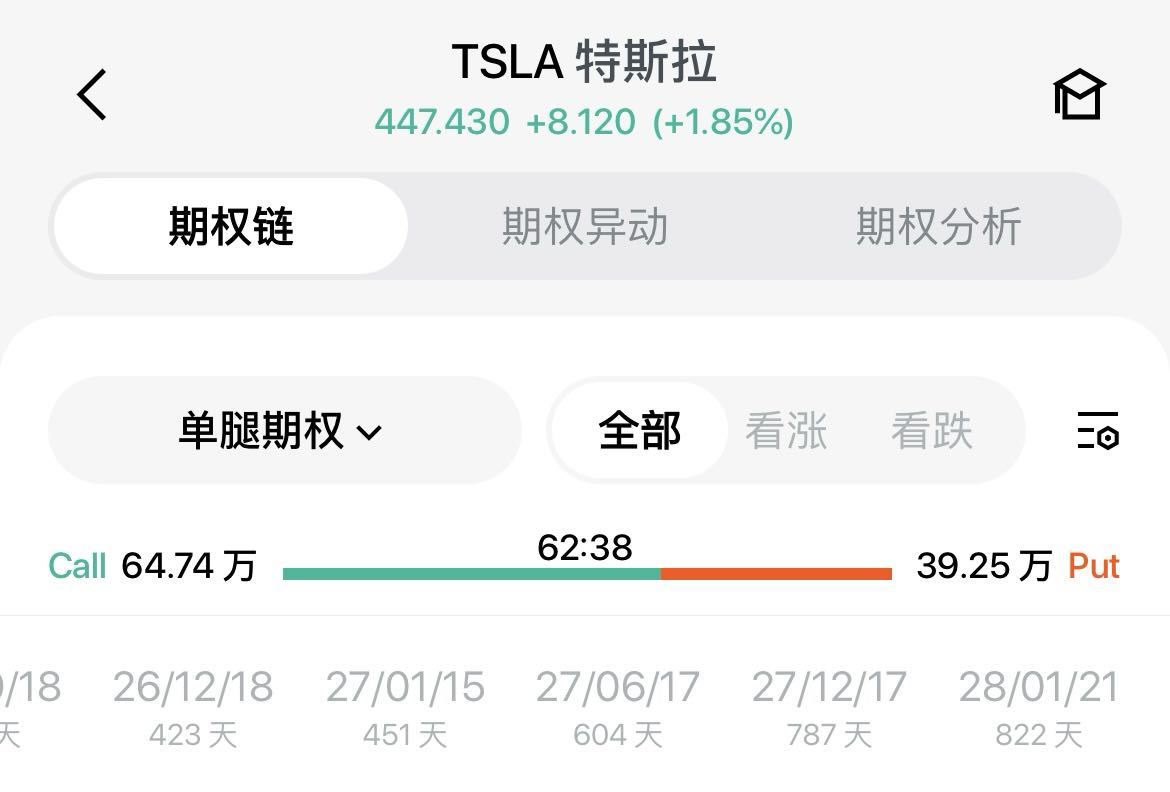
Unlike the weekly or monthly options we usually encounter, LEAPS have expiries typically over a year, with some as long as three years.
For example, you can find LEAPS options expiring in 2028 for $Tesla(TSLA.US) on the Longbridge app.
Two core advantages of LEAPS for long-term positioning:
Slow time decay: While all options suffer time decay, LEAPS, with their long expiries, "melt" much slower than short-term options. This gives you ample time to wait for your expected move, making them ideal for long-term plays.
Built-in leverage: They let you control the same number of shares as buying the stock outright but with far less capital, significantly improving capital efficiency.
A real-world example:
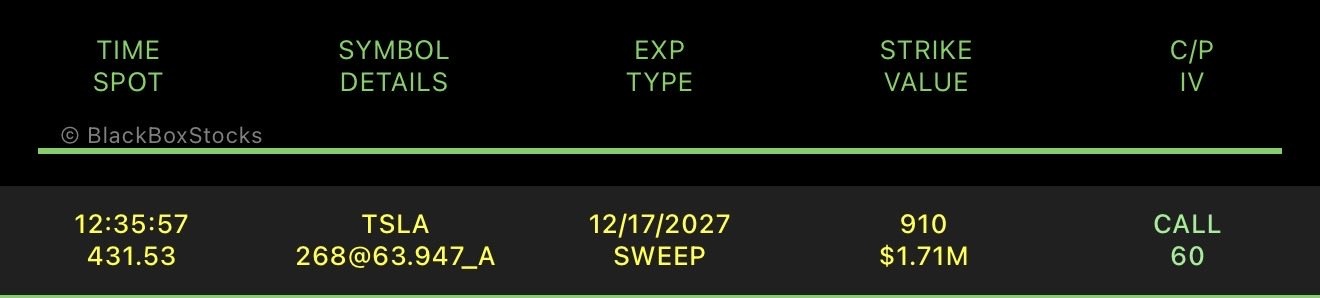
Not long ago, a whale invested $1.71 million to buy deep out-of-the-money (OTM) Tesla LEAPS Calls expiring December 2027 with a strike of $910. These options now cost $69 each, so one contract is $6,900.
Let’s do the math:
$6,900 buys 1 LEAPS Call, controlling 100 Tesla shares.
But Tesla’s current price is $450, so buying 100 shares outright costs $45,000.
Comparing returns:
If Tesla hits $1,200 by 2027 (for 100 shares):
Stock return: $120,000 - $45,000 = $75,000 (~167% return).
LEAPS return: ($1,200 - $910) × 100 - $6,900 = $22,100 (~320% return).
While the absolute gain is smaller than the stock, the return on the $6,900 outlay far exceeds the stock’s.
Why do whales love LEAPS Calls?
Ultimately, the core appeal is leverage. With the same capital, LEAPS can deliver far greater potential returns than buying the stock outright.
This is why you’ll see Wall Street pros and Capitol Hill insiders often use this strategy. When they’re bullish on a stock long-term, they often buy LEAPS Calls as stock substitutes.
For instance, Pelosi has bought deep in-the-money (ITM) LEAPS Calls on $Broadcom(AVGO.US), $NVIDIA(NVDA.US), and $Palo Alto Networks(PANW.US), though those are too expensive for most. The Tesla OTM LEAPS mentioned above are relatively cheaper.
Of course, LEAPS have drawbacks too:
Time isn’t infinitely your friend: Options have fixed expiries. If you buy OTM LEAPS Calls and the stock doesn’t reach the strike by expiry, the options expire worthless, and you lose your entire investment. Thus, this strategy requires strong conviction in the stock’s long-term trend.
Liquidity can be poor: Compared to ETFs, LEAPS often have wider bid-ask spreads, meaning higher trading costs if you exit early.
Chop also causes decay: If the stock oscillates, the option’s value will drop. But LEAPS decay is less severe than leveraged ETFs, mainly because they have more time value.
In short:
LEAPS offer a middle ground.
If you’re long-term bullish on a company but find the stock too expensive or capital inefficient, LEAPS are a great alternative.
They give you time to wait for the thesis to play out while amplifying potential gains via leverage.
But the critical prerequisite: You must have unshakable conviction in the stock’s long-term uptrend! This strategy only works if you’re right on direction and have enough time.
Final summary: How to choose between leveraged ETFs and LEAPS Calls?
For short-term trading and swing plays, pick leveraged ETFs: They’re flexible, low-barrier, and more direct in trending markets.
For long-term holds and stock substitutes, pick LEAPS Calls: They replace stock, leverage time, and sustain leverage longer.
Remember: Leveraged ETFs are "sprints," LEAPS Calls are "marathons."
Your choice depends not just on the market but also on your investment rhythm and patience. With earnings season here, how will you play it?
I hope today’s discussion of these two strategies gives you some ideas.
The copyright of this article belongs to the original author/organization.
The views expressed herein are solely those of the author and do not reflect the stance of the platform. The content is intended for investment reference purposes only and shall not be considered as investment advice. Please contact us if you have any questions or suggestions regarding the content services provided by the platform.
