

 Posts
PostsHow to control risks in a portfolio? This indicator is very important

The Hong Kong and US stock markets have been quite volatile these past two days. There's one metric that's particularly important in such volatile conditions, so today we'll discuss what Beta is.
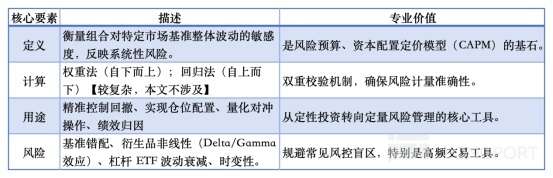
Beta isn't just a volatility indicator - it precisely measures a portfolio's sensitivity to "overall market volatility," serving as an intuitive gauge for whether investors are betting on the market (Beta Bet) or individual stocks (Alpha Bet).
The risk measured by Beta (systematic risk) cannot be eliminated through diversification, making it a core element of risk allocation.
Correctly calculating and managing portfolio Beta is a prerequisite for investors to achieve more precise risk budgeting, control drawdowns, allocate positions, and hedge market risks. Beta can also assist with performance attribution.
When β=1, it means the portfolio's volatility is roughly the same as the benchmark market (e.g., S&P500), known as market-neutral risk.
When β>1, the portfolio's volatility exceeds the market, typically seen in high-growth stocks or cyclical industries;
Conversely, when β is between 0 and 1, the portfolio's volatility is less than the market, usually characteristic of defensive or low-volatility strategies.
More unusually, β<0 indicates the asset moves opposite to the market, common examples include short index positions, put options, and certain inverse leveraged ETFs.
Industry Beta References
Broad Market ETF (SPY) ≈1.0
Tech/Growth Leaders mostly 1.1–1.5
Defensive Sectors (Utilities/Consumer Staples) mostly 0.5–0.8
Cash/Short-term Bonds≈0
How to Calculate Portfolio Beta?
Conventionally, there are two calculation methods: Weighting Method and Regression Method. When necessary, factor expansion (Multi-Factor Beta) can be used to precisely identify volatility sources. However, regression and factor expansion are more commonly used in scenarios requiring high accuracy. For most investors, the precision from the Weighting Method is sufficient.
Let's specifically discuss how to calculate using the Weighting Method.
First, obtain the historical Beta for each holding (typically calculated by third-party data providers based on CAPM or multi-factor models), then multiply by its market value weight in the portfolio, and finally sum to get the portfolio Beta. Note the calculation for short positions and cash: short positions have negative weights, and their Beta should be negative.
Example: $100k portfolio
AAPL $30k, β=1.2→weight 0.30, contribution 0.30×1.2=0.36
QQQ $20k, β=1.1→0.20×1.1=0.22
Bank stocks $20k, β=1.0→0.20×1.0=0.20
Utilities $10k, β=0.6→0.10×0.6=0.06
Cash $20k, β=0→0.20×0=0
Total β=0.36+0.22+0.20+0.06+0=0.84
This means: when the market moves 1%, your portfolio moves roughly 0.84%.
How to Actually Use Beta?
For most investors, Beta has two main applications.
1. Quantify Risk Exposure
Simply put, it helps estimate how market movements affect your individual stocks and portfolio.
2. Hedging
Based on target Beta, calculate how many ETFs or options to sell for hedging to reach your desired level.
Follow Vivian for continuous analysis of HK/US market trends
The copyright of this article belongs to the original author/organization.
The views expressed herein are solely those of the author and do not reflect the stance of the platform. The content is intended for investment reference purposes only and shall not be considered as investment advice. Please contact us if you have any questions or suggestions regarding the content services provided by the platform.
