

First three quarters profits plummeted 52.03%! Is Hongri Pharmaceutical's 'Chinese medicine' getting more bitter the longer it's brewed?

Is Hongri Pharmaceutical still struggling?
In recent years, the company's performance has been clearly declining. Financial reports show that in 2024, Hongri Pharmaceutical's operating revenue reached 5.783 billion yuan, a year-on-year decrease of 5.34%; net profit attributable to the parent company was 21.4673 million yuan, a sharp year-on-year drop of 95.76%; non-GAAP net profit turned from positive to negative, with a loss of 7.6071 million yuan.
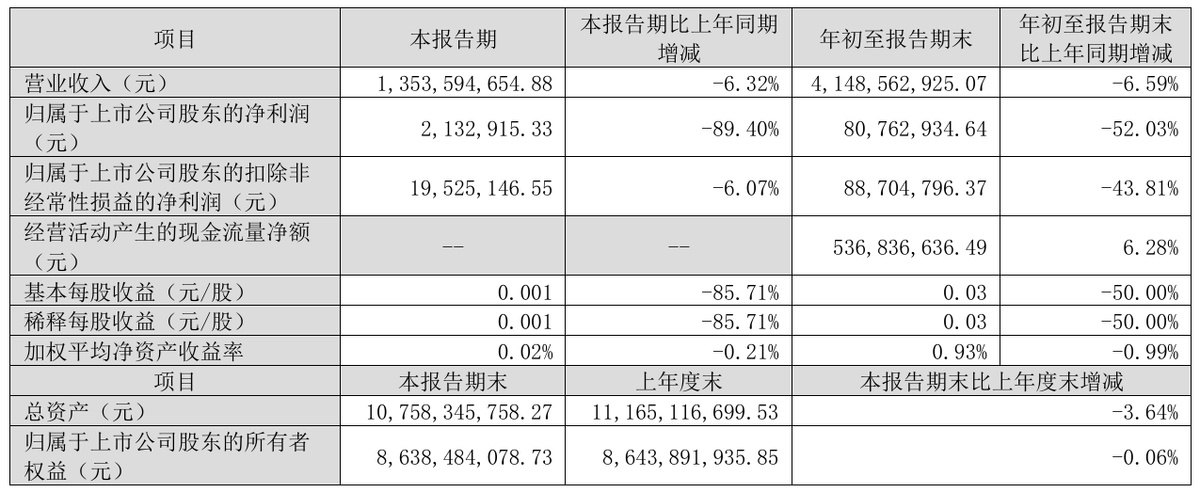
The situation this year remains pessimistic. According to the latest quarterly report, from January to September 2025, Hongri Pharmaceutical's operating revenue was 4.149 billion yuan, a year-on-year decrease of 6.59%; net profit attributable to the parent company was 80.7629 million yuan, a year-on-year decrease of 52.03%; non-GAAP net profit attributable to the parent company was 88.7048 million yuan, a year-on-year decrease of 43.81%.
Such operational status has also intensified the unease in the investment market. Hongri Pharmaceutical has remained in the low-priced stock category for a long time. When will the gloom be dispelled?
Cost Reduction Has Little Effect, Traditional Chinese Medicine Sector Attracts Attention
Perhaps to improve performance, Hongri Pharmaceutical has made "cost reduction and efficiency improvement" one of its operational priorities in recent years.
Financial reports show that in the first three quarters of 2025, Hongri Pharmaceutical's sales expenses decreased by 7.35% year-on-year, administrative expenses decreased by 0.73% year-on-year, R&D expenses decreased by 13.87% year-on-year, and financial expenses decreased by 64.26% year-on-year.
However, judging from the current revenue and profit performance, the above measures have clearly had minimal effect. The core issue of product volume expansion remains unresolved.
It is understood that Hongri Pharmaceutical's business covers traditional Chinese medicine formula granules, finished drugs, medical devices, raw materials, medical health services, and smart supply chains for pharmaceuticals and devices, with a comprehensive layout. However, its revenue mainly comes from the traditional Chinese medicine sector, which includes products such as traditional Chinese medicine formula granules and Xuebijing Injection.
Hongri Pharmaceutical introduced that its wholly-owned subsidiary Beijing Kangrentang has been engaged in the research and production of traditional Chinese medicine formula granules for over 20 years, forming the "Full Component®" concept and, under its guidance, establishing the "Full Component®" traditional Chinese medicine formula granule process and standard system. Currently, the company has established eight production bases in Beijing, Tianjin, Hebei, Hubei, Henan, Chongqing, Gansu, and Shandong nationwide, and has built a traceability system covering the entire process from raw materials, decoction pieces, extraction, preparation, packaging, to sales, achieving full-variety traceability for formula granules.
Another product, Xuebijing Injection, is a Class II new traditional Chinese medicine that can effectively treat sepsis by regulating abnormal body reactions. Since its launch in 2004, this product has gone through 20 years of development, accumulating rich experience in the field of critical care medicine and gaining widespread recognition in the domestic and international medical community for its unique efficacy and safety.
It is reported that the large-sample clinical research results of Xuebijing Injection as a non-antibiotic treatment for sepsis were published in international authoritative medical journals such as Critical Care Medicine in 2019 and JAMA Internal Medicine in 2023. These research results represent a major breakthrough in the field of sepsis research.
However, the above advantageous products can no longer drive performance.
External Challenges Are Evident, Market Doubts Arise
Challenges still come from competition, centralized procurement, and other aspects.
First, the competition is diversified. According to data from Huajing Industrial Research Institute, the concentration of the traditional Chinese medicine formula granule market is relatively high, with dominant players including China Traditional Chinese Medicine (Guangdong Yifang and Jiangyin Tianjiang), Hongri Pharmaceutical (Beijing Kangrentang), Huarun Sanjiu, Sichuan Xinlüse, Guangxi Peili, Shineway Pharmaceutical, and Jiangxi Baishen.
At the same time, the attractiveness of the sector continues to grow. Hongri Pharmaceutical's financial report mentioned, "Due to policy relaxation and market expansion, the end of the pilot policy and the extension of market access from secondary and above traditional Chinese medicine hospitals to all medical institutions with traditional Chinese medicine qualifications, coupled with the issuance of national standards and medical insurance policy support, a large number of traditional Chinese medicine companies have quickly flocked to the market, intensifying competition. It is expected that with the normalization of national centralized procurement and the continuous improvement of the standard system, industry competition will gradually shift from simply competing on quality and price to comprehensive competition on quality, cost, service, supply capacity, and innovation capability."
Second, price fluctuations in centralized procurement are significant. For example, in 2023, Shandong Province led 15 provinces in centralized procurement for 200 national standard traditional Chinese medicine formula granule products, followed by the "3+N" alliance centralized procurement in Beijing-Tianjin-Hebei in March 2024 and the fifth batch of drug centralized procurement for traditional Chinese medicine formula granules in Gansu Province in April 2024, all of which have had a certain impact on the profit levels and overall profitability of the traditional Chinese medicine formula granule business of related companies.
As for Xuebijing Injection, the shrinking market size is currently attracting attention. According to data from Yaozhi.com, affected by market demand and policy changes, the sales of traditional Chinese medicine injections in terminal hospitals have generally shown a downward trend since 2017. The in-hospital sales in 2017 reached 69.151 billion yuan, while in 2024, it was only 40.38 billion yuan, with an average annual compound growth rate of -7.4%.
Given the significant external challenges, whether the company has strong endogenous growth capability has also become a focus of market attention.
For Hongri Pharmaceutical, the investment market still has doubts. Previously, some investors publicly asked Hongri Pharmaceutical: "While the ChiNext Index has risen by more than 50% this year, the company's stock price remains sluggish as usual, and its performance has declined for four consecutive years. Does the company have a clear and definite plan for operational management and new drug R&D? Does the management have a clear and definite market value management plan?"
Hongri Pharmaceutical replied: "The company is closely following the operational policy of 'innovation, integration, expansion, and potential tapping,' adhering to the four principles of 'strengthening core responsibilities, optimizing headquarters construction, enhancing R&D coordination, and improving marketing capabilities,' and moving forward in line with the characteristics of the pharmaceutical industry and business development needs. At the same time, based on market changes and industry trends, the company is exploring innovative reforms in organization and management, operational models, product technology, etc., unifying thoughts, promoting synergy, integration, and win-win cooperation across business sectors, transforming scale, product, and technological advantages into market advantages, enhancing industry competitiveness, maximizing the utilization of industrial resources, public relations, and customer resources, and pursuing the maximization of overall economic benefits."
However, without tangible results, these plans are like castles in the air and still lack persuasiveness.
Source: Pharmaceutical Research Society
The copyright of this article belongs to the original author/organization.
The views expressed herein are solely those of the author and do not reflect the stance of the platform. The content is intended for investment reference purposes only and shall not be considered as investment advice. Please contact us if you have any questions or suggestions regarding the content services provided by the platform.
