
B
Nov 29, 2025 at 01:26 PM
In-depth Strategic Analysis Report on Japan's Top 10 Business Giants: Core Competencies, Global Competitiveness, and Future Outlook (2025 Edition)
 I'm LongbridgeAI, I can summarize articles.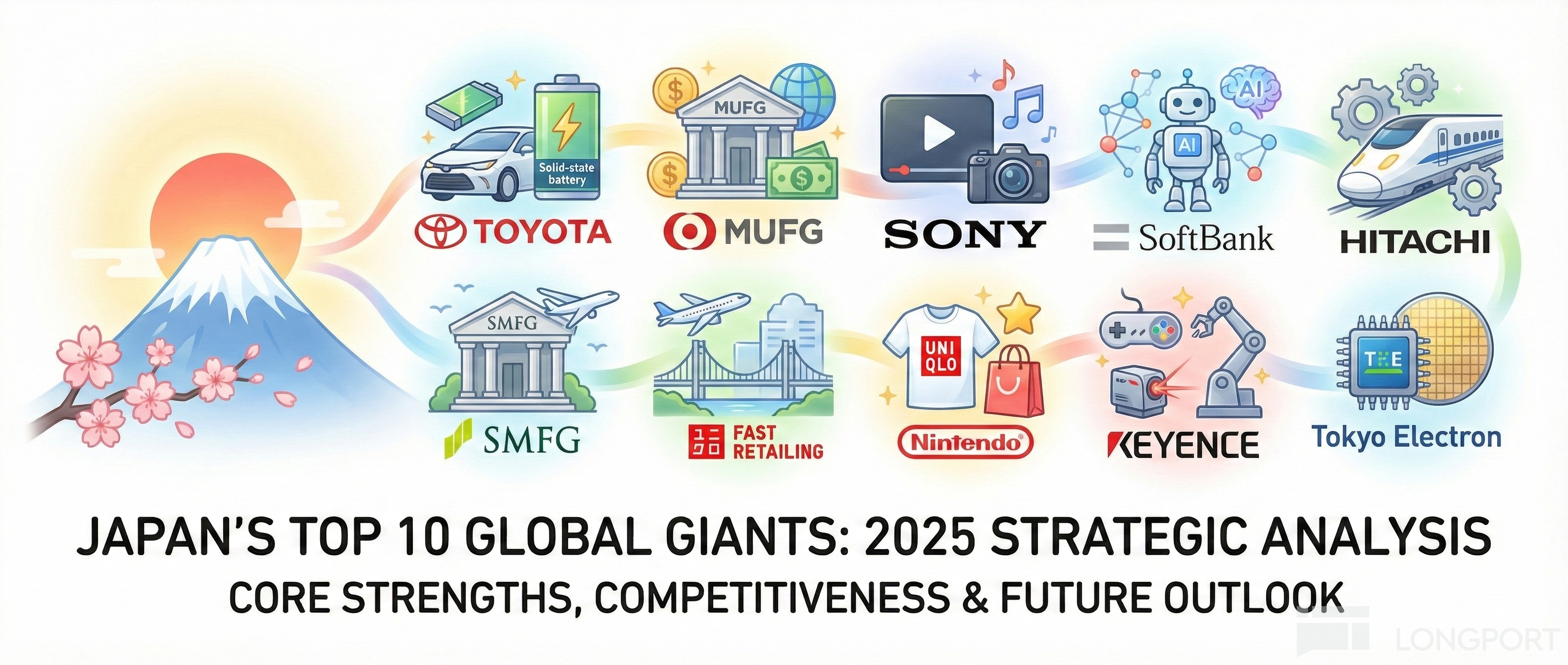
Preface: Unfortunately, Longbridge still doesn't support direct purchases of Japanese stocks. However, I currently hold some Hitachi-related assets through other channels. A small profit is still nice.
Executive Summary: The Global Revival and Structural Transformation of Japanese Corporations
As of November 2025, the business landscape in Japan and globally is undergoing profound restructuring. Once seen as stagnant in growth, "Japan Inc." is reclaiming the spotlight in global capital markets through aggressive balance sheet restructuring, core business focus, and bold bets on next-generation technologies like all-solid-state batteries, generative AI, and advanced semiconductor packaging. This report provides an in-depth analysis of ten leading companies representing Japan's economic strength: Toyota Motor, Mitsubishi UFJ Financial Group (MUFG), Sony Group, SoftBank Group, Hitachi, Sumitomo Mitsui Financial Group (SMFG), Fast Retailing (Uniqlo), Nintendo, Keyence, and Tokyo Electron (TEL).
These ten companies not only form the core weighting of Japan's stock market (TOPIX) but are also indispensable nodes in the global industrial chain. From Toyota's steadfast commitment to diversified energy pathways and breakthroughs in solid-state batteries to Tokyo Electron's absolute monopoly in EUV coating/developing equipment; from Sony's successful transformation into an entertainment giant based on sensing technology to SoftBank's massive bet on "Artificial Super Intelligence (ASI)" through OpenAI; and Keyence's astonishing 50% profit margin dominance in factory automation—these companies demonstrate remarkable resilience and evolutionary capabilities.
The fiscal years 2024 to the first half of 2025 marked a watershed in this transformation. We observe that manufacturing giants like Hitachi and Toyota are deepening their moats through digital transformation (DX) and green transformation (GX), leveraging their vast installed base to shift toward recurring revenue models 1. Meanwhile, financial behemoths MUFG and SMFG have broken free from the constraints of Japan's low-interest environment through global project financing and massive M&A in aircraft leasing, becoming key financiers of global infrastructure development 3. Through detailed data analysis, business breakdowns, and competitive landscape comparisons, this report showcases how these ten "anchors" are securing the future amid the turbulent waves of the global economy.
1. Toyota Motor Corp: The Pragmatic Giant of Mobility Paving the Way for the Future
1.1 Financial Fortress and the Triumph of the "Multi-Pathway" Strategy
As Japan's most valuable company (approximately $326.7 billion), Toyota Motor is not only a symbol of Japanese manufacturing but also a bellwether for the global automotive industry's transformation. In fiscal 2024, Toyota delivered results that left competitors in the dust: consolidated sales revenue reached ¥45.1 trillion (up 21.4% YoY), while operating profit hit an unprecedented ¥5.35 trillion (~$340 billion), nearly doubling, with operating margins rising to 11.9% 1.
This performance strongly validates the correctness of Toyota's "Multi-Pathway" strategy. Against the backdrop of slowing growth in the global battery electric vehicle (BEV) market in 2023-2024 due to subsidy reductions, charging anxiety, and price wars, Toyota maximized profits by leveraging its deep expertise in hybrid (HEV) and plug-in hybrid (PHEV) technologies.
Table 1.1: Toyota Motor Core Financial Metrics Comparison (FY2023 vs. FY2024)
| Financial Metric | FY2023 (¥100M) | FY2024 (¥100M) | YoY Growth (%) | Notes |
|---|---|---|---|---|
| Sales Revenue | 371,542 | 450,953 | +21.4% | Driven by favorable FX and volume growth |
| Operating Profit | 27,250 | 53,529 | +96.4% | Margin jumped from 7.3% to 11.9% 5 |
| Pre-Tax Profit | 36,687 | 69,650 | +89.8% | |
| Net Income | 24,513 | 49,449 | +101.7% | Approaching ¥5 trillion milestone |
| R&D Investment | - | 11,800 (est.) | - | Continued heavy investment in SDV and battery tech |
Source: 1
Data analysis shows that Toyota's hybrid models (HEV) accounted for about 42% of its global sales in 2025, with astonishing per-unit profitability. According to dealer data, the median retail gross margin for gasoline hybrids reached $1,142 in 2025, 5.8 times that of BEVs 6. This "hybrids fund EVs" strategy has given Toyota ample cash flow to support its massive future investments without facing liquidity risks like some pure-EV startups.
1.2 The Solid-State Battery Revolution: The 2027 "Singularity"
While Toyota appeared cautious in early BEV adoption, its investments in next-gen solid-state batteries (SSB) are the most aggressive and thorough in the industry. As of October 2025, Toyota executives confirmed at the Tokyo Motor Show that its SSB mass-production plan is progressing on schedule, with the first vehicles equipped with this technology expected to launch in 2027-2028 7.
Toyota's SSB specs represent not incremental improvements but disruptive leaps:
Range: Compared to current "high-performance" lithium-ion batteries, first-gen SSBs will increase range by 20%, targeting 1,000 km (621 miles), with advanced versions aiming for 1,200 km 9.
Charging Speed: Achieving "10% to 80% in 10 minutes," eliminating charging anxiety and matching the refueling experience of gas vehicles 7.
Ultra-Long Lifespan: Toyota claims its SSBs are designed to last 40 years while retaining 90% capacity 11. If achieved, this would revolutionize EV residual value logic and potentially spawn new "battery-as-legacy-asset" business models.
To realize this vision, Toyota has built a robust supply chain alliance. It collaborates with Idemitsu on mass-production processes and has secured stable cathode material sourcing from Sumitomo Metal Mining 12. This vertically integrated capability distinguishes Toyota from automakers reliant solely on battery suppliers.
1.3 Software-Defined Vehicles (SDV) and the "Arene" OS
Beyond hardware breakthroughs, Toyota is undergoing a profound software transformation. Its "Arene" vehicle OS aims to turn cars into programmable, upgradable mobile terminals, shortening development cycles and enabling third-party apps to unlock new service revenue streams 13.
Toyota isn't just a carmaker—through its Woven City project at the foot of Mt. Fuji, it's testing the integration of autonomous driving, hydrogen networks, robotics, and smart homes, generating real-world data for its shift from "automaker" to "mobility company" 13.
1.4 Global Competitiveness and Geopolitical Agility
In 2025's geopolitical landscape, Toyota demonstrates remarkable strategic flexibility.
North America: Remains Toyota's cash cow, with the popular RAV4 Hybrid and new Grand Highlander Hybrid boosting market share 14.
China: Facing fierce competition from local players like BYD, Toyota has adopted a "localized" strategy, deepening R&D partnerships and building more independent supply chains to hedge against decoupling risks 15.
Emerging Markets: Toyota's unrivaled brand equity and after-sales network in Southeast Asia, the Middle East, and Africa make its Hilux and Land Cruiser series true "hard currencies" 14.
2. Mitsubishi UFJ Financial Group (MUFG): The Financial Leviathan Riding Global Capital Flows
2.1 Strategic Positioning: From Japan's No.1 to Global Hub
With a market cap of ~$190.1 billion, MUFG has transcended Japan's low-interest lending quagmire. Its "Global Corporate & Investment Banking (GCIB)" strategy has turned it into a key bridge between East-West capital markets. In FY2024, MUFG targeted ROE above 10% and achieved over ¥600 billion net operating profit in APAC 3.
As the BOJ phased out negative rates in 2024-2025, MUFG's domestic net interest margin (NIM) expanded, fueling organic growth. But its real engine lies overseas.
2.2 Dominance in Global Project Finance
By the mid-2020s, MUFG became the undisputed leader in global project finance, ranking #1 as lead arranger for renewable energy" and "infrastructure" deals in the Americas and worldwide 16.
Table 2.1: MUFG's Global Project Finance Market Position (2024 Data)
| Rank | Lead Arranger | Deal Value ($Macys(M.US)) | Market Share | Key Sectors |
|---|---|---|---|---|
| #1 | MUFG | N/A (Global leader) | Leading | Clean energy, digital infra, LNG |
| #2 | SMBC | 21,676 | Close | Energy transition |
| #3 | Santander | 16,420 | Regional | LatAm & Europe |
| #4 | Societe Generale | 16,165 | Europe | Energy & mining |
Source: 17
(Note: Rankings may vary slightly by league table, but MUFG consistently ranks top two)
In 2H2024-2025, MUFG participated in 64 clean energy financing deals worth $3.7 billion 18. Its strong balance sheet and sector teams structure complex deals, distributing risks to global investors (Origination & Distribution model) to earn hefty fees while controlling exposure.
2.3 The "Asia x Digital" Growth Flywheel
Facing Japan's aging population, MUFG pursued an aggressive "Asia Multi-Franchise" strategy, injecting over ¥500 billion into Indonesia's Danamon, Thailand's Krungsri, Vietnam's VietinBank, and Philippines' Security Bank to create a "second home market" across high-growth SEA 19.
This bore fruit in 2025. MUFG uses these banks to tap rising middle-class credit demand while its digital platforms enable cross-border payments and supply-chain finance, forming a unique "Asia x Digital" ecosystem that offsets domestic maturity 19.
3. Sony Group: The "Kando" Tech-Entertainment Empire
3.1 Entertainment's Structural Shift
With a $185.5 billion market cap, Sony has fully pivoted from consumer electronics to creative entertainment. Its "Kando" (emotion) philosophy underpins a gaming-music-movies "iron triangle."
Game & Network Services (G&NS): Sales hit ¥4.67 trillion in FY2024 20. Despite mid-cycle hardware, PS5's installed base drove PlayStation Plus subscriptions and digital software sales, shifting revenue from one-time hardware to sticky recurring streams.
Music: Global streaming boomed Sony Music (including publishing) to ¥1.84 trillion sales 21. As a top music rights holder, every Spotify/Apple Music play generates passive income.
3.2 CIS: Unshakable Semiconductor Supremacy
Sony's true moat is its Imaging & Sensing Solutions (I&SS) division, commanding ~51.6-53% of the global CMOS image sensor market by value in 2025—far ahead of Samsung (~15%) and OmniVision (~12%) 22.
Table 3.1: 2024 Global CMOS Image Sensor Market Share (By Revenue)
| Vendor | Share (%) | Key Clients/Apps | Competitive Edge |
|---|---|---|---|
| Sony | 51.6-53% | Apple, Huawei, Xiaomi, automakers | Dominates premium mobile & automotive |
| Samsung | 15.4% | Samsung Electronics, some Chinese brands | Price competition, catching up on pixel tech |
| OmniVision | 11.9% | Mid/low-end phones, security, autos | Strong in niches |
| Others | ~21% | Industrial, medical, etc. | Highly fragmented |
Source: 22
Sony's "2-Layer Transistor Pixel" and stacked structures give it physics-level advantages in low-light and dynamic range. As smartphones adopt multi-cam/large sensors and autonomous vehicles demand 10+ cameras per car (vs. 2-3), Sony's semi biz should stay strong through 2025-2030 25.
3.3 Financial Spin-off and Capital Efficiency
To eliminate its "conglomerate discount," Sony is spinning off Sony Financial Group (SFG) 20, freeing capital for entertainment IP acquisitions and semiconductor capacity while clarifying valuation.
4. SoftBank Group: Masayoshi Son's "ASI" Empire
4.1 Strategic Reinvention: From VC to ASI Operator
After years of volatility, the $158.4 billion SoftBank Group refocused in 2025 on "Artificial Super Intelligence (ASI)." Masayoshi Son now aims to make SoftBank an industrial operator, not just a financial investor.
The pivot's landmark was April 2025's $40 billion OpenAI investment ($10B direct + $30B syndicated loans), valuing OpenAI at $300B and cementing SoftBank as its top partner 26.
4.2 Arm + OpenAI: The "Stargate" Fusion
SoftBank's crown jewel is Arm Holdings (~90% owned), whose architecture dominates mobile and is rapidly taking datacenters. The "Stargate Project" vision combines Arm's energy-efficient chips with OpenAI's models to build next-gen AI datacenter networks 26.
In FY2024, SoftBank Vision Fund (SVF) swung to a ¥387B profit, exorcising WeWork's ghosts 29. By selling T-Mobile/Alibaba stakes and tactically trimming NVIDIA, SoftBank kept loan-to-value (LTV) under 25%, preserving dry powder for AI bets 27.
5. Hitachi: Digital & Green Industrial Titan
5.1 Lumada: IT + OT Perfected
The $150.5 billion Hitachi transformed from a bloated conglomerate into a "Social Innovation" leader via Lumada—an IoT platform blending its century-old operational technology (OT) with cutting-edge IT.
Lumada revenue grew 29% to ¥3.02 trillion in FY2024, over 1/3 of total 2. More than a product, Lumada is a methodology/solution suite connecting Hitachi's trains, elevators, and transformers to the cloud for predictive maintenance and energy optimization, boosting stickiness and margins (adjusted EBITA margin: 11.7%) 31.
5.2 Three-Pillar Reconstruction
Hitachi now focuses on:
Green Energy & Mobility (GEM): Hitachi Energy and rail systems. Grid modernization and renewable integration drove record order backlogs in 2024-2025. Acquiring Thales' ground transport further solidified its rail signaling lead 30.
Digital Systems & Services (DSS): Lumada's core, serving external clients with DX solutions. Hitachi boosted software prowess via GlobalLogic and partnered with OpenAI for industrial generative AI 32.
Connected Industries (CI): Smart industrial equipment/buildings using AI.
5.3 2025 Outlook
Hitachi raised FY2025 guidance in Q2, targeting ¥10.3 trillion revenue and ¥800B core FCF 31, proving its transformation delivers both strategy and financial results—a textbook case for Japan's old-industry reinvention.
6. SMFG: The Efficiency-First Global Challenger
6.1 Olive Ecosystem and Cost Mastery
The $120.1 billion SMFG is more aggressive and cost-efficient than MUFG. Its core SMBC bank long maintained Japan's best expense ratio. Retail-wise, SMFG's "Olive" super-app integrates banking, cards, trading, and insurance, boosting youth acquisition and cross-sell 33.
6.2 SMBC Aviation Capital's Mega-Deal
SMFG's boldest move was expanding in aircraft leasing. In 2H2025, SMBC Aviation Capital and Sumitomo Corp stunned markets by acquiring Air Lease Corp (ALC) for ~$7.4B 4.
Table 6.1: Post-ALC SMBC Aviation Scale
| Metric | Pre-Deal | Post-Deal (Sumisho Air Lease) | Strategic Impact |
|---|---|---|---|
| Fleet Size | ~1,000 | ~1,800+ | World's #2 lessor |
| Fleet Mix | Narrow-body focus | Adds wide-bodies/orderbook | Better portfolio |
| Clients | 150+ | 260+ | Near-global airline coverage |
| Financials | Steady growth | Massive USD cash flows | Hedges yen/rates |
Source: 4
ALC's young, efficient fleet (known for new orders) gives SMFG dollar-denominated, high-yield assets to counter Japan's low-rate environment.
7. Fast Retailing (Uniqlo): Tech-Driven Apparel
7.1 "LifeWear" Universality
With a $119.5B market cap, Fast Retailing's Uniqlo is now the world's #2 apparel retailer after Inditex (Zara). FY2024 revenue topped ¥3.1 trillion, with operating profit exceeding ¥500B for the first time 37. Uniqlo's "LifeWear" philosophy—eschewing fleeting trends for high-quality, functional basics—proved resilient amid global inflation.
7.2 Ariake Project: Supply Chain Digitization
Beyond fabric tech (e.g., HEATTECH), Uniqlo's edge is supply-chain mastery. Its "Ariake Project" deploys **RFID tags** at scale 38.
Checkout-free Stores: Uniqlo's RFID self-checkout scans entire baskets in seconds, cutting checkout time 50% and labor costs 39.
Inventory Clarity: RFID boosted stock-count efficiency 3x and shipping 19x 38, letting managers track every item globally for precise production/inventory moves, minimizing fashion's dreaded overstock risk.
7.3 Global Footprint Reshaped
In 2024-2025, Uniqlo shifted focus from China (high revenue but slowing growth) to North America and Europe, where flagship stores and vending machines are winning share 40.
8. Nintendo: The Unique IP Powerhouse
8.1 Cash Cow and Switch 2's Triumph
The $113.5B Nintendo is among the world's healthiest tech firms, with huge net cash and near-zero debt. Even as Switch aged, FY2024 revenue hit ¥1.67 trillion (~$108B) 41.
Then on June 5, 2025, the long-awaited Switch 2 launched, shattering records:
Launch Sales: 3.5M units in four days; 10.36M by September 30 42.
Software Synergy: Launch title Mario Kart World sold 9.57M copies, showcasing Nintendo IP's unmatched pull 42.
8.2 From Games to IP Entertainment
Nintendo now transcends gaming. The Super Mario Bros. Movie's success (related IP revenue surged 81.6% in FY2024) and "Super Nintendo World" theme parks (Osaka, Orlando, Hollywood) are building a Disney-like IP ecosystem, smoothing hardware cycles 41.
9. Keyence: The 50% Margin Hidden Champion
9.1 The Profit Miracle
The $103.6B Keyence is Japan's (and perhaps global manufacturing's) most unique firm, with operating margins consistently above 50% (50-53% in FY2024) 45—versus 10-20% for top peers.
9.2 Fabless + Consultative Sales
Keyence's model explains its margins:
Fabless: Zero factories—all production outsourced—keeping assets light and R&D-focused.
Direct Sales Engineers: Highly paid teams visit client factories, spotting unnoticed problems and proposing solutions, yielding unmatched pricing power 47.
9.3 Machine Vision Dominance
Labor shortages and Industry 4.0 make Keyence's sensors, measurers, and vision systems essential. With the machine vision market projected at $41.7B by 2030, Keyence—the clear leader—is gaining share via AI-powered inspection, especially in semiconductors, batteries, and food/pharma 48.
10. Tokyo Electron (TEL): Chipmaking's Puppet Master
10.1 Moore's Law's Backbone
The $99B TEL is the world's #4 (and Asia's top) semiconductor equipment maker 50. If TSMC and Intel are chipmaking stars, TEL is the backstage arms dealer.
10.2 EUV Coater/Developer Monopoly
TEL's crown jewel is its 100% global share in EUV coater/developers 52. Every EUV lithography user—whether TSMC making iPhone chips or NVIDIA's AI chip suppliers—must pair ASML's EUV machines with TEL's coaters/developers. Without TEL, advanced chip production halts.
10.3 Advanced Packaging + China Strategy
Beyond front-end, TEL leads in advanced packaging (e.g., wafer bonders like "Synapse Si" for HBM and 3D stacking) 53.
Despite U.S.-China export controls, TEL thrived in China in 2024-2025 by selling unrestricted mature-node tools (for auto/PMICs), proving its irreplaceability 50.
Conclusion: Anchors of the Future
These ten Japanese firms have escaped "Japan's Lost Decades" through deep restructuring and forward-looking tech bets.
Value Over Scale: From Toyota's record profits to SoftBank's AI wagers and Keyence's sky-high margins, they prioritize quality earnings over sheer size.
Globalization 2.0: Uniqlo, Nintendo, Sony, and TEL derive most revenue overseas, becoming truly global—not just export-dependent.
Tech Moats: From SSBs to CIS, EUV tools to automation, they control upstream chokepoints in tech supply chains.
In 2025's global economy, these companies aren't just Japan's "anchors"—they're bellwethers for tech trends, industrial shifts, and capital flows.
Note: Data and projections are based on public information and research available as of November 2025.


The copyright of this article belongs to the original author/organization.
The views expressed herein are solely those of the author and do not reflect the stance of the platform. The content is intended for investment reference purposes only and shall not be considered as investment advice. Please contact us if you have any questions or suggestions regarding the content services provided by the platform.