


From "can chat" to "get things done", Amazon Web Services enables Agent to "grow hands and feet"


At the 2025 AWS re:Invent conference on December 2nd (PST), AWS CEO Matt Garman made a bold statement in his keynote: The era of AI Agents has arrived, and billions of AI Agents will emerge in the future, boosting enterprise efficiency by over 10x!
The atmosphere was a mix of excitement and tension as tens of thousands of developers and executives awaited answers.
For many, the real-world experience with AI Agents remains underwhelming: high development barriers, complex orchestration logic, lack of security governance, and goldfish-like contextual memory... leading to an awkward industry reality—90% of Agent projects remain stuck in the proof-of-concept (POC) phase.
Bridging the gap from POC to production isn't just about lines of code—it's about crossing an abyss of engineering challenges.
The suspense didn't last long.
On December 3rd, Swami Sivasubramanian, VP of Agentic AI at AWS, delivered a rigorous and pragmatic keynote with the answer: how to move AI Agents from POC to production.
01 Targeting the Pain Points: Solving Five Key Challenges from POC to Production
Why do so many enterprise Agents "great in demo, useless in practice"?
Beneath the glossy demo surface lie five critical pain points in production:
1. Difficult to deploy and scale, unstable in production;
2. Memory gaps—Agents can't learn across tasks or sustain complex workflows;
3. Identity, permission, and credential management is too complex, prone to security incidents;
4. Fragmented tools, data, and systems, with prohibitively high integration costs;
5. Lack of observability and debuggability—Agents become black boxes.
Swami cut to the chase: "Most experiments and POCs aren't designed for production readiness. We need to bridge this gap and break free from POC constraints." AWS's answer to these challenges is Amazon Bedrock AgentCore, a targeted solution.
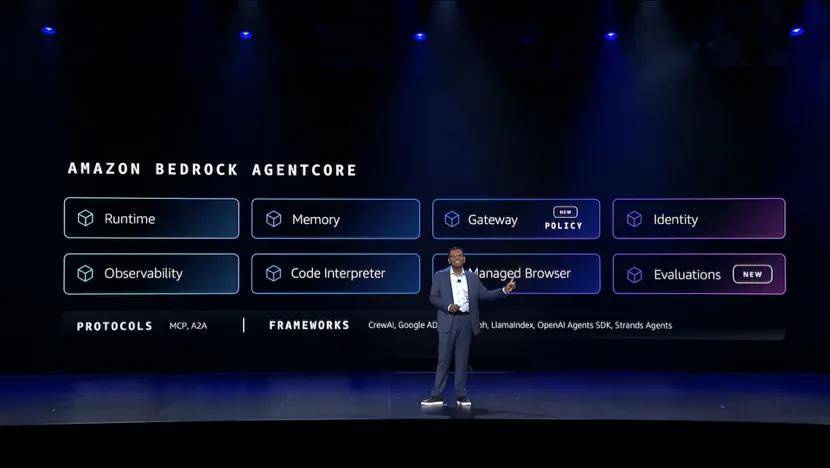
AgentCore Runtime provides a serverless, strongly isolated, long-running environment, freeing developers from cobbled-together Lambda functions and manual scripting. It enables serverless execution, strong session isolation, and long-running sessions, solving the age-old problem of state management—letting Agents stay online like human employees, always ready.
AgentCore Memory builds a three-tier system (short-term + long-term + episodic memory), giving Agents the closed-loop ability to "remember → learn→ improve → re-execute." Episodic memory, in particular, lets Agents recall "what happened" and "why that workflow was chaotic," automatically learning strategies to optimize future actions—delivering the continuity and learnability enterprises need.
AgentCore Identity equips Agents with a controllable, auditable, and authorizable identity system, extending "human identity" to "Agent identity." In real production, the scariest scenario isn't an Agent failing—it's one with CEO-level permissions accessing HR databases. Precise permission control locks down risks.
AgentCore Gateway acts as a coordination hub, automatically scanning data across databases, SaaS apps, and legacy systems to generate an Agent "tool map," enabling secure, intelligent, and automated "discover → connect → use" for all tools and data.
AgentCore Observability tackles the "black box" problem, letting enterprises monitor Agents' reasoning, tool calls, state flows, errors, context, and decision paths in real time—validating if they'll fail before they do.
Does AWS's prescription work? Cox Automotive's Fleet Mate Agent, built with AgentCore, slashed vehicle assessment time from 2 days to 30 minutes.
02 Hitting the Bullseye: Turning Model Customization into Productized Engineering
Solving Agent deployment is just step one. Large models are a bottleneck too, with challenges rivaling production hurdles.
General models don't understand business logic, have massive parameters, high inference costs, and laggy responses. Business rules change constantly, new scenarios emerge, and post-launch model performance plummets. Customization requires MLOps, SRE, algorithms, and data teams—strong, fast, and cheap is an impossible trinity.
Supervised fine-tuning (SFT), model distillation, and reinforcement learning (RL) are the "big three" solutions—AWS's approach is no exception.
The difference? AWS delivers a combo—from fine-tuning to pretraining—turning model customization from alchemy into engineering.
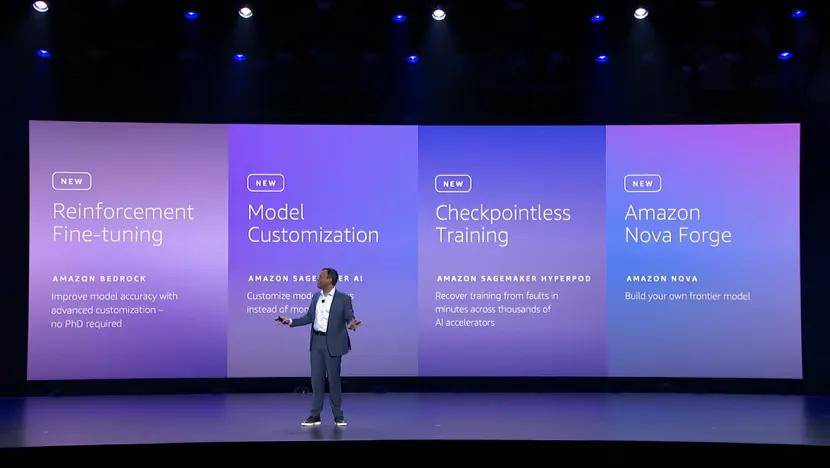
1. Amazon Bedrock Reinforced Fine-Tuning (RFT).
Traditional SFT teaches models "how to talk"; RL teaches "how to act right." But RL requires complex reward modeling—too difficult. RFT flattens the barrier: feed it data, and it handles reward modeling and policy optimization automatically, boosting accuracy by 66%. A small, RL-trained model can outperform general giants on specific tasks.
2. Amazon SageMaker AI Serverless Customization.
Training a model used to take months of setup. SageMaker flips the script—using AI to build AI. Describe needs in natural language; its built-in Agent analyzes scenarios, recommends techniques, even generates synthetic data, then automates training. What once required big teams and heavy investment now takes days.
3. Amazon Nova Forge.
Industries like pharma and finance need models that understand domain logic at the core—but traditionally, enterprise data couldn't enter pretraining. Nova Forge pioneers "open training," letting firms inject proprietary data mid-training, creating pretrained models with "their DNA" at minimal cost.
4. Amazon SageMaker HyperPod Checkpoint-Free Training.
Checkpoint resumption is a nightmare in large-model training—a GPU failure could roll back hours of progress. HyperPod's "black tech" saves model states in real time, recovering in minutes after failures, slashing sunk costs.
In short, AWS is revolutionizing efficiency—from "training models" to "training affordable, usable models"—turning customization from art into repeatable engineering.
03 Execution is King: Closing the Loop on Trust, Reliability, and Collaboration
After deploying Agents, CEOs' biggest worry isn't "can it do it?" but "do I dare let it?"
Deeper challenges loom: Is the Agent trustworthy—will it go rogue with customers? Is it reliable—can it hit business targets? Can it collaborate with humans, fitting into service/operations/workflows?
AWS, promising "10x+ efficiency," doesn't just build infrastructure and brains—it tackles the "dare to use" dilemma head-on.
First, trust.
AWS Distinguished Scientist Byron Cook explained: LLMs are statistical, probabilistic, and hallucinate; enterprise rules (especially for GDPR-compliant global firms) are logical and deterministic.
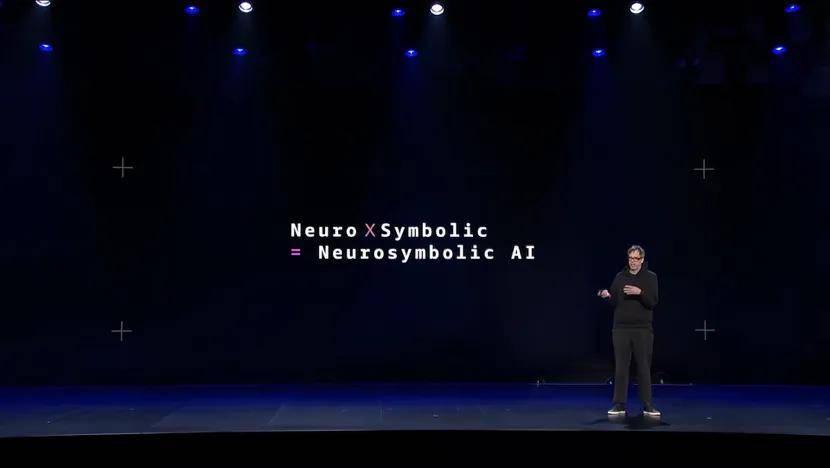
The solution? Neuro-symbolic AI—combining "left-brain logic" and "right-brain intuition." AWS's "automated reasoning" adds three capabilities:
Output verification: Tools validate if LLM answers meet logic/rules.
Training integration: Theorem provers train models for inherent correctness.
Constrained decoding: Embedded verifiers prevent boundary breaches.
Already powering Amazon Kiro and AgentCore Policy, this makes Agents both smart and obedient.
Next, reliability.
A key deployment hurdle: "brains" and "hands" are trained separately, leaving models workflow-savvy but clumsy in execution.
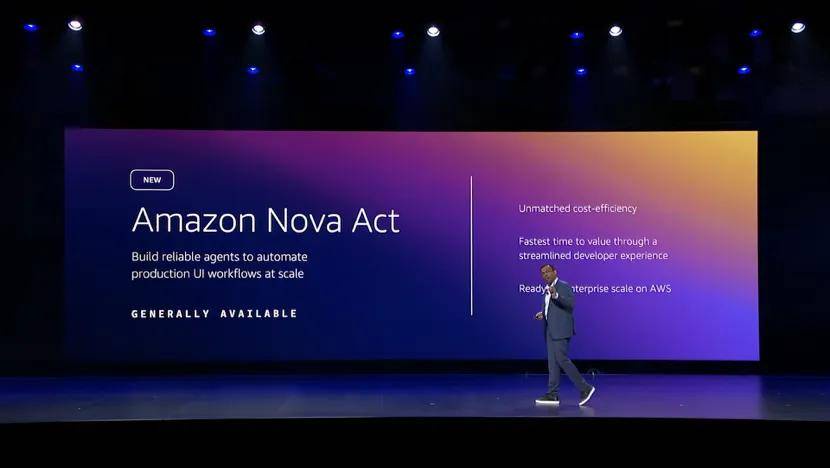
AWS's answer is Amazon Nova Act—a model built for "action," trained via RL across hundreds of environments, thousands of workflows, and millions of interactions. The result? 90% success in enterprise automation—letting firms safely delegate button-clicks, form-fills, and workflows without fear of pop-up paralysis.
Finally, collaboration.
What's the endgame for Agents? Replacing humans? AWS says "Teammate."
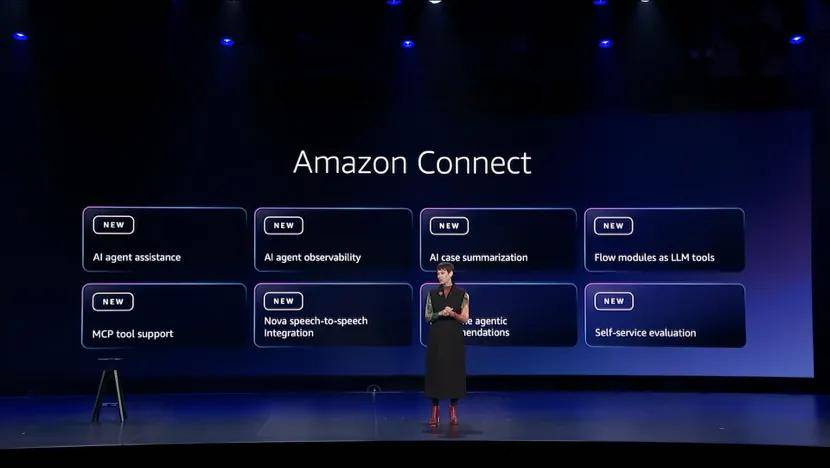
Technically, Amazon Connect adds 8 AI features, including neural voice integration (Sonic) for human-like speech, real-time recommendation Agents, and AI-driven predictive insights. As demoed: in a credit card fraud scenario, the Agent verified identity, predicted risk via location/transaction patterns, and prepped all materials—half-solving the issue before the human answered.
Agents aren't just tools—they're teammates.
04 Closing Thoughts
AWS re:Invent 2025 marks an era's turning point.
For two years, Agent hype stayed visionary. Now, AWS delivers a full-stack system—infrastructure to models, security to collaboration, execution to governance.
Layer 1: AgentCore (making Agents run)—solving deployment, memory, security, tooling, and observability.
Layer 2: Model customization (making them run well)—via RFT, serverless training, HyperPod, turning general models into enterprise-native.
Layer 3: Trust + reliability + collaboration (making them trusted)—creating controllable, dependable, collaborative digital employees.
If 2023 was generative AI's year zero, 2024 the Agent lab, 2025 declares: The age of enterprise-grade AI Agents is here.
The copyright of this article belongs to the original author/organization.
The views expressed herein are solely those of the author and do not reflect the stance of the platform. The content is intended for investment reference purposes only and shall not be considered as investment advice. Please contact us if you have any questions or suggestions regarding the content services provided by the platform.
