

Consultation volume crashes as soon as it picks up? Tianrun Cloud (02167.HK) uses AI to break through the 'front-end growth bottleneck' in the franchise industry

$TI CLOUD(02167.HK)
In an era where AI is reshaping industries, the front-end consultation model of the franchise industry has barely changed—it primarily relies on human customer service for reception, Q&A, and information confirmation. For managers, this represents an extremely dangerous situation: the growth logic of the industry has changed, but the operational methods of businesses remain the same.
The cost of franchise industry advertising is rising, lead acquisition is becoming more expensive, and consultation entry points are still handled by humans—limited scalability, rigid cost structures, and diminishing room for efficiency improvements. As more brands begin to explore how AI can reshape sales and customer service, if front-end consultations remain stuck in manual mode, it equates to losing competitiveness at the very first step of the business growth chain.
Management must face a reality: future competition will no longer be about who invests more manpower, but who possesses smarter, more scalable front-end capabilities.
ZENAVA is built on this trend—helping businesses transition from human-driven to AI-driven operations, ensuring the first step of franchise consultations comes with efficiency and cost advantages.
1. Superficially Reception, Essentially a Growth Bottleneck
In most chain brands, the first point of contact for franchise consultations is still handled by human customer service. On the surface, this job doesn’t seem complex, but in today’s multi-channel, high-frequency consultation environment, it has actually become a high-pressure, highly complex role.
First, consultation volume has surged. With the internet’s ubiquity, customers no longer just inquire via 400 hotlines or official website forms—they also flood in from public accounts, mini-programs, Douyin/Kuaishan ads, Xiaohongshu, third-party franchise platforms, and more. The more channels there are, the more dispersed consultations become, making it harder to control the workload of customer service.
Second, customer service responsibilities go far beyond “reception.” They need to answer a wide range of questions from potential franchisees: franchise fees, payback periods, support policies, store-opening processes, etc. While these high-frequency questions are repetitive, they must be answered professionally, accurately, and consistently.

At the same time, customer service must also complete information collection and profile building. Store location, budget, experience, opening timeline, whether the inquiry is personal, competitor comparisons… This information is just as critical to backend business development as the consultation itself, but manual collection often results in incomplete records, missing fields, or misunderstandings.
Third, customer service also handles the first round of “pre-screening.” They must judge whether the inquirer meets brand requirements during interactions: whether the budget is sufficient, whether the city is open, whether the intent is genuine, whether conditions are met, etc. This judgment heavily relies on personal experience, making it difficult to maintain uniform standards.
Under this model, the work of human customer service presents a clear contradiction: superficially repetitive labor, but behind it lies high-risk cognitive judgment; superficially simple processes, but in reality, they determine the efficiency and cost of the business development chain.
Ultimately, franchise consultations—originally meant to drive business growth—have instead become a structural bottleneck limiting brand expansion speed.
2. ZENAVA: Shifting Front-End Consultations from Human to AI Mode
Against this backdrop, ZENAVA’s value is truly activated.
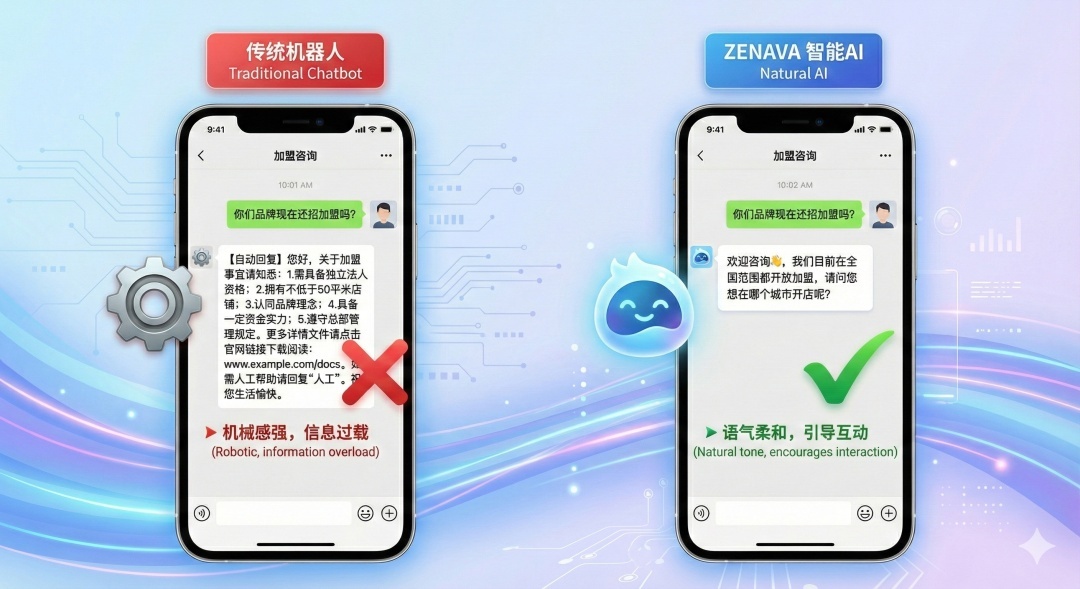
First, when interacting with inquirers, ZENAVA can engage in natural conversations like a real person.
For example, when a user sends a message in a public account asking, “Is your brand still recruiting franchisees?” it won’t respond with a canned official text like traditional bots. Instead, it replies in a natural tone: “Welcome! We’re currently open for franchising nationwide. Which city are you looking to open a store in?”—soft tone, smooth logic, making users willing to continue the conversation rather than exiting due to “feeling too robotic.”
Second, leveraging the corporate knowledge base, ZENAVA can accurately answer all kinds of franchise policy questions.
For instance, when a client asks in succession, “What’s the franchise fee?” “What services are included?” “How long is the payback period?” ZENAVA provides structured, reviewed, and externally consistent professional answers. There’s no risk of human agents “not explaining clearly,” “forgetting,” or “giving inconsistent explanations.” The more complex the policies and details, the more obvious AI’s advantages become.
Third, during actual conversations, ZENAVA automatically captures key client information in real time to build profiles.
For example, when a client says, “I’m planning to open a store in Chengdu’s Shuangliu with a budget under 300K,” “I’ve worked in food service before,” ZENAVA automatically extracts:
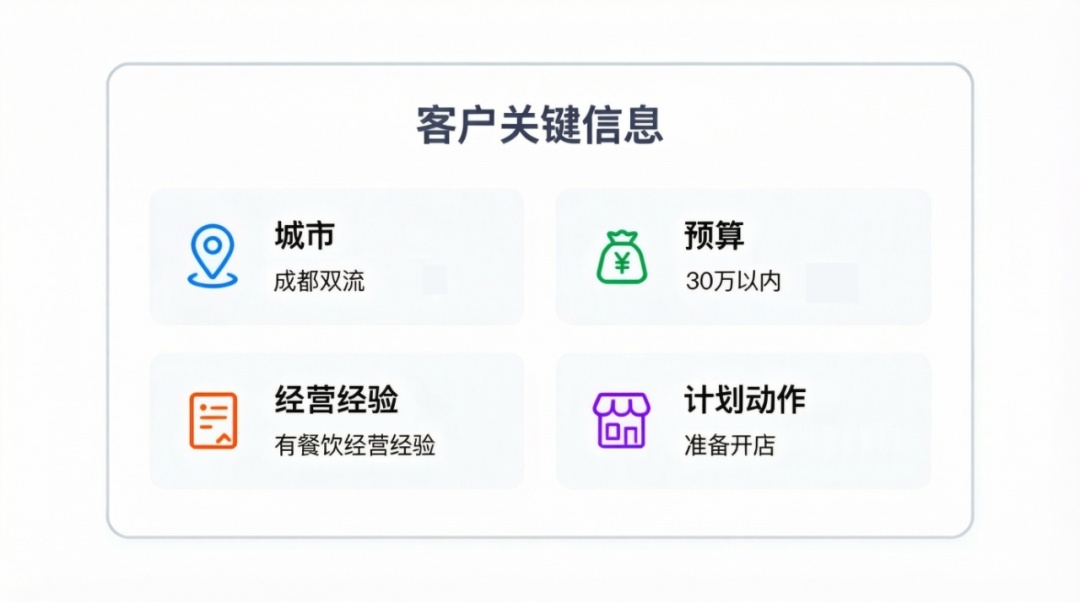
This process doesn’t require human agents to juggle chatting and note-taking, nor does it lead to omissions or errors.
Based on this structured information, ZENAVA can also automatically perform lead screening.
For example, if the system identifies “budget insufficient to meet the minimum investment threshold” or “city quota full,” it automatically marks the lead as low-priority. Conversely, if it detects signals like “planning to open within 3 months,” “sufficient budget,” or “inquirer is the decision-maker,” it labels the lead as Class A, generates a work order, and sends it to the relevant regional business development manager—all without human intervention.
Most critically, ZENAVA isn’t affected by fluctuations in consultation volume.
Within an hour of an ad campaign, 300 inquiries might flood in suddenly. Traditional customer service often can’t keep up, but ZENAVA handles concurrent processing with second-level responses. Whether during campaigns, peak hours, or multi-channel interactions, it operates steadily, enabling front-end reception capacity to truly scale infinitely with business needs.
3. From Human-Driven to AI-Driven: The Growth Divide Has Emerged
In the past, franchise consultations relied on “throwing more people at it”—hiring more agents, taking more calls, more rounds of communication. But now, with higher expenses, costlier leads, and more channels, if the entry point still depends on human labor, efficiency stagnates and competitiveness declines.
ZENAVA is rewriting the growth logic: It’s not about having more people but about who can make the front end smarter and more automated. ZENAVA helps businesses transition from human-driven to AI-driven operations, ensuring every consultation is efficient, standardized, and scalable—essentially locking in future growth curves in advance.
Now, we also welcome more businesses to join us in building a small POC, letting ZENAVA run and test in real-world scenarios. We believe you’ll see firsthand the value and potential of an AI-driven service system.
$TI CLOUD(02167.HK)
The copyright of this article belongs to the original author/organization.
The views expressed herein are solely those of the author and do not reflect the stance of the platform. The content is intended for investment reference purposes only and shall not be considered as investment advice. Please contact us if you have any questions or suggestions regarding the content services provided by the platform.
