


Snow mountain opening season, China's outdoor "Chengdu moment": How does Decathlon capture the new trend of urban outdoor activities?

Chengdu, December 11, 2025 /PRNewswire/ -- As winter sets in Chengdu, the city's life trajectories are visibly converging toward outdoor activities.
With ski resorts like Xiling Snow Mountain and Taizi Ridge opening one after another, Chengdu has ignited an outdoor craze: bustling ski slopes, booming climbing gyms, and popular mountain trails around the city are once again bustling with peak-season crowds—Mount Siguniang has welcomed over 2 million visitors for three consecutive years, while Xiling Snow Mountain alone can attract over 10,000 visitors in a single day, with mountain resort hotels fully booked. The participant base is also expanding: local enthusiasts, "weekend outdoor adventurers" from neighboring cities, and families using Chengdu as their winter vacation starting point collectively form a larger winter outdoor community.
Amid this growing enthusiasm, a new store has caught the attention of Chengdu's outdoor scene: the meeting point for ski carpooling, trail running groups, and outdoor content creators' shooting routes all lead to the same destination—Decathlon's first outdoor concept store in Asia, located in Chengdu's Raffles City. Just three days after opening, it has already attracted over 20,000 visitors, quickly becoming the "default starting point" for urban outdoor activities.
This is no coincidence. In a city with a mature outdoor culture, a new store must have a clear logic behind its rapid rise as a "central hub." Tracing backward from "trends first, practice second," three key themes emerge:
First, products stem from real outdoor scenarios, not lab-conceived ideas.
Second, outdoor activities are evolving from sports to lifestyles, with broader and more everyday demands.
Third, the brand has deep roots in Chengdu, thoroughly understanding local users and communities.
These three themes collectively form the core competitiveness of this outdoor concept store.
Reverse-Engineering Products from Real Scenarios: R&D Must Happen in the Wild
The global outdoor industry is undergoing a significant shift: product competition is no longer about material specifications but about real-world adaptability. As outdoor participation trends accelerate toward younger, diverse, and high-frequency engagement, users prioritize gear that performs reliably, stably, and intuitively in real environments—not just technical specs.
Chengdu amplifies this demand. According to provincial mountaineering association statistics, Chengdu has over 300 climbing companies, with the May Day holiday alone drawing thousands to outdoor activities. As a city with exceptionally high outdoor resources and participation density, Chengdu users face diverse and frequent usage environments, making stable gear performance across scenarios even more challenging.
Take rock climbing, for example. Chengdu and its surroundings feature three typical scenarios—indoor gyms, natural cliffs, and high-altitude icefalls—each demanding different gear. A single technical metric can't cover all scenarios; R&D must rely heavily on-site validation, not just lab tests.
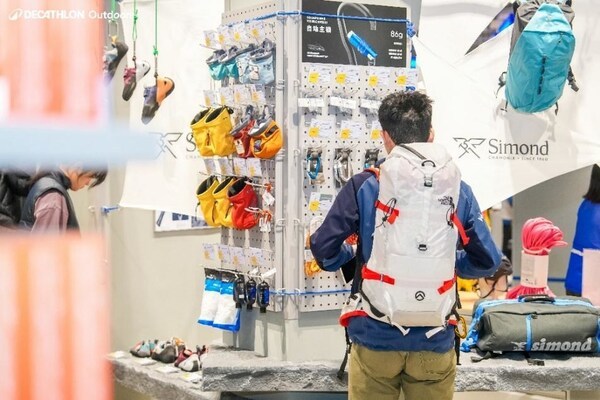
Decathlon's climbing brand Simond showcases multi-scenario products for indoor, outdoor, and ice climbing
Decathlon's R&D system is built on scenario-based practice. Its two mountain sports R&D centers are located at the foot of Mont Blanc, the "highest peak in the Alps"—the starting point isn't concepts but feedback from athletes, outdoor enthusiasts, and real natural environments. The R&D team forms a closed loop between "lab testing, field trials, athlete co-creation, and expert feedback," embodying a clear design philosophy: Listen to the wild first, then return to the drawing board.
This approach is exemplified by the Asia-debuting Park & Ride 900 Pro all-terrain snowboard at Raffles City. Instead of following the traditional "design, mass-produce, promote" pipeline, it evolved through long-term field testing by freestyle skier Sacha Balicco. Prototypes were taken directly to terrain parks, backcountry snow, and steep slopes, with the team adjusting structures based on real feedback. The final "triple-fiber structure"—carbon fiber's responsiveness, bamboo fiber's natural rebound, and fiberglass's stability—wasn't theorized but proven optimal under real-world conditions.
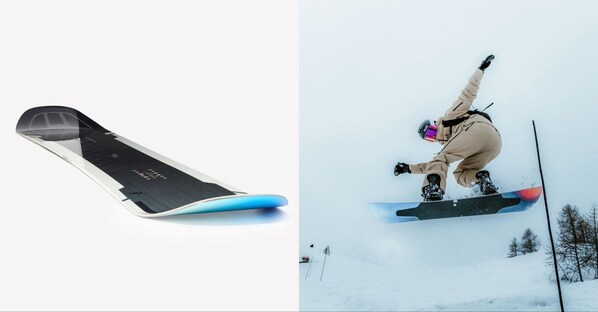
Decathlon's Asia-debut Park & Ride 900 Pro snowboard, shaped by athlete field testing
For Chengdu, this R&D approach naturally aligns with its multi-tiered outdoor demands. Users don’t seek "more professional" but "more effective in real scenarios." The concept store reflects Decathlon’s shift from tech-driven to scenario-driven, from performance-focused to experience-focused.
The Rise of the Great Outdoors: When Activities Become Lifestyles
If scenario-based R&D answers "why products are chosen," the "Great Outdoors" positioning answers "why users start their outdoor lives here."
One reason Decathlon’s concept store quickly became Chengdu’s winter hub is its timing—outdoor activities are expanding from niche sports to mass lifestyles in China.
Over the past decade, China’s outdoor craze has seen waves: the "hardcore era" of mountaineering and trekking; the "newbie expansion era" of camping and light hiking, bringing outdoors to the mainstream; and now the ongoing "lifestyle era."
The GOIF2024 Outdoor Consumption Trends Report notes that 46.3% of Chinese consumers spend ¥1,000–5,000 annually on outdoor activities, with 8% exceeding ¥10,000. This spending pattern shows outdoors as a year-round lifestyle, not a seasonal interest.
Under this trend, traditional "single-category focus" retail can’t meet cross-scenario needs. Users now seek one-stop, multi-group, all-season solutions.
Decathlon’s concept store is built for this. It zones spaces by activity scenarios, offering gear, knowledge, routes, and community events. Here, users solve not just sport-specific problems but "how to efficiently enter outdoor living."
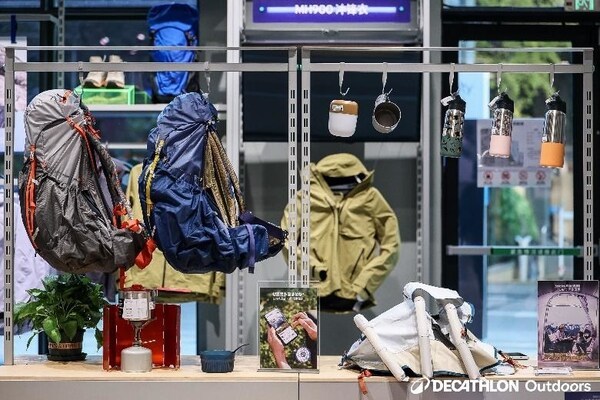
Decathlon’s outdoor concept store offers a one-stop shopping experience zoned by activity scenarios
This capability makes the store a natural hub for Chengdu’s growing outdoor wave. For winter ski-goers, it’s not about complex choices but a clear, reliable, accessible path to the wild.
Local Long-Termism: From Store Expansion to Urban Integration
To truly embed in a city’s outdoor ecosystem, brands must understand its lifestyle and community fabric. Chengdu’s outdoor culture is inherently vibrant, with active groups, strong organization, and stable participants. Here, outdoor consumption decisions are rarely solo but emerge from group discussions and shared experiences—whether choosing gear, routes, or difficulty levels, people trust collective and veteran input over individual judgment.
This means brands must offer not just products but scenario-based services validated by communities.
With 18 years and 9 stores in Chengdu, Decathlon deeply grasps this dynamic, infusing its concept store with strong community logic.
In-store "Mountain Lab" and "Finger Strength Wall" become popular check-in spots
Shoppers arrive with diverse needs: families prepping for ski season, runners checking if trail shoes suit Qingcheng’s slippery paths, young parents seeking versatile camping/hiking combos.
Decathlon’s store solves these because its "sport experts" are long-term outdoor participants themselves. They’t just staff but certified coaches, outdoor leaders, or decade-deep specialists. Thus, they offer not generic advice but field-tested insights—scenario judgment, gear selection, usage tips, and local community pathways.
This expertise naturally expands the store from a sales point to a city-outdoor gateway. Crucially, it’s not isolated but extends Decathlon’s localization: partnering with climbing gyms, supporting ski groups, hosting photo hikes—integrating the brand into local sports life. The concept store manifests this long-term relationship—it doesn’t just serve sports needs but helps shape urban outdoor culture.
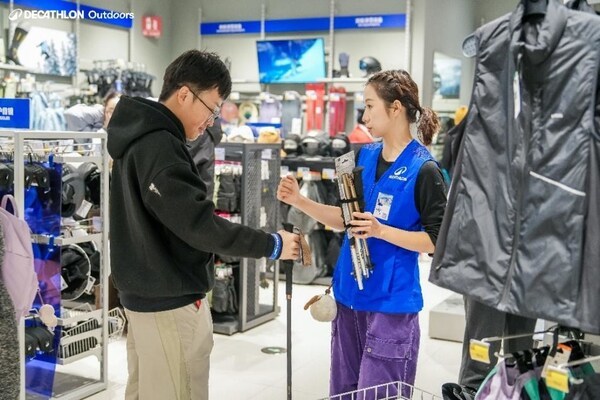
Store sport experts provide tailored product advice
Thus, this store’s emergence isn’t about "Chengdu needing an outdoor retailer" but "Chengdu needing a hub for outdoor lifestyles."
Conclusion: As Nature Becomes Essential, What Outdoor Brands Do Cities Need?
By 2025, China’s outdoor apparel/footwear market has entered the ¥100-billion tier, growing at double digits. But the real change is structural: outdoors shifting from sports to lifestyles, single to multi-scenario, product to experience consumption.
In this context, an outdoor brand’s value isn’t measured by store size but by enabling more people to embrace nature. Decathlon’s concept store plays this role: scenario-based R&D meets real needs, "Great Outdoors" logic embraces lifestyle shifts, and long-termism integrates into urban culture.
When mountains aren’t distant but urban routines, outdoor brands transcend gear suppliers to co-build city lifestyles. Decathlon’s Chengdu presence lets more people access nature easily, enriching the city’s outdoor culture.
The copyright of this article belongs to the original author/organization.
The views expressed herein are solely those of the author and do not reflect the stance of the platform. The content is intended for investment reference purposes only and shall not be considered as investment advice. Please contact us if you have any questions or suggestions regarding the content services provided by the platform.
