



HK IPO: Analysis of Xidi Zhijia's Subscription

Xidi Autonomous Driving is a leading Chinese commercial vehicle autonomous driving technology supplier, specializing in the R&D and commercialization of autonomous trucks in closed scenarios, V2X vehicle-road coordination, and intelligent perception solutions.
The company plans to allocate the net proceeds of approximately HK$1.309 billion from the global offering as follows: 55% for R&D, 15% for commercial expansion, 20% for industrial chain investment and M&A, and 10% for working capital and general corporate purposes.
Offering Information and Lottery Rate
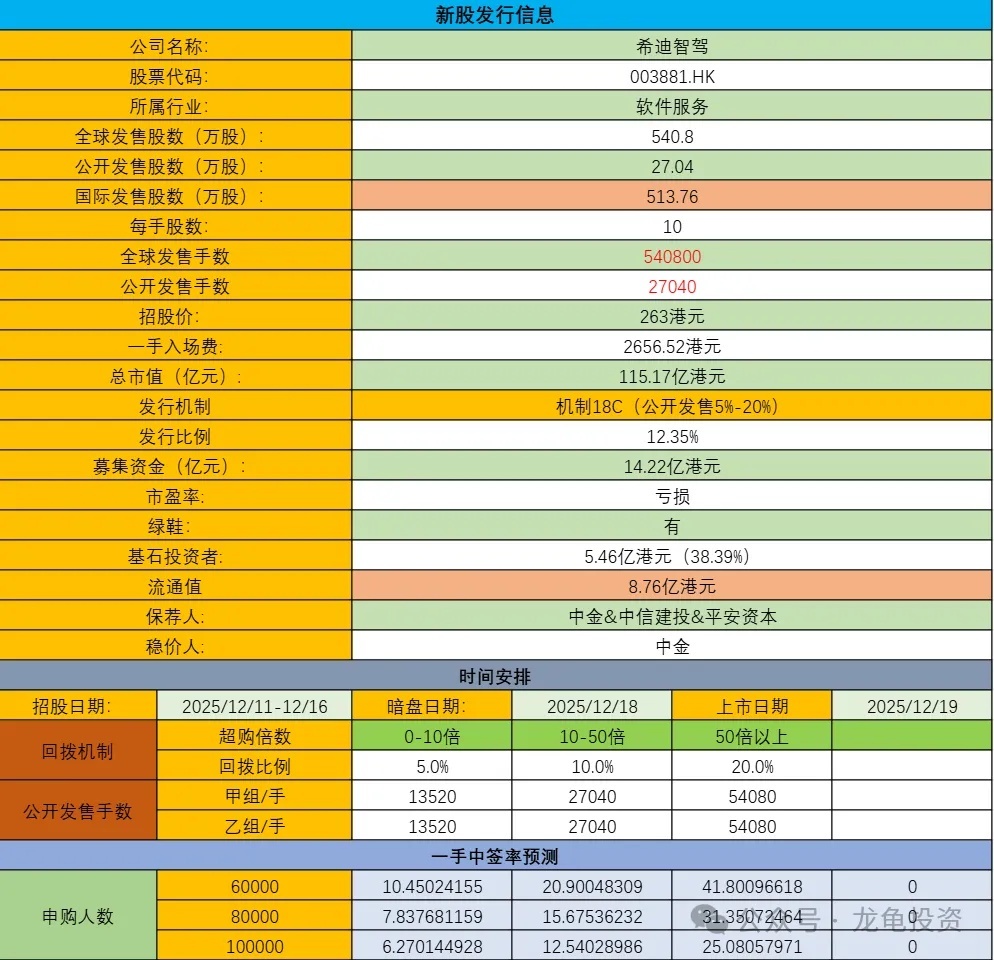
The company is offering 5.408 million shares globally, with 10 shares per lot. As of the time of writing, the oversubscription rate is 6.44x. The offering is conducted under the Chapter 18C mechanism, and achieving a margin financing multiple of 10-50x is not an issue. There are 27,040 lots each for Group A and Group B, with an estimated 60,000 to 100,000 participants. The one-lot lottery rate is 10%, and applying for 300 lots guarantees one lot.
Historical Investor Information and Sponsors
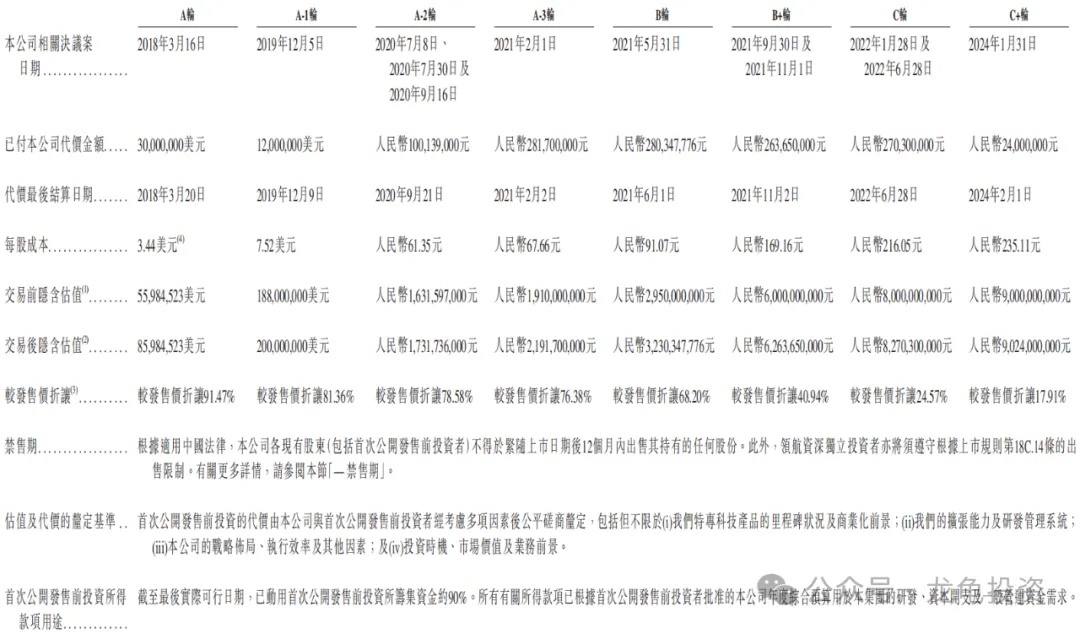
Before its IPO, Xidi Autonomous Driving completed a total rounds of financing, with the last C+ round closing in December 2024 at a cost of RMB 235.11 per share, implying a post-transaction valuation of RMB 9.024 billion (approximately HK$9.96 billion), representing a 17.91% discount to the offering price. Five cornerstone investors subscribed to HK$546 million, accounting for 38.39% of the offering. None of the major players participated before the IPO. Had Sequoia and Baidu been cornerstone investors, the situation would have been entirely different. Thus, certain details can reveal the quality of a new stock.
The IPO is jointly sponsored by CICC, CITIC Securities, and Ping An Capital, with CICC acting as the stabilizing agent. CICC's stabilization is virtually non-existent, but CITIC Securities among the three sponsors is decent.
Lock-up arrangements: Existing shareholders are subject to a 12-month lock-up, while cornerstone investors have a 6-month lock-up.
Industry Outlook and Competitive Landscape
While passenger cars are still "cautiously" testing NOA on open roads, autonomous commercial vehicles have already begun generating real revenue within "walled" environments. CIC divides this sector into three segments: closed, intercity trunk, and urban roads. Among these, closed scenarios (mines, ports, industrial parks) have become the only segment achieving scaled monetization due to "clear boundaries, regulation-friendly policies, and single safety responsibility entities."
In 2024, China's closed-scenario autonomous commercial vehicle sales reached RMB 2.6 billion, accounting for half of the global market. By 2030, this is expected to expand to RMB 56.8 billion, with a CAGR of 67.5%, significantly higher than the 141% for intercity trunk and 178% for urban roads (from extremely low bases). On the demand side, the mining sector alone offers a potential equipment market of RMB 550 billion—China has 1,500 large and medium-sized mines. Replacing all 50,000+ traditional mining trucks with autonomous ones at RMB 2.5 million per unit would create a market worth hundreds of billions. On the policy front, the NDRC, National Energy Administration, and Mine Safety Administration have jointly mandated that "by 2025, the intelligentization rate of large coal mines must reach ≥90%, and by 2026, intelligent production capacity must account for ≥60%," effectively installing a "countdown" payment timer for downstream buyers.
The core pain point in closed scenarios is not "algorithmic prowess" but 24×7 economic production: fully unmanned loading-transport-unloading processes, mixed fleet scheduling of manned and unmanned vehicles, and reliability in extreme conditions (-40°C to 60°C, high dust, high humidity). Whoever can package "L4 algorithms + automotive-grade domain control + vehicle-by-wire + cloud scheduling" into a deployable production tool will secure orders first. In terms of business models, selling equipment (one-time) and selling transportation services (ton/kilometer-based fees) coexist, but domestic clients prefer "outright purchase + financial leasing"—paying 30% upfront and the balance over 2–3 years, often requiring suppliers to provide guarantees or buyback commitments, making cash flow and financial support capabilities 隐形门槛。
In 2024, China's autonomous mining truck solutions market was RMB 1.9 billion, with a CR5 of 97%, showing a "one leader, one strong player, and multiple newcomers" pattern:
Yikong Zhijia (51.6%): Backed by OEMs, integrated in-house R&D + vehicle manufacturing, focusing on ultra-large fleets of 100+ trucks with high per-project value.
Company D (15.5%): Started in ports, expanded into mining, asset-heavy operations.
Xidi Autonomous Driving (12.9%): Third-party tech supplier, pure L4 solution provider without fleet ownership.
Company G (10.3%): Leverages parent company's mining resources, regionally focused.
Company J (6.7%): Startup, targeting small open-pit mines with low-cost RMB 800k kits.
Technologically, the industry has evolved from "getting it to run" to a refinement phase emphasizing "mixed fleets, ≥95% uptime, 30% cost-per-ton reduction." Sensing accuracy, positioning redundancy, onboard computing power, and cloud scheduling latency are now the four key evaluation metrics. Xidi stands out in "mixed fleet operations": its scheduling system can simultaneously manage manned and unmanned vehicles, achieving 0.1-meter precision parking in mixed traffic, with certified loading-transport efficiency 104% of manual operations. It also set a global record with a 56-vehicle mixed fleet in Inner Mongolia, creating a demonstration effect.
Overseas, the Middle East, Australia, and South America urgently need Chinese autonomous mining trucks due to high labor costs and union risks but require SIL2 functional safety + 欧美 OEM channels. Both Yikong Zhijia and Xidi have secured pilot orders in Australia's Pilbara region, with deliveries starting in 2026.
Closed-scenario autonomous driving is the "fastest self-sustaining" segment in China's smart vehicle sector, benefiting from a five-year window, trillion-yuan equipment replacement, and policy countdown. Xidi, with its "independent third-party tech + largest mixed fleet deployment + HK listing platform" trifecta, currently ranks in the domestic mining truck autonomous driving top tier. However, facing the leader's 51.6% market share, it must accelerate in scaled deliveries, overseas channels, and financial strength to defend its 12.9% "beachhead" and advance further.
Financials
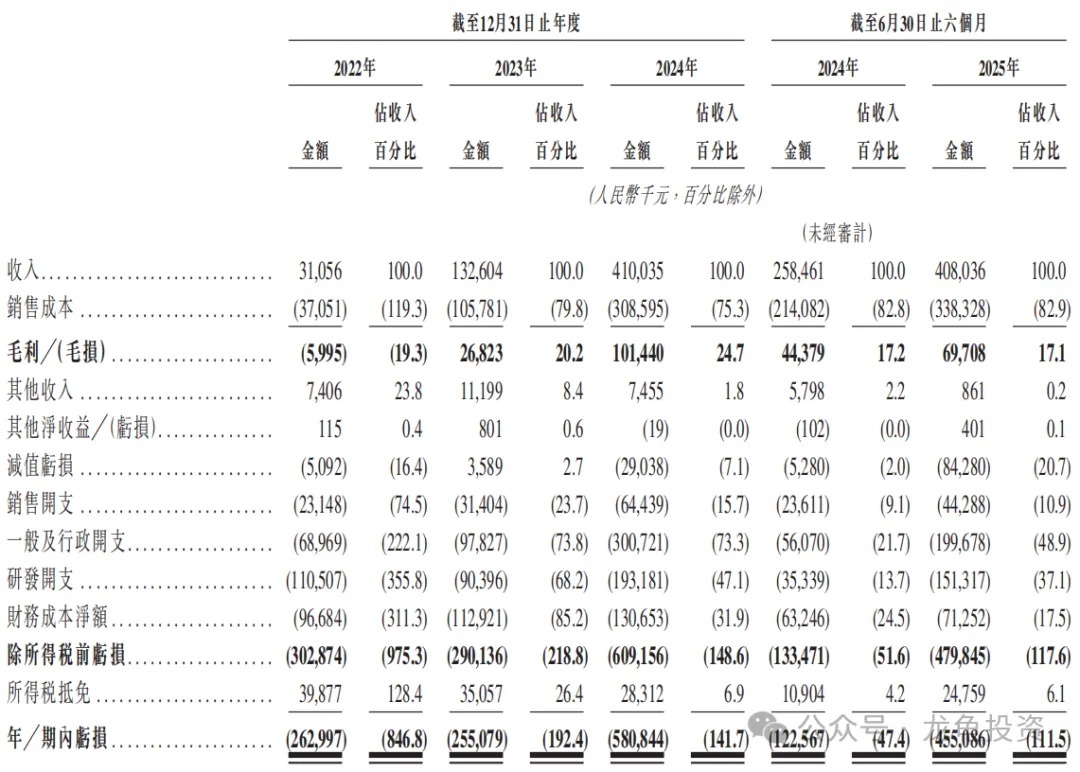
Revenue: HK$31.056 million in 2022, HK$133 million in 2023, HK$410 million in 2024, and RMB 560 million for the last 12 months as of June 30, 2025.
Gross Profit/Loss: Gross loss of HK$5.995 million in 2022, gross profit of HK$26.823 million in 2023, and HK$101 million in 2024; RMB 127 million for the last 12 months as of June 30, 2025.
Net Loss/Profit: Net loss of HK$263 million in 2022, HK$255 million in 2023, HK$581 million in 2024, and HK$913 million for the last 12 months as of June 30, 2025.
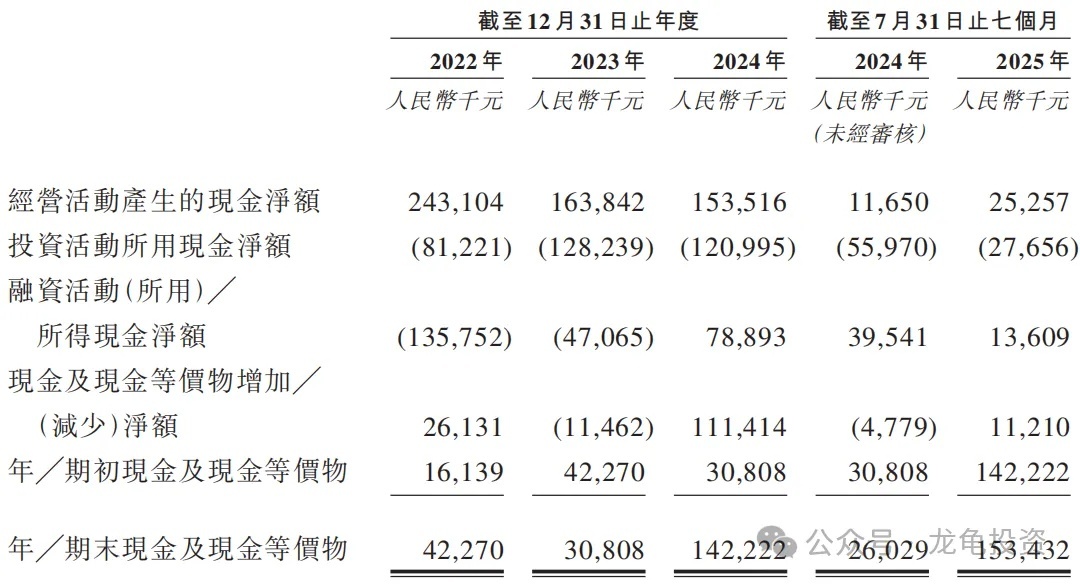
The company remains in a "cash-burning" phase—operating cash flow was negative from 2022 to H1 2025 (total net outflow of ~RMB 760 million over 3.5 years). Cash and equivalents dropped from RMB 310 million at end-2024 to RMB 190 million at end-June 2025, but the HK$1.309 billion IPO proceeds will cover 16–20 months of operational cash needs.
Comprehensive Review
Xidi Autonomous Driving is currently the first listed company in the autonomous mining truck solutions market, where the leader is Yikong Zhijia with a 51.6% share, while Xidi ranks third. Two other listed companies in the commercial AV space are Pony.ai and WeRide, both already listed on Nasdaq and HKEX. Though their segments differ slightly, they belong to the broader autonomous driving market.
Pony.ai has an HKEX market cap of HK$52.025 billion, 2024 revenue of RMB 529 million, and a net loss of RMB 1.94 billion. WeRide's HKEX market cap is HK$23.776 billion, with 2024 revenue of RMB 361 million and a net loss of RMB 2.517 billion. Xidi's offering implies a market cap of HK$11.517 billion, 2024 revenue of RMB 410 million, and a net loss of RMB 581 million.
On one side is the commercial vehicle segment, on the other Robotaxi. Though both are AV plays, the commercial vehicle segment resembles a "steady-growth industrial firm." Its "asset value" lies in: validated business model, clearer cash flows, lower risk, and stronger short-term profitability. The Robotaxi segment resembles a "platform tech firm with vast imagination." Its "asset value" lies in: high technical barriers, strong network effects,极高的 market ceiling, and long-term disruptive potential.
Overall, while Xidi can't match Pony.ai and WeRide's valuation benchmarks, its offering valuation isn't too expensive by comparison. As the first listed player in autonomous mining trucks, it has some scarcity value. However, the Chapter 18C mechanism means a 20% clawback if oversubscription exceeds 50x, flooding the market with shares—not ideal. The current IPO wave has also dampened Xidi's 热度, though its fundamentals and narrative are among the better in this batch.
Subscription Plan:
Will dip a toe; final plan after covering other IPOs will be shared on Star Planet.
Disclaimer: Investing involves risks; participation requires caution. The mentioned are personal records only and do not constitute investment advice. No liability for losses. If this helps, please like, share, and forward to friends in need—much appreciated!
The copyright of this article belongs to the original author/organization.
The views expressed herein are solely those of the author and do not reflect the stance of the platform. The content is intended for investment reference purposes only and shall not be considered as investment advice. Please contact us if you have any questions or suggestions regarding the content services provided by the platform.
