



Wo'an Robot goes to Hong Kong, embodied intelligence moves from 'humanoid fantasy' to household reality

While humanoid robots are still demonstrating tasks like pouring water, dancing, and shaking hands, another, more realistic path of embodied intelligence is quietly approaching a commercial inflection point.
Recently, Woan Robotics (Shenzhen) Co., Ltd. passed the Hong Kong Stock Exchange's listing hearing, becoming one of the few Chinese robotics companies to report profits before going public.
Almost simultaneously, Xidi Zhijia, founded by "DJI Godfather" Li Zexiang, launched its IPO, making the market suddenly realize: this might be the concentrated realization of the same industrial logic across different tracks.
Especially at a time when capital is increasingly divided on embodied intelligence, the emergence of Woan Robotics seems like a counterintuitive answer. It does not bet on the "most human-like" robot form but instead chooses to start from home scenarios, breaking down embodied intelligence into a sellable, scalable, and profitable systems engineering project.
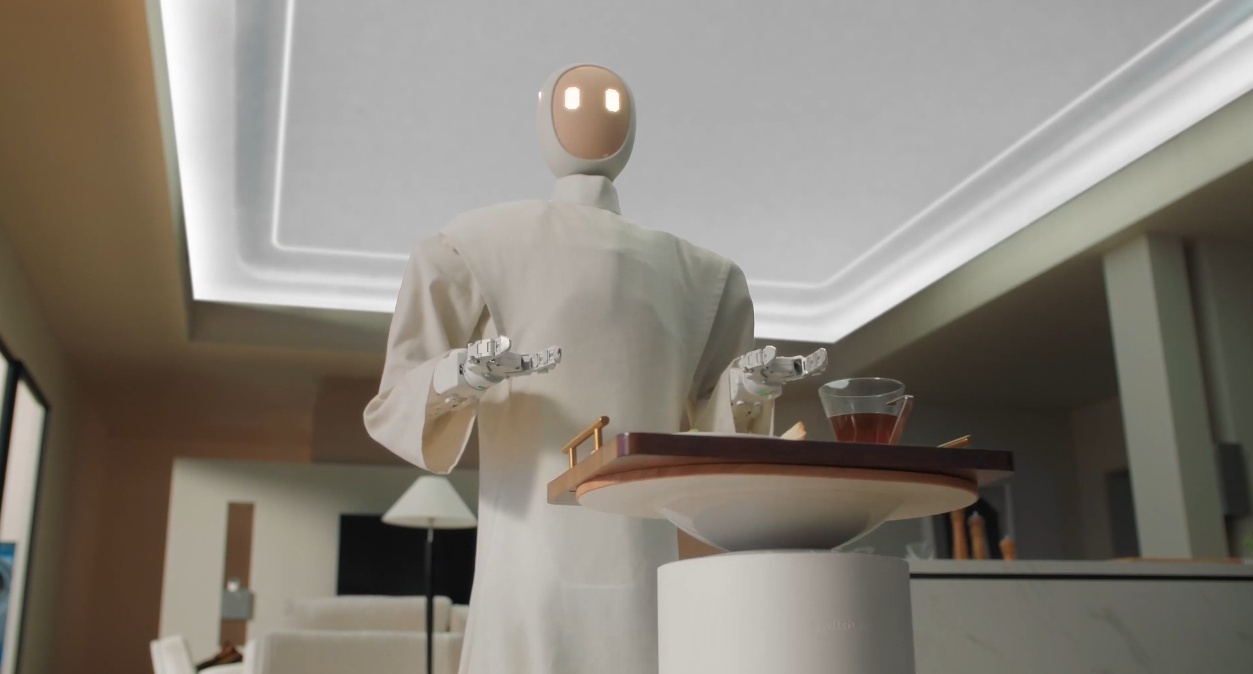
How did Woan Robotics turn losses into profits and cross the threshold?
In China's robotics industry, "technologically advanced but commercially unprofitable" is almost a universal footnote. High R&D costs, limited application scenarios, and slow scaling have forced most companies to repeatedly switch between storytelling and burning cash.
Woan Robotics stands out by not treating embodied intelligence as a one-time technological breakthrough but as a sustainable, deliverable home system capability.
Financially, the results of this choice are already visible. The prospectus shows that from 2022 to 2024, Woan Robotics' revenue grew from 275 million yuan to 610 million yuan, with gross margins rising from 34.3% to 51.7%.
By the first half of 2025, its gross margin further improved to 54.2%, achieving profitability for the first time with a net profit of 27.9 million yuan and adjusted EBITDA of 54.14 million yuan.
In the highly hardware-driven robotics industry, such a gross margin structure is uncommon. In contrast, most service or humanoid robot companies still hover around 30%-40% gross margins, heavily relying on scaling to dilute costs. Woan's rising gross margins suggest its pricing power isn't solely based on "selling hardware."
The key lies in product form. Unlike pursuing a single "super robot," Woan breaks down home life into multiple high-frequency, sustainable scenarios—smart control, household assistance, security, elderly care, energy management—and builds product portfolios and system platforms around them.
This approach enables technology reuse and ensures new features don't linearly increase costs.
More importantly, home scenarios naturally foster "incremental intelligence." Home users don't demand general or human-like intelligence from robots but prioritize stability, controllability, and practical value.
This allows embodied intelligence to solve problems incrementally through continuous learning and feature stacking, gradually unlocking commercial value.
From this perspective, Woan Robotics isn't the most radical player in embodied intelligence but may be the closest to achieving a real-world commercial loop.
With cash and equivalents remaining at nearly 200 million yuan in H1 2025 alongside profitability, this signal is particularly critical for capital markets—it means its IPO is no longer a "lifeline financing" but closer to proactive capital expansion.
Could home robots be the consumer gateway to embodied intelligence?
Over the past year, the narrative around embodied intelligence has been dominated by "humanoid robots." Capital, media, and industry attention have centered on "how human-like" and "how general-purpose" they are, but the result has been cost overruns, unclear commercial paths, and lengthening delivery cycles.
Home robots occupy an awkward position. The market size exists, but they've long lacked "technological sex appeal."
According to Frost & Sullivan, by 2024 retail sales, Woan Robotics is already the world's largest AI-embodied home robot system provider, with an 11.9% market share. Yet in capital terms, this sector is seen as "evolved appliances" rather than the next-gen smart gateway.
Woan's IPO is reigniting this undervalued discussion.
Li Zexiang's consistent philosophy prioritizes engineering execution over conceptual breakthroughs. From DJI to autonomous driving to home robots, the common thread isn't technical alignment but solving scalable delivery first. Xidi Zhijia and Woan Robotics' near-simultaneous IPO pushes suggest this methodology is now entering its payoff phase.
For Hong Kong stocks, Woan Robotics offers a direction: a robotics company with real revenue, improving gross margins, clear applications, and a visible profit inflection. These are precisely what the HK market craves during tech expansion phase.
But disagreements persist. Where is the true ceiling for home robots? Can they become "quasi-essentials" like robotic vacuums, or remain mid-to-high-end discretionary purchases? Will growth slow as the market matures, capping long-term valuations?
Time will tell.
One thing is certain: embodied intelligence's commercialization path is undergoing a realist turn. When "most human-like" is no longer the sole goal, "first to profit" is regaining consensus.
In this context, Woan Robotics' IPO resembles a watershed: it may not represent embodied intelligence's final form but could prove one thing first—robots don't have to be perfect to become a business.
And that might be the real reason capital is now willing to ring the HKEX bell for it.
The copyright of this article belongs to the original author/organization.
The views expressed herein are solely those of the author and do not reflect the stance of the platform. The content is intended for investment reference purposes only and shall not be considered as investment advice. Please contact us if you have any questions or suggestions regarding the content services provided by the platform.
