



Japan's interest rate hike and its impact on global capital flows


The Bank of Japan raised interest rates again at its monetary policy meeting on December 19, as widely expected by the market, increasing the target for the unsecured overnight call rate by 25 basis points to 0.75%, marking the highest level for Japan's policy rate in 30 years since 1995.
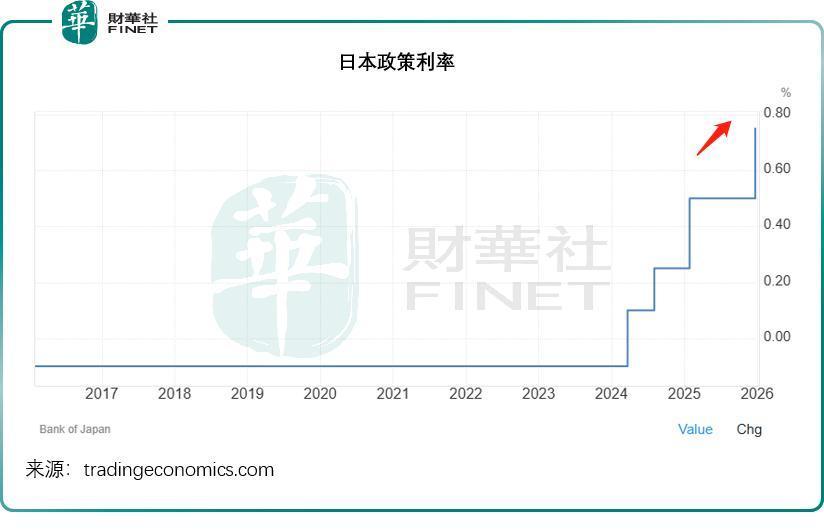
In its official statement, the central bank noted that Japan's population is shrinking, leading to persistently tight employment conditions. Despite tariff impacts, corporate profits are expected to remain strong, and the bank stated that companies are "very likely" to continue raising wages next year, with prices expected to rise moderately.
The Bank of Japan expects that, despite changes in policy rates, real interest rates will remain negative, which can continue to provide solid support for economic activity. Given that real interest rates remain low, if economic performance meets expectations, the central bank will continue to raise rates and adjust monetary policy.
Bank of Japan Governor Kazuo Ueda said that the decision on further rate hikes will be made after assessing the impact of the 0.75% hike on the economy and prices. Judging from his tone, the likelihood of a rate hike in the short term will depend on inflation, wages, and economic performance, and given his communication style, he will likely signal his intentions in advance.
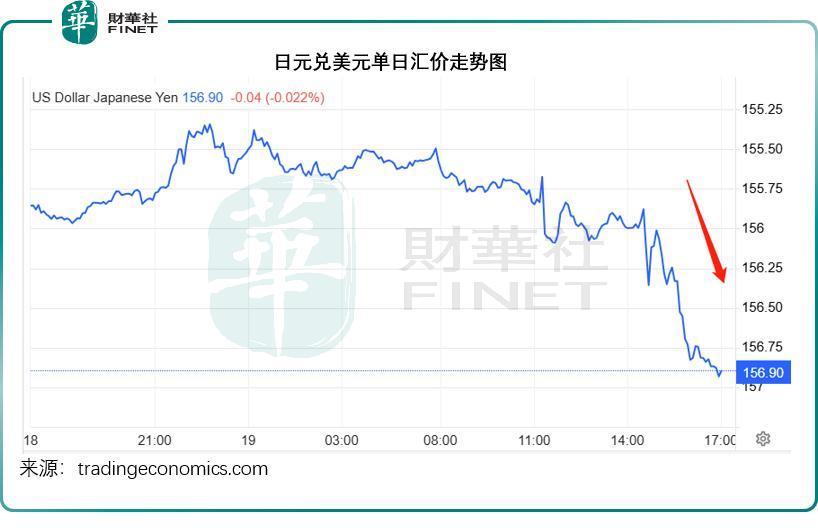
We note that after Japan announced the rate hike, the yen weakened against the U.S. dollar, falling to around 156, close to 157, hitting a one-week low. This may be due to Ueda's failure to provide a clear path for further rate hikes, and the prime minister's inclination toward more accommodative policies to stimulate the economy, which has not alleviated investor concerns about Japan's increasing debt to finance its spending.
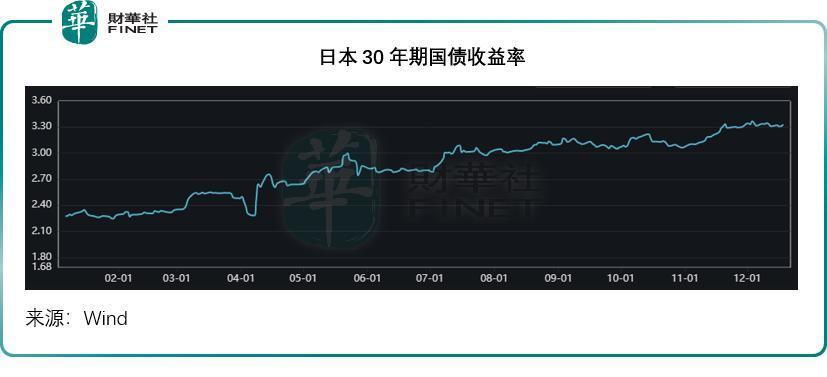
As shown in the chart below, Japan's 30-year government bond yield remains at elevated levels.
Other Central Banks' Policy Moves in Line with Expectations, Yen's Advantage Not Obvious
On the other hand, other major central banks around the world have recently announced their latest interest rate policies.
The Federal Reserve cut rates by 25 basis points on December 10 and began expanding its balance sheet to provide liquidity to the market. But the focus is on its future rate path: the latest U.S. economic data showed that inflation unexpectedly fell to 2.7% in November, below the forecast of 3.1% and the 3% reading in September. Core inflation, excluding volatile food and energy prices, was 2.6%, below the expected 3%.
Notably, due to the government shutdown, the U.S. did not release October inflation data. Economists believe the November data may not accurately reflect the current state of U.S. inflation, given the lack of October data. On the other hand, recently released U.S. employment data showed the unemployment rate rose slightly to a four-year high in November.
On the data alone, these figures provide justification for the Fed to raise rates aggressively. But the actual decision will still depend on the views of the Fed's voting members on the economic outlook, and next year's Fed rate decisions may even involve political factors, adding uncertainty.
A day before the Bank of Japan's policy decision, the Bank of England cut rates by 0.25 percentage points to 3.75%, while signaling uncertainty about further cuts. The European Central Bank kept rates unchanged, but markets widely expect it may reverse course and hike.
Compared with Japan's negative real interest rates, Japan's rate advantage is not obvious, which may be one reason the yen has not strengthened.
Japanese Stocks Rebound After Initial Drop
After the rate hike announcement, Japanese stocks initially fell but then rebounded. As shown in the chart below, the Nikkei 225 rose 505.71 points, or 1.03%, to 49,507.21.
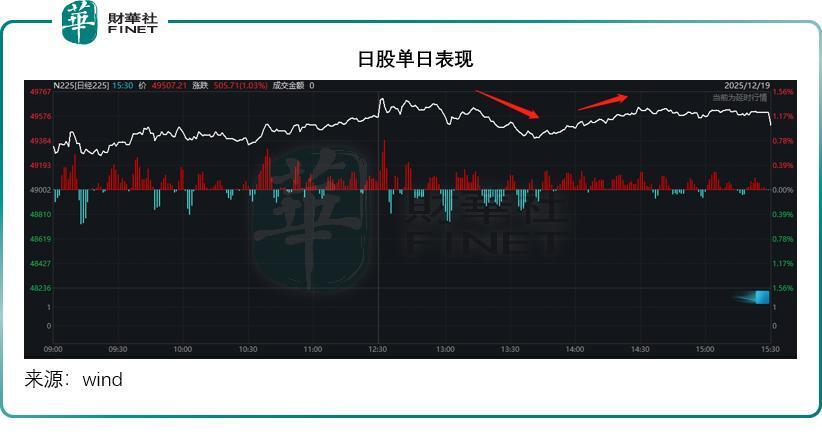
We speculate that the reasons for the stock market rally may include the rate hike being in line with market expectations, with the market having already priced in the potential impact. SoftBank Group surged 6.14%; bank stocks led gains, with Sumitomo Mitsui Financial Group up 2.20% and Mitsubishi UFJ Financial Group up 0.84%. The weaker yen benefited export-oriented stocks, with trading firm Itochu Corp. up 0.97% and Marubeni up 2.45%.
A report by Nikkei Chinese Edition showed that as of December 18, overseas investors' net purchases of Japanese stocks this year exceeded 5 trillion yen, possibly reaching 5.88 trillion yen, with the full-year figure on track to hit a record high since the start of Abenomics in 2013. On one hand, U.S. tariff policies have prompted investors to diversify, making Japanese stocks an important destination for capital. On the other hand, expectations for corporate and economic reforms in Japan have fueled a surge in high-risk investments.
However, the report also noted that overseas investors' net purchases of Japanese stocks are currently only one-third of the 2013 level, and with U.S. stocks performing strongly, funds that flowed out after 2014 have yet to return. Moreover, since mid-November, concerns that the new prime minister's fiscal policies could lead to a surge in Japanese debt and push up long-term rates have caused overseas investors to slow their purchases of Japanese stocks.
Additionally, we believe that as Japan's unpopular policies continue, its tourism and trade activities, and even investments in Southeast Asia, are likely to be severely impacted. These negative effects have not yet been reflected in the statistics but could weigh on Japan's economic performance going forward. Whether Japanese stocks can maintain their highs remains highly uncertain.
Spillover Effects: Implications for Hong Kong Stocks
The spillover effects of Japan's rate hike are gradually emerging in global markets. Traditionally, Japan's "yen carry trade"—borrowing low-cost yen to invest in higher-yielding global assets—has been a significant international capital allocation strategy. If yen yields rise, this arbitrage opportunity could narrow or even reverse, potentially leading to a repricing of risk assets.
Yen carry trades typically involve buying cryptocurrencies and high-growth tech stocks (particularly in emerging markets like Hong Kong's tech sector) to maximize yield differentials.
Now, with yen yields rising and the carry trade's appeal diminishing, investors may be forced to sell overseas assets to repay yen-denominated debt, putting pressure on risk assets such as Hong Kong's large-cap tech stocks.
We note that after the Bank of Japan's rate decision, the yen did not strengthen significantly but instead weakened slightly. Meanwhile, emerging markets, particularly Hong Kong stocks, have remained relatively stable, with no signs yet of a large-scale unwinding of carry trades. The Hang Seng Tech Index (HSTECH.HK) closed up 1.12%.
Among them, $TENCENT(00700.HK) rose 1.49%, $BABA-W(09988.HK) gained 0.83%, $XPENG-W(09868.HK) surged 7.65%, and $HORIZONROBOT-W(09660.HK) jumped 7.04%.
However, it is important to note that while Hong Kong stocks have not been significantly impacted so far, this does not mean the risks have completely dissipated. Historical experience shows that after the Bank of Japan's rate hike in July 2024, a rapid appreciation of the yen triggered a large-scale unwinding of carry trades, leading not only to a plunge in the Nikkei but also a short-term decline in Hong Kong stocks.
Objectively speaking, even if Hong Kong stocks experience short-term volatility due to carry trade unwinding, this would not signal a trend reversal but could present an ideal buying opportunity for high-quality Hong Kong stocks. Historically, after short-term adjustment triggered by yen carry trades, high-quality stocks tend to quickly recover their valuations. More importantly, Hong Kong stocks are currently trading at historically low valuations, offering clear advantages over other emerging markets, while southbound capital continues to provide stable liquidity support. At the same time, China's economic fundamentals are stable and improving, with policymakers sending positive signals, and the easing of U.S.-China tensions and domestic demand-boosting measures providing a foundation for Hong Kong stocks' recovery. For long-term investors, short-term volatility is precisely an opportunity to identify high-quality assets, with industry leaders with strong earnings visibility and competitive advantages standing out after deep corrections.
Against the backdrop of global liquidity restructuring and market divergence in Hong Kong, how can investors accurately capture opportunities in high-quality assets? The highly anticipated annual event—the 2025 Hong Kong Wealth Management Summit and the 12th "Top 100 Hong Kong Stocks" Awards Ceremony—is about to kick off, with authoritative rankings to be announced, providing important guidance for investors. Global investors are invited to join this capital gathering to seize post-adjustment opportunities in an increasingly volatile market environment.
Author: Mao Ting
The copyright of this article belongs to the original author/organization.
The views expressed herein are solely those of the author and do not reflect the stance of the platform. The content is intended for investment reference purposes only and shall not be considered as investment advice. Please contact us if you have any questions or suggestions regarding the content services provided by the platform.
