



Weichai Lovol's Hong Kong IPO: What Changes Will Occur When Agricultural Machinery Starts Talking About Algorithms?

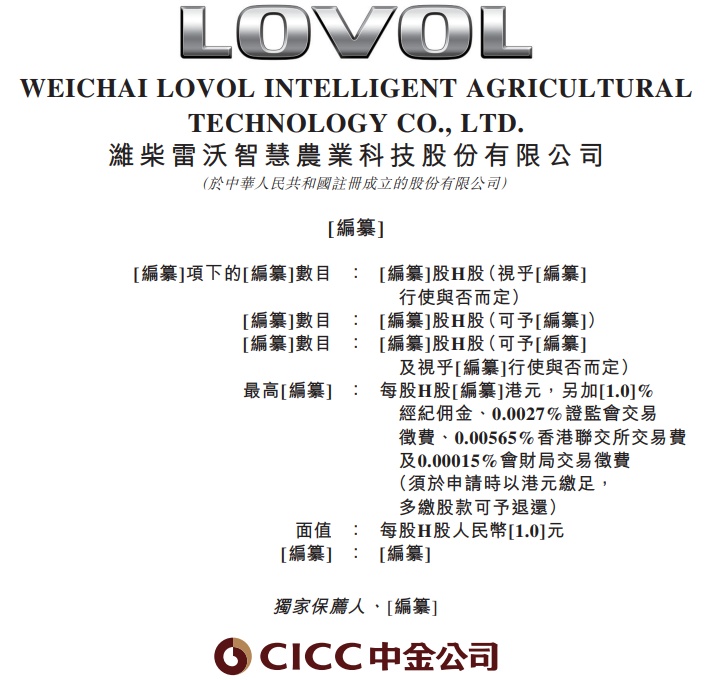
If Weichai Lovol is viewed merely as an "agricultural machinery company," its upcoming IPO on the Hong Kong Stock Exchange holds little discussion value. However, once placed within the macro context of food security, agricultural labor collapse, and the wave of intelligent transformation, the company's capital moves become intriguing.
In June, Weichai Lovol, a subsidiary controlled by Weichai Power, submitted its IPO application to the Hong Kong Stock Exchange for the first time and recently updated its prospectus. In conventional terms, this is not a typical "high-growth" IPO.
How can Weichai Lovor tell a compelling new story about "future agriculture" in the capital market?
The Solid Foundation of Smart Agricultural Machinery
In the current market environment, investors are inundated with stories but lack verifiable profitability. From this perspective, Weichai Lovol isn't particularly attractive, but it is solid enough.
The agricultural equipment industry exhibits clear cyclical characteristics, influenced by factors such as grain prices, agricultural subsidy policies, and raw material costs. Weichai Lovol's performance fluctuations partly reflect these industry traits.
According to the updated prospectus, Weichai Lovol's revenue from continuing operations for 2022–2024 was RMB 15.95 billion, RMB 14.68 billion, and RMB 17.39 billion, respectively, showing a "decline followed by recovery" trend amid industry cycles. During the same period, its continuing operating profit remained stable at RMB 0.8–1.0 billion, indicating steady rather than rapid growth.
The slight dip in the middle was related to adjustments in agricultural machinery subsidy policies and periodic fluctuations in market demand. The recovery in 2024, however, benefited from the release of demand for high-end intelligent agricultural machinery under the food security strategy and the initial commercialization of the company's smart agricultural services.
In terms of business nature, Weichai Lovol positions itself as a "comprehensive smart agricultural solution provider," transitioning from traditional agricultural machinery manufacturing to a dual-driven model of "equipment + services."
Currently, its two core pillars are complete sets of agricultural machinery and smart agricultural services. The former covers machinery for plowing, planting, managing, harvesting, and drying, addressing the equipment needs of "who will farm the land." The latter, based on IoT, AI, and big data technologies, provides precision decision-making and collaborative guidance to tackle the challenge of "how to farm scientifically."
This business transformation successfully helped Weichai Lovol navigate the cyclical adjustments of 2023, achieving both scale and efficiency gains. Its gross profit margin grew by 18.7% in 2024, reaching RMB 2.302 billion.
In terms of production layout, Weichai Lovol operates six production bases and nine production lines, with capacity ranking among the top in China. However, the proportion of smart agricultural machinery capacity still needs further clarification.
Upon closer examination of its financial structure, some noteworthy details emerge.
Despite its considerable revenue scale, its gross profit margin has long hovered around 13%, which is unremarkable in the equipment manufacturing industry, suggesting room for improvement in product value-added. Compared to global agricultural machinery giant John Deere, Weichai Lovol also lags significantly in profitability.
In R&D, as of the latest practicable date, the company holds 2,443 domestic patents, including 168 invention patents, and has participated in drafting over 100 national, industry, and association standards. These technological foundations support its intelligent transformation.
However, the commercialization of smart agricultural services is still in its early stages. While Weichai Lovol has proposed data-driven solutions, how to translate technological advantages into sustainable revenue models remains to be explored.
Its sales network covers over 120 countries and regions, indicating an initial global footprint. However, the proportion of overseas revenue is not detailed in the prospectus, leaving the actual effectiveness of its globalization strategy unclear.
Fundamentally, Weichai Lovol is commendable for its stability. But to gain a firm foothold in the secondary capital market, the company must answer: Can it become "more valuable" in the future?
Can Companies Become "More Valuable" in the Smart Agriculture Wave?
The core contradiction in agriculture is shifting toward "structural shortages + labor collapse." Public data shows that China's agricultural workforce declined from ~180 million in 2020 to 160 million in 2024, with rural residents aged 65+ accounting for nearly 20%. By 2030, the agricultural labor force may further drop to 140 million. Meanwhile, structural grain shortages persist, with grain imports reaching 160 million tons in 2024.
This means future agricultural growth can only come from higher efficiency.
Technologically, Europe and the U.S. are ahead in smart agriculture: EU agricultural automation stands at 72%, while U.S. smart agriculture adoption exceeds 80%. As a major agricultural country, China is accelerating its catch-up. Admittedly, this gap is partly due to terrain and crop complexity constraints.
But the overarching trend is clear: "smart agriculture" has become an urgent solution to challenges like "who will farm the land" and "how to farm scientifically." China's smart agriculture is transitioning from pilot demonstrations to large-scale applications, with the next decade seen as a "golden development period."
At the corporate level, Weichai Lovol repeatedly emphasizes "complete sets of agricultural machinery + smart agricultural services." Its value lies not in the equipment itself but in breaking down agricultural production into algorithm-optimizable processes.
Its business logic can be simplified into three layers: equipment (covering plowing, planting, managing, and harvesting), data (real-time collection of operational, soil, and environmental data), and decision-making (AI-generated standardized instructions for end-to-end grain production solutions).
This approach aligns with industry trends but may face practical hurdles like insufficient data standardization, poor cross-platform compatibility, and low farmer acceptance. Moreover, the switching costs for the entire solution far exceed those for single equipment purchases.
More critically, China's agricultural production is dominated by small-scale operations, with smallholders accounting for over 98% of farming entities (Ministry of Agriculture data). This means smart agriculture solutions must be highly flexible and cost-effective to achieve scalable adoption.
Weichai Lovol states in its prospectus that IPO proceeds will fund new agricultural machinery production bases, smart production line upgrades, R&D, and overseas expansion—directions broadly consistent with industry trends.
But whether capacity expansion matches market demand is a key risk. China's agricultural machinery market has shifted from incremental to stock competition, where simply expanding capacity may worsen oversupply. Product upgrades and business model innovation are more critical for new opportunities.
The commercialization model for smart agricultural services remains exploratory. The industry currently has three main models: one-time hardware + software sales, subscription-based services, and value-sharing based on outcomes. Weichai Lovol has yet to clarify its service monetization approach, which could impact long-term profitability.
From a policy perspective, national emphasis on food security and agricultural modernization, along with optimized machinery purchase subsidies, provides favorable conditions for Weichai Lovol's development.
The copyright of this article belongs to the original author/organization.
The views expressed herein are solely those of the author and do not reflect the stance of the platform. The content is intended for investment reference purposes only and shall not be considered as investment advice. Please contact us if you have any questions or suggestions regarding the content services provided by the platform.
