


From macro to quantitative: A full analysis of the 2025 US stock market Christmas rally, what's the probability of replicating last year's crash?

Recently, the market has hit another closing high, and this Christmas rally has been quite strong. However, with the market reaching new highs, more and more investors are starting to worry about whether it will repeat last year's scenario of a pullback right after the Christmas rally. Therefore, I've prepared a research report to address this question from the perspectives of the macroeconomic environment and quantitative simulations.
1. Research Background and Problem Definition
The Christmas rally typically refers to the phenomenon where the stock market performs strongly during the last five trading days of the year and the first two trading days of the new year. Historical data shows that since 1950, the S&P 500 has recorded positive returns in this seven-day window about 79% of the time, with an average gain of approximately 1.3%. This seasonal effect is higher than the average seven-day window gain of about 0.2%, with 77% of the years showing positive returns.
2024 was an exception to this pattern. Despite the S&P 500 rising 23.3% for the year, the index fell on every trading day between Christmas and New Year's, with a total December decline of about 2.4%, marking the first time in the index's history that it fell throughout the Christmas-New Year period. On December 27, 2024, the last trading day of the holiday-shortened week, the three major U.S. indices collectively plummeted, ending the previous uptrend.
Looking at this year's situation, as of yesterday's close, the S&P 500 has risen to 6,909 points, setting a new all-time high. The strong Q3 GDP report (4.3% economic growth) has boosted market sentiment but also lowered expectations for short-term rate cuts. Throughout 2025, U.S. stocks have remained resilient amid a series of political and monetary policy shocks (tariffs, Fed policy), with the S&P 500 delivering a total return of about 17.48% as of December 23.
So far, the trend has been highly similar to last year's. Will there be a significant pullback after the 2025 Christmas rally, as happened last year? Next, we'll verify this through data analysis and model simulations.
2. Overview of the Historical Christmas Rally Pattern
Reasons for the Christmas rally: Lower year-end trading volumes, institutional portfolio adjustments (e.g., tax optimization, year-end book closing), employee bonus reinvestments, and holiday optimism collectively contribute to the Christmas rally.
Rarity of failure: It is very rare for the Christmas rally to fail (i.e., the index declines during this window) two years in a row. LPL Financial's statistics show that since 1972, this has only happened in 1993-94 and 2015-16. Therefore, while the possibility of failure cannot be ruled out, the historical probability of consecutive failures is low.
3. Analysis of Last Year's (2024) Post-Christmas Rally Performance
In 2024, the S&P 500 experienced a strong rally before Christmas but fell throughout the window from Christmas to New Year's. Starting on December 27, 2024, U.S. stocks saw a sharp sell-off within a week, with the three major indices closing lower, led by tech and growth stocks, with the S&P 500 falling 1.11%.
The failure of the 2024 Christmas rally was mainly related to the following factors:
1. Unclear Fed policy signals: The market expected the Fed to maintain or cut rates in December 2024, but officials' hawkish bias led to a rise in the yield curve, suppressing stocks.
2. High valuations: Large-cap tech stocks in the S&P 500 were near historical highs, increasing year-end profit-taking pressure.
3. Rising bond yield attractiveness: Against the backdrop of sustained high interest rates, some funds flowed into the fixed-income market.
In summary, it's important to note that the 2024 decline was more influenced by macro policy expectations, valuations, and liquidity than the Christmas rally itself.
4. This Year's (2025) Christmas Rally
Overall strong performance: Since 2025, U.S. stocks have continued to rise, driven by AI-fueled growth expectations and better-than-expected economic data. Yesterday, the S&P 500 hit a new all-time high of 6,909 points.
Low volumes, still-high valuations: Trading volumes in late 2025 are below annual averages, reflecting reduced market participation ahead of the holidays. Meanwhile, the S&P 500's P/E ratio remains at historically high levels, indicating continued optimism.
Macro policy changes: The Fed conducted a hawkish rate cut in December 2025, lowering the target range to 3.50%-3.75%, but the statement provided no clear signals, leaving the market divided on the 2026 rate-cut path. Lower rates have slightly reduced bond yields, but they still compete with stocks.
Comparing this year's situation with last year's, the similarities include:
1. Like last year, the index has already seen significant gains before the holidays, and valuations are high.
2. The Fed's policy direction remains uncertain, and market expectations for future rate cuts are divided.
Differences:
1. It is extremely rare for the Christmas rally to fail two years in a row.
2. Economic growth and corporate earnings growth in 2025 are higher than last year, and overall market risk appetite is stronger.
5. Model and Simulation Methodology
To assess the potential pullback risk after the 2025 Christmas rally, I built a simplified Monte Carlo model based on the historical Christmas rally window return distribution and the 2024 anomaly. The model assumes:
In 79% of cases, the seven-day window return is positive, averaging 1.3% with a standard deviation of 1.0 percentage point. In 21% of cases, the return is negative, averaging -1.0% with a standard deviation of 1.5 percentage points (using the 2024 -2.4% drop as a reference to extend tail risk).
By randomly sampling 10,000 simulations, each simulating a seven-day window return, we obtain a probability distribution.
Key statistical results from the simulation are as follows:
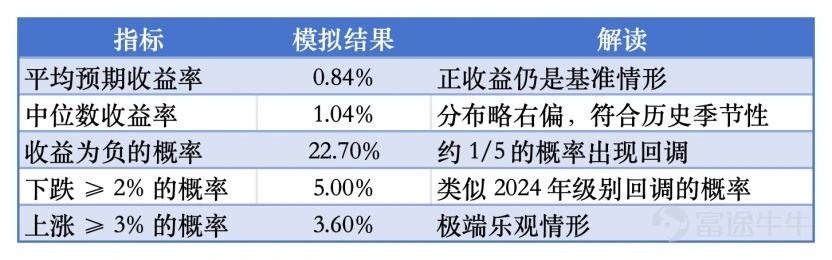
The simulation shows that, under the assumed distribution, the probability of a pullback similar to last year's (~2.4%) is about 5%, representing tail risk rather than a baseline scenario. In the vast majority of cases, returns remain positive, averaging close to 0.8%.
However, it's important to note that the model's parameters are based solely on historical averages and recent events and may not fully represent future market conditions.
Combining historical distributions with the current macro environment, the most likely post-Christmas 2025 scenarios, ranked by probability, are:
Scenario A (Baseline): High volatility / Mild profit-taking
Range: -1% ~ +1%
Probability: ≈ 55–60%
Logic: Lower holiday liquidity, year-end profit-taking, but no clear policy/earnings shocks
Scenario B (Bearish): Technical pullback, but not replicating 2024
Range: -1% ~ -2%
Probability: ≈ 17–18%
Logic: High valuations, crowded longs, repricing of 2026 rate-cut expectations
Scenario C (Tail): Replicating 2024's ≥2% pullback
Range: ≤ -2%
Probability: ≈ 5%
Necessary conditions (all must occur):
Fed suddenly turns hawkish, or rates/dollar/long-end yields rise sharply simultaneously, or AI leaders face systemic earnings/guidance shocks
Current data does not support all these conditions occurring simultaneously.
6. Risk Factors
Policy risk: The Fed may adjust monetary policy in early 2026, and any hawkish or dovish signals could trigger short-term volatility.
Valuations and corporate earnings: Current tech stock valuations are high, and if 2026 earnings growth falls short of expectations, the market may undergo valuation corrections.
Liquidity risk: Lower holiday volumes mean individual orders have a greater impact on prices, amplifying volatility.
External shocks: Geopolitical and trade policy uncertainties could still trigger market sentiment swings.
7. Conclusion
Although the market's pre-Christmas 2025 state shares similarities with 2024 in terms of positioning, valuations, and sentiment, historical statistics and probability distributions suggest that the likelihood of a post-Christmas pullback on par with 2024's (≥2%) is only about 5%, representing tail risk rather than a baseline scenario.
The more reasonable baseline path remains high volatility or mild profit-taking, with the market's true directional move more likely delayed to early 2026 (FOMC meeting window), determined by the monetary policy path and earnings realization.
$NVIDIA(NVDA.US) $Tesla(TSLA.US) $Meta Platforms(META.US) $Amazon(AMZN.US) $SPDR Gold Shares(GLD.US) $iShares Silver Tr(SLV.US)
The copyright of this article belongs to the original author/organization.
The views expressed herein are solely those of the author and do not reflect the stance of the platform. The content is intended for investment reference purposes only and shall not be considered as investment advice. Please contact us if you have any questions or suggestions regarding the content services provided by the platform.
