


 Total Assets
 Rate Of Return
Beginner's Practical Guide to Options: Mindset (Part 1)

Recently, I found that many people still treat options like stocks, merely using them as a leveraged speculative tool.
Beginners who are just starting with options must understand what options are actually used for. One key concept to grasp is: options are essentially stock insurance. In our daily lives, insurance is highly prevalent—property insurance, critical illness insurance, life insurance—all are familiar to us. But when it comes to options, many people are clueless, unaware that options are, in fact, another form of insurance.
When buying insurance, you pay premiums; when buying options, you pay option premiums.
"Insurance premium" and "option premium" are the same word in English—both are called "premium." Everyone understands insurance, so to grasp options, you need to realize that options are stock insurance.
For example, someone holds a large amount of stock but fears a sharp price drop that could lead to financial disaster. They wonder: can they buy insurance for their stock?
Thus, options come into play. Holding stock at $200 per share, fearing it might drop to $100, but not wanting to sell—how to mitigate the loss? What to do?
(Think for yourself here, don’t feel like typing) 😂
Simple: they can buy put options.
If options are stock insurance, who acts as the insurer? For car insurance, we go to car insurance companies—but for stock insurance, who do we turn to?
In the options market, we can act as both the buyer and the seller of insurance. This means individuals can also issue insurance, effectively playing the role of an insurance company.
Let’s look at the software’s options order interface.
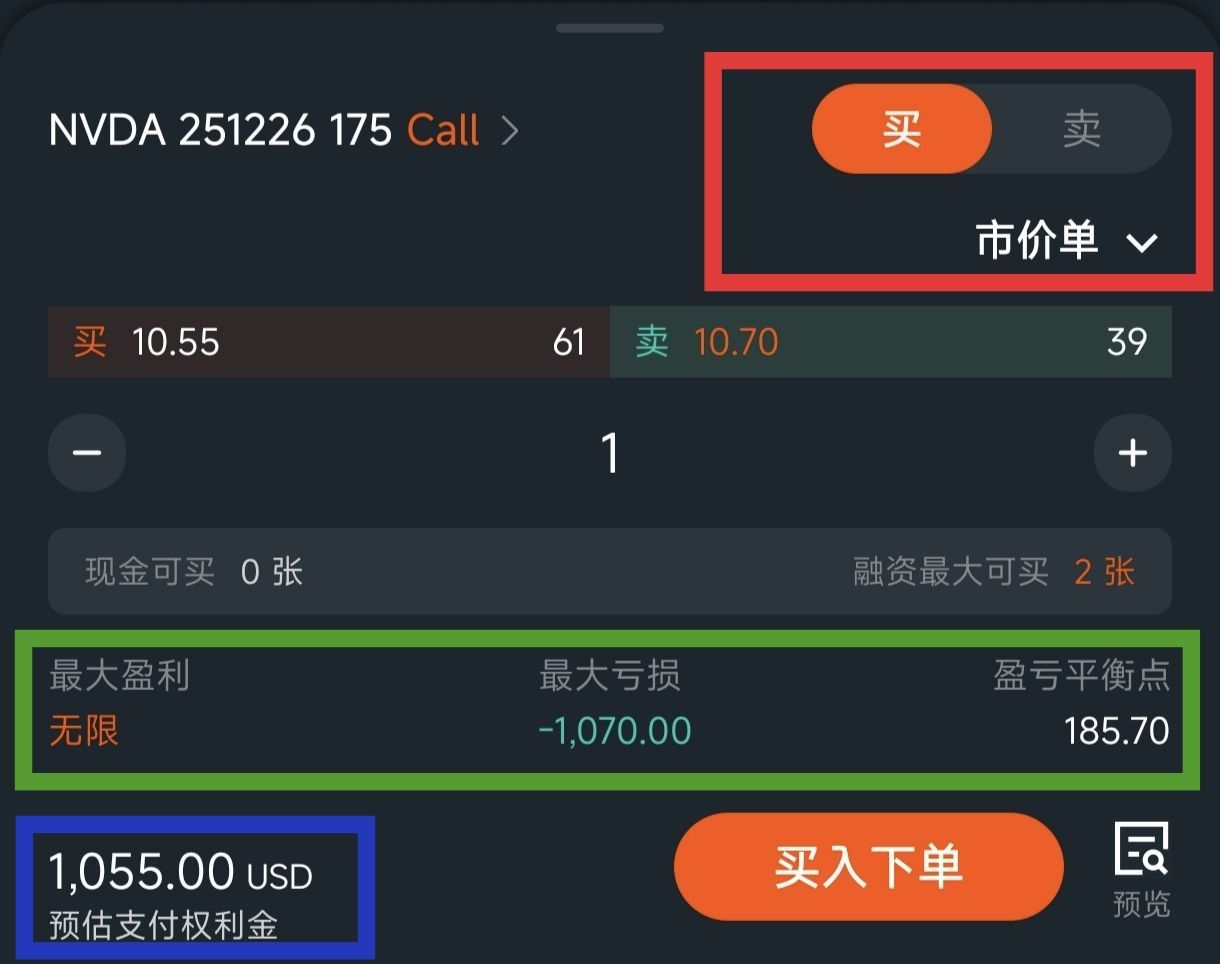
The above shows NVIDIA’s call options. The red box lets you choose whether to buy or sell insurance. The option buyer is the one buying insurance, and the price of this insurance is $1,055 per contract (blue box). Within the term, if the stock rises, profits can be made. The green box shows maximum profits as unlimited, while maximum losses are limited to the premium of $1,070 (blue box).
Below is the option seller, acting as the insurer.
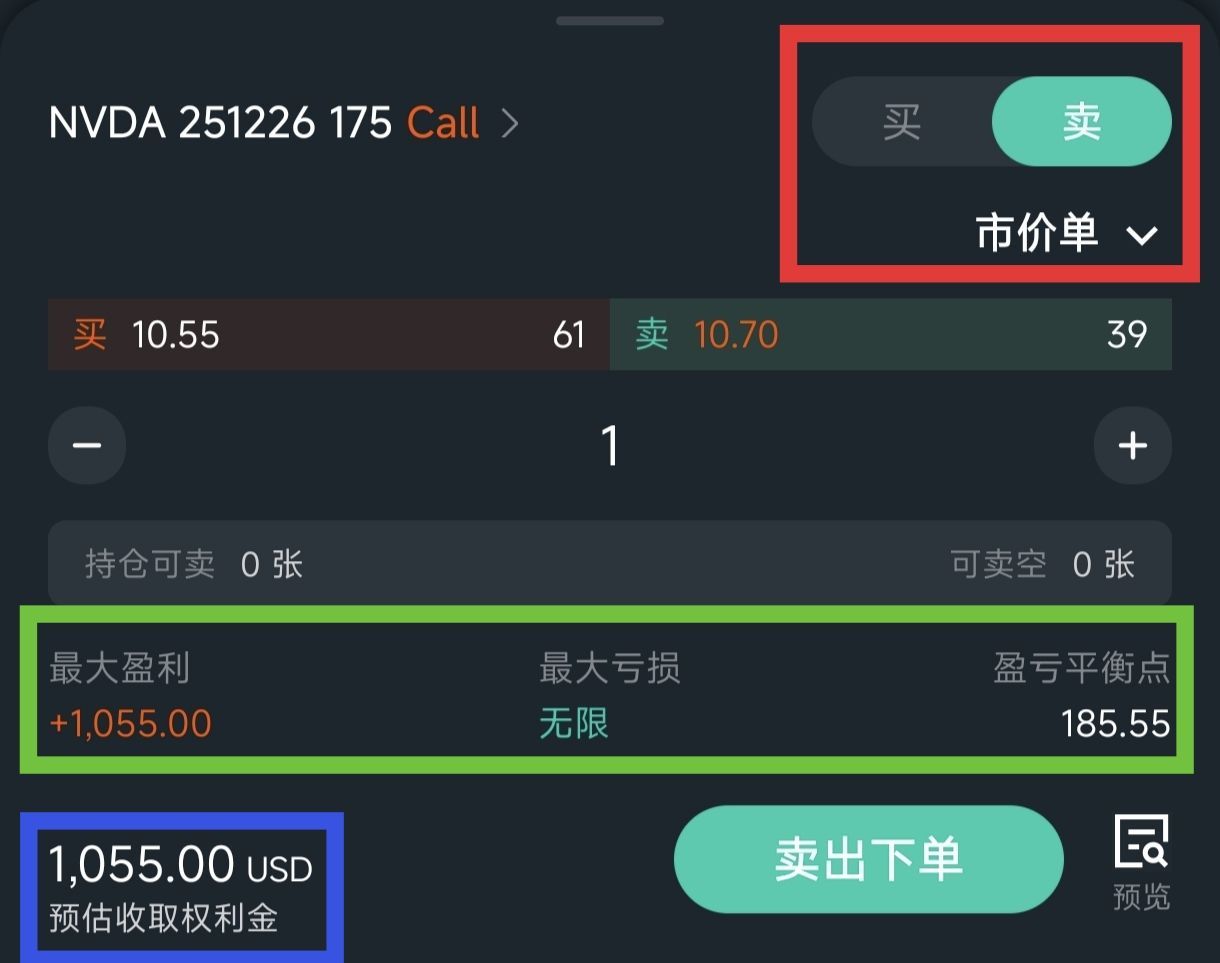
You can see that for the same call option, the buyer and seller are on opposite sides. The seller’s maximum profit is limited to the premium in the blue box, while maximum losses are unlimited. The small text under the blue box changes from "prepaid" to "received in advance."
When buying, we pay money out; when selling, we receive money in. So as an option buyer, we pay to acquire the option, with profits depending on future price movements. As a seller, we receive money upfront.
After all this, I believe it’s now easy to understand what options are. The option premium is equivalent to an insurance premium, the option’s duration is like the insurance term, and the strike price is akin to the criteria for assessing an insurance claim.
I’ve written many practical guides on options and shared some useful strategies. Everyone can start with the basics. Practice is always the best way to learn.
The copyright of this article belongs to the original author/organization.
The views expressed herein are solely those of the author and do not reflect the stance of the platform. The content is intended for investment reference purposes only and shall not be considered as investment advice. Please contact us if you have any questions or suggestions regarding the content services provided by the platform.
