

Fundamental analysis methodology - Institutional holdings tracking

Many stock friends follow me because of fundamental analysis. Recently, I also wanted to systematically sort out the methodology of fundamental analysis. After some thought, I decided to start with institutional holdings tracking.
Institutional holdings are an important way for companies to obtain liquidity. Holdings by top-tier institutions can also add credibility to a company. At the same time, institutional allocations tend to be long-term, which can also act as a stabilizer for stock volatility. The U.S. stock market's characteristic of siphoning global liquidity has attracted a large number of institutional investors, with the M7's institutional holdings consistently accounting for over 70%. For growth companies, institutional holdings are even more important. Expanding market capitalization and entering indices to gain passive fund allocations can often lead to significant stock price jumps, such as being included in the $NASDAQ-100(.NDX.US) and the $SPDR S&P 500(SPY.US).
However, "institutions" is a general term, and different institutions have different preferences. Before discussing, let me first explain the classification of institutions.
- Long only & Mutual: Annual turnover is below 30%, with average holdings >3 years; investment strategies tend to be top-down stock selection, valuation anchoring, and relative returns.
- Hedge Funds: Holdings span multiple quarters; short-term hedging does not mean withdrawal.
- ETF and asset management giants: Nearly half of institutional ETF holdings ≥2 years.
- Sovereign Wealth Funds: Average holdings are close to 10 years; strategies focus on asset-liability matching and prefer countercyclical buying.
- Family Office: 3-10 year holdings; more focused on alternative asset allocations, with most seeking risk diversification and a few considering intergenerational asset transfer.
It can be seen that although cycles differ, the commonality among institutions is asset allocation. The SEC requires institutions with assets under management exceeding $100 million to submit 13F filings, disclosing their holdings (including long positions and options) as of the last day of the previous quarter within 45 days after the end of each quarter. Therefore, the data is lagging, but much information can still be gleaned from changes between quarters.
13F is a public document on the SEC's website, but this is from the institutional perspective. If I want to see how a company's institutional holdings have changed, I can't check each one individually. Where there's demand, there's supply. The website Fintel provides summaries of institutional 13F filings for each company. You can search for "Institutional Ownership" to view them.
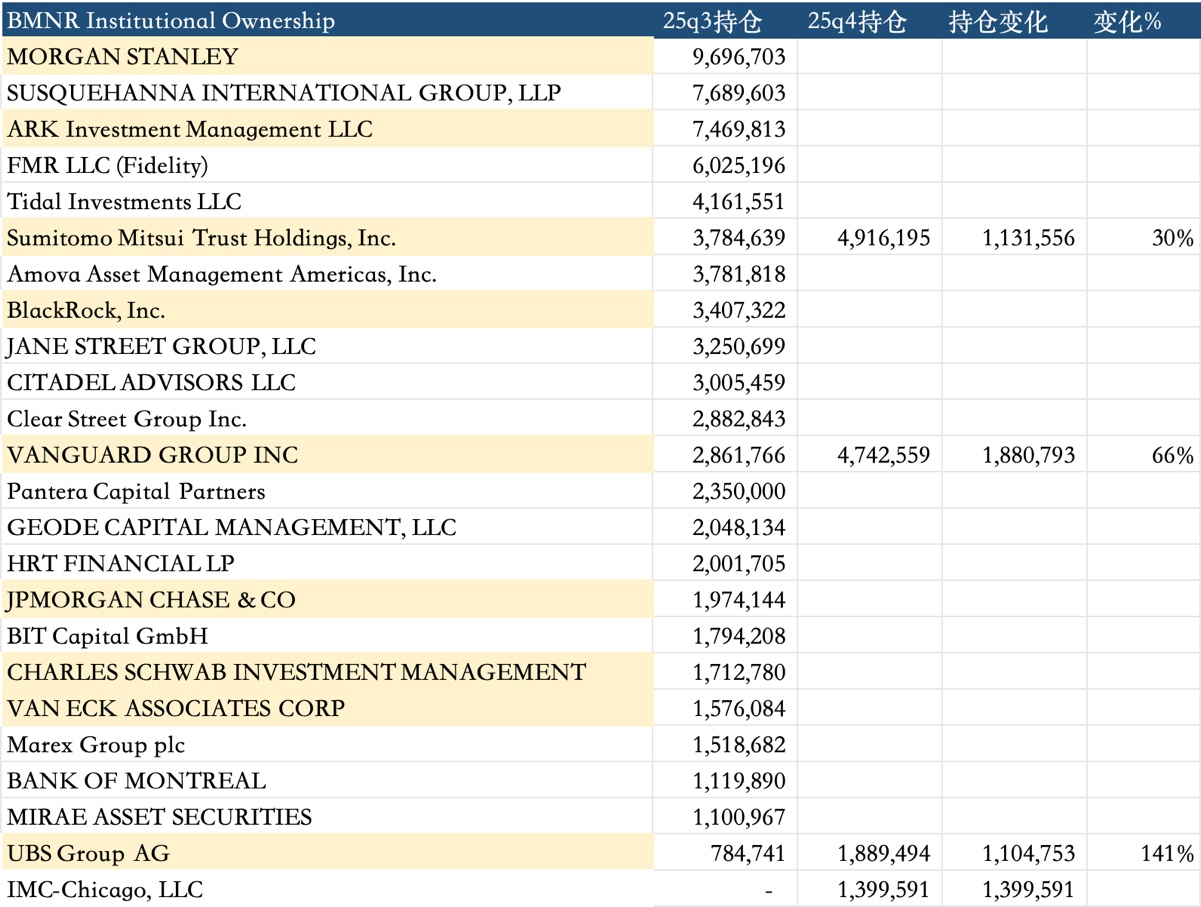
If I use Gemini to create a crawler, I can get a table like this. This is the institutional tracking of BMNR holdings over 1 million shares that I maintain with Gemini's help. Due to the crypto crash in Q4, I'm very interested in how BMNR's institutional investors acted in Q4. There's still some time before the 45-day deadline, but some institutions have already disclosed—all of them increased their positions.
However, changes in institutional holdings are just one perspective. The market is always a game, and top-tier institutions aren't necessarily right. But having this information is better than not having it. You can use this method to look at the companies you're interested in. I hope this is helpful to everyone.
The copyright of this article belongs to the original author/organization.
The views expressed herein are solely those of the author and do not reflect the stance of the platform. The content is intended for investment reference purposes only and shall not be considered as investment advice. Please contact us if you have any questions or suggestions regarding the content services provided by the platform.
