



On the eve of bidding farewell to the 9% export tax rebate benefit, Deye Co., Ltd., whose market value has quietly doubled, is rushing to the Hong Kong stock market

In early 2026, the vitality of Hong Kong's capital market continued the strong momentum of 2025.
Nearly 40% of the active listing applications in the Hong Kong stock market in 2025 were from new energy companies. By 2026, just over a month in, nearly 20 A-share companies, including Deye, Xinquan, and Shenzhen Capchem, had submitted applications to the Hong Kong Stock Exchange, with leading new energy companies actively pursuing "dual listings" or "internationalization" strategies.
It is not hard to see that the Hong Kong stock market is becoming a core hub connecting China's new energy industry chain with global capital and markets.
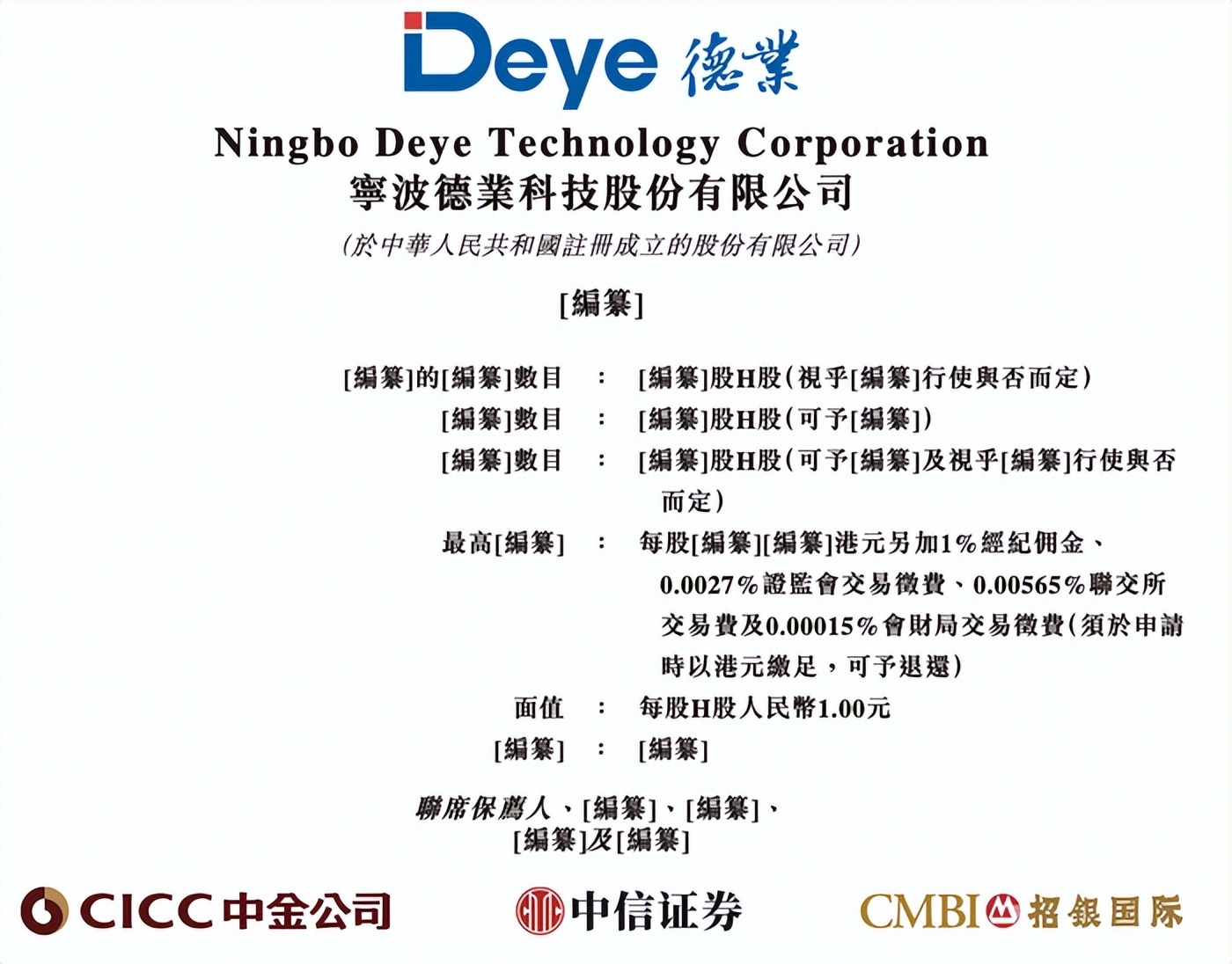
Against this macroeconomic backdrop, Deye chose to submit its listing application to the Hong Kong Stock Exchange, planning to further solidify its global market layout, R&D capabilities, and production capacity expansion strategy through international capital.
High Growth Driven by Overseas Markets
Deye was founded in 2000, initially focusing on environmental appliances and home appliance component manufacturing. It gradually entered the inverter industry through technological accumulation and channel expansion. According to the company's website, as early as 2016, it began laying out photovoltaic inverter products and later shifted its core growth focus to photovoltaic and energy storage systems.
The backdrop of this strategic transformation is the global energy structure shift, where photovoltaic power generation and energy storage systems have become key nodes for maximizing the use of renewable energy. As the "bridge" equipment between photovoltaic and energy storage systems, inverters play a core role in converting direct current into grid-compatible alternating current, making them a critical component for the operational efficiency and stability of the entire photovoltaic storage system.
The company's performance in the A-share market also reflects the success of its transformation. Since its listing on the Shanghai Stock Exchange's main board in April 2021, Deye has seen steady growth in its performance, with market capitalization fluctuating but generally maintaining a high level. During the past two years of the new energy countercycle, the company's stock price quietly nearly doubled. As of the recent closing, its A-share total market capitalization exceeded the 80 billion yuan mark.
Sustained and stable growth in performance is the strongest support for its valuation. In 2023, revenue was approximately 7.48 billion yuan, expanding to 11.21 billion yuan in 2024, with net profit increasing from 1.79 billion yuan to 2.96 billion yuan. In the first three quarters of 2025, revenue reached 8.85 billion yuan, with a net profit of 2.35 billion yuan and a profit margin of about 26.5%.
Its growth momentum mainly comes from the new energy sector. Business structure shows that in the first three quarters of 2025, energy storage inverters accounted for the highest proportion of revenue at 41.8%, followed by energy storage battery packs at 27.5%, while photovoltaic inverters accounted for about 9.5%. Other businesses such as dehumidifiers and heat exchangers also contributed to the overall performance.
Notably, Deye's business shows a clear overseas orientation. In the first nine months of 2025, overseas revenue was 6.715 billion yuan, accounting for 75.9% of total revenue, with products covering over 150 countries and regions across six continents.
In fact, since its inception, Deye has focused on overseas markets. At that time, giants like Sungrow and Huawei were fiercely competing in large-scale ground power stations and mainstream global markets, while Deye, with its "Deye" brand, took the lead in penetrating emerging markets such as Southeast Asia, the Middle East, Africa, and South America.
These regions have relatively weak grid infrastructure, high electricity prices, and abundant sunlight resources, creating a natural demand for integrated household photovoltaic and energy storage solutions. Deye, with its "Deye" brand, took the lead in entering Southeast Asia, the Middle East, Africa, and South America, building brand awareness and establishing a relatively comprehensive sales network. It has also maintained a certain market share in Europe, forming a barrier in overseas channels. Over the past three years, its sales in South Africa, Vietnam, India, and other regions have grown rapidly.
Misaligned competition has brought attractive financial returns, and the company has also fed its substantial profits back to shareholders.
The prospectus shows that from 2023 to the first nine months of 2025, the overall gross margin of its overseas business remained in the high range of 40%. The gross margin of its core product, energy storage inverters, has long exceeded 50%, becoming the company's main profit engine. In contrast, many companies focused on domestic competition or low-margin component businesses find it difficult to reach this level.
High gross margins support strong profitability. As a result, the company has been generous with dividends during the reporting period, with total dividends declared in 2024 and the first nine months of 2025 exceeding 4.3 billion yuan. This is due to strong cash flow support and reflects management's confidence in the current profit model. As of the end of September 2025, its cash and equivalents reached 4.4 billion yuan.
This "profitable and dividend-paying" characteristic is particularly prominent in the new energy industry, which still requires significant capital investment.
Export Tax Rebates to End, Hong Kong Listing as a Strategic Hedge
To further enhance its global competitiveness, Deye is advancing capacity expansion and overseas production base construction. Domestically, the company continues to expand production at its Ningbo Beilun and Cixi bases, increasing new energy product capacity and storage capabilities. Overseas, it is building a new production base in EcoWorld Business Park II, Johor, Malaysia, to be closer to Southeast Asian and Middle Eastern markets, shorten delivery cycles, reduce logistics costs, avoid trade barriers, and strengthen supply chain resilience.
A Hong Kong listing clearly aligns well with Deye's long-term globalization achievements.
However, Deye's journey to the Hong Kong stock market is not without challenges. The industry it operates in is at a critical crossroads, with multiple headwinds from cycles, policies, and competition testing the sustainability of its strategy.
After years of rapid growth, the global photovoltaic and energy storage markets are showing signs of short-term adjustment. Consulting firm Wood Mackenzie predicts that global photovoltaic inverter shipments may see a slight 2% decline in 2025, with the drop potentially widening to 9% in 2026. Major markets like China, Europe, and the U.S. face demand uncertainties. This means the industry as a whole may shift from "incremental competition" to a more brutal "stock competition" phase.
A bigger impact comes from a major shift in domestic industrial policy. Recently, China's Ministry of Finance announced that the value-added tax export rebate for photovoltaic products will be canceled starting April 1, 2026, with a phased implementation path until it is fully zeroed out by 2027. This marks the official end of a key support policy that has been in place for over a decade.
For companies like Deye with extremely high overseas revenue shares, the impact is direct and significant. The previous rebate rate of about 9% was essentially an important part of corporate profits. After the policy is canceled, this cost will need to be absorbed by the companies themselves, either squeezing profit margins or attempting to pass it on to downstream customers through price hikes—the latter being extremely difficult in the context of fierce global competition. This is undoubtedly a severe test of the company's cost control and product premium capabilities.
The blue ocean market where Deye has found success is attracting increasing attention from giants. As growth slows or barriers rise in mainstream markets like Europe and the U.S., leading domestic companies like Sungrow and GoodWe, as well as overseas competitors, are accelerating their penetration into emerging markets such as Southeast Asia, the Middle East, and Africa. With their brand, capital, and technological advantages, they are bound to challenge Deye's existing market share and pricing power. The prospectus also lists "intensified competition" as a major risk, warning of potential price wars that could compress gross margins.
Against this backdrop, Deye's Hong Kong listing has clear strategic intentions. The prospectus outlines the use of funds raised, mainly including enhancing R&D capabilities, expanding domestic and overseas production bases, and strengthening global marketing networks. This is precisely a targeted response to the above challenges.
The copyright of this article belongs to the original author/organization.
The views expressed herein are solely those of the author and do not reflect the stance of the platform. The content is intended for investment reference purposes only and shall not be considered as investment advice. Please contact us if you have any questions or suggestions regarding the content services provided by the platform.
