

 Amazon StockPro
My Amazon got hit hard, should I abandon it?

After the earnings report was released today, the night market plummeted, with the highest drop seemingly around 11%, I didn't pay too much attention. Many shareholders who held the stock were directly scared silly. 😂. As far as I know, quite a few people cut their losses and ran during the night market. Since I have a heavy position, combined with a certain proportion of option effects, it really did hurt me. The last time it hurt this much was when $TAL Edu(TAL.US) was hit by a domestic policy, directly plummeting 90% in a single day. So, apart from my former employer $Alibaba(BABA.US), I haven't bought any Chinese concept stocks since.
I spent some time reading the earnings report and looked at the transcript of the earnings call (my English level is limited and not sufficient to listen to the original audio 😅).
Below are some of my views, for reference only, and do not constitute any investment advice.
I think $Amazon(AMZN.US)'s current strategy in AI infrastructure construction still resembles a startup with an unlimited budget, because the entrepreneurs (management) see a vast blueprint of opportunity, which is why they dare to place such heavy bets.
Previously, the market was optimistic because of the company's large-scale capital expenditures; but now it is being suppressed and scrutinized by the market instead. However, we are still in the early stages of a multi-year AI infrastructure cycle.
The current market focus is: Amazon's capital expenditures are $55 billion higher than expected, reaching a total of $200 billion.
At first glance, it's quite scary. Meanwhile, Google's capital expenditures for the next year are $180 billion, with cloud growth at 48% this quarter; Microsoft's are $105 billion, with cloud growth at 39% this quarter.
The market doesn't understand because spending that much money, no one can clearly tell if the return on investment is reasonable, so the market sells first and asks questions later. It's practically creating a great escape, a severe stampede. 😅
Let's briefly sort out what level Amazon's performance is at in the current market environment:
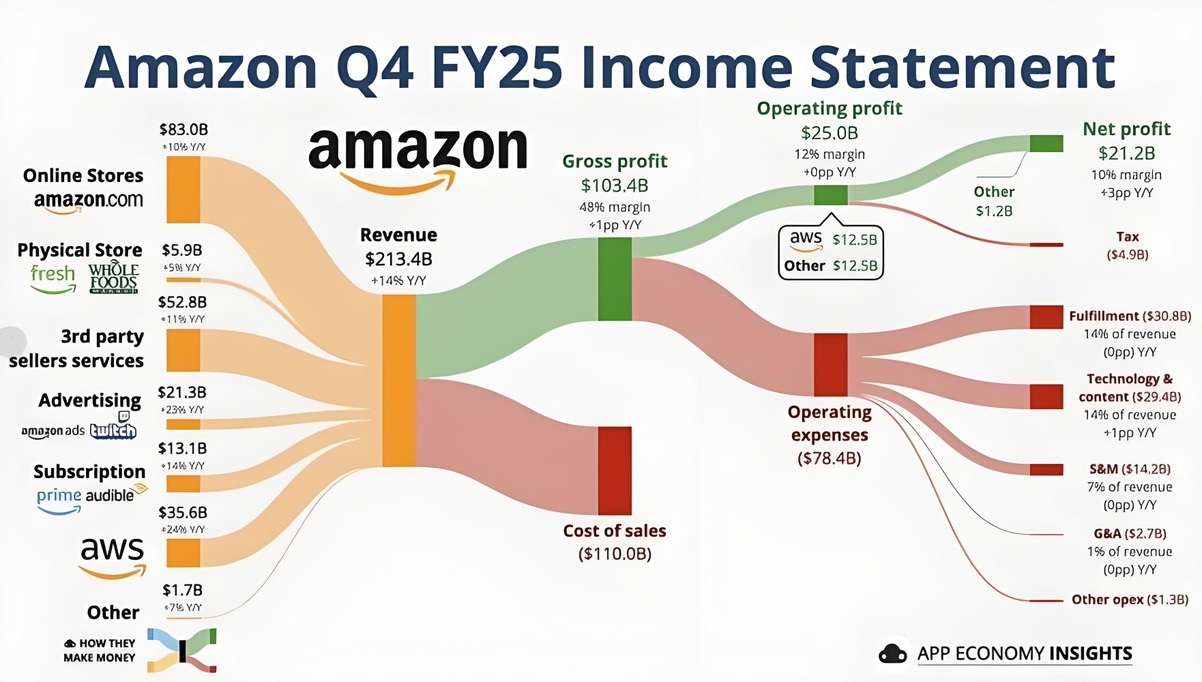
- AWS growth hit a new high since Q4 2022, surging 24% year-over-year, with annualized revenue reaching $142 billion.
To put it more intuitively: globally, a company with annual revenue exceeding $140 billion and growth still exceeding 24%, only $NVIDIA(NVDA.US) can rival that.
In addition, Amazon's order backlog is as high as $244 billion, a 40% year-over-year increase, and it's still growing rapidly every quarter.
Directly comparing AWS growth with Google Cloud and Microsoft Cloud isn't really fair, because the three are not on the same scale at all:
• Amazon AWS annualized scale: $142 billion, growth 24%, annual increment ~$34 billion
• Microsoft Cloud ~$85 billion, growth 39%, annual increment ~$33 billion
• Google Cloud ~$71 billion, growth 48%, annual increment ~$34 billion.
The increments of the three are almost identical.
Another reason for the plunge is that its free cash flow isn't good enough, because all operating cash flow is being reinvested, and the market thinks Amazon's return on this investment won't be high. But essentially, Amazon is preemptively positioning itself for the profit period of computing power shortage, which is instead seen as a negative by the market. 😮💨
My view is simple:
In the short term, Amazon is indeed taking on risk. In the next 12 months or so, the market will closely watch AWS revenue, repeatedly comparing it with its capital expenditures. This will become the logic for evaluating the entire cloud provider sector. But I believe this skepticism will gradually fade, and Amazon's current capital expenditure cycle will definitely deliver returns in the future.
The earnings call also made it very clear:
"We expect total capital expenditures to be around $200 billion, mainly directed towards AWS, because demand is extremely strong... We will monetize the new computing capacity as quickly as possible, converting it into revenue as soon as the equipment is deployed."
Current analyst forecasts: by fiscal year 2030, Amazon's free cash flow will reach $190 billion, corresponding to a compound annual growth rate close to 50%, assuming a profit margin of about 15.4%.
After this capital expenditure cycle ends, free cash flow will further explode.
$190 billion in free cash flow, given a 30x valuation—considering Amazon's business quality and growth prospects, I think it's completely reasonable, corresponding to a market cap of about $5.7 trillion.
I believe that in the next 3–4 years, this target has a good chance of being achieved.
Having said all that, when will the stock price rise?
Currently, capital expenditures are interpreted negatively. The digestion of this sentiment requires a change in perspective, which is that the market believes "capital expenditures are necessary."
Why not when the input-output ratio is verified? Because stock prices always reflect expectations. If everything is already verified, the stock price would have risen long ago, and most people wouldn't catch that main upward trend.
Therefore, the turning point for sentiment is when capital expenditures gain everyone's recognition. I believe this won't take too long.
I hope Amazon's shareholders work happily and live earnestly 💪🤣. As the friends in the comments section said, everyone knows I'm just writing this for fun, don't take it seriously, 🤣.
The copyright of this article belongs to the original author/organization.
The views expressed herein are solely those of the author and do not reflect the stance of the platform. The content is intended for investment reference purposes only and shall not be considered as investment advice. Please contact us if you have any questions or suggestions regarding the content services provided by the platform.
